Choosing the Best Personality Assessment for Corporate Team Building
Comparing DISC, MBTI, and Enneagram for Team Development
By Josh Tay, One Dynamics Team Building
In the realm of corporate team building, understanding personality dynamics is crucial for fostering collaboration and enhancing communication. This article delves into three prominent personality assessments: DISC, MBTI, and Enneagram. Each of these tools offers unique insights into individual behaviors and motivations, which can significantly impact team dynamics. By exploring their purposes, unique features, advantages, and limitations, organizations can make informed decisions about which assessment best suits their team-building needs. The challenge many organizations face is selecting the right tool that aligns with their specific goals and team dynamics. This guide will provide a comprehensive overview of each assessment, their key differences, and how they can be effectively implemented in corporate settings.
Assessment Purpose
The primary purpose of personality assessments in team building is to enhance understanding among team members. The DISC assessment focuses on behavioral styles, categorizing individuals into four distinct types: Dominance, Influence, Steadiness, and Conscientiousness. This categorization helps teams identify how different personalities interact and communicate. In contrast, the MBTI (Myers-Briggs Type Indicator) emphasizes cognitive styles, identifying 16 personality types based on preferences in perception and judgment. Lastly, the Enneagram centers on emotional intelligence, categorizing individuals into nine types that reflect their core motivations and fears. Understanding these differences is essential for selecting the right assessment for team building.
Unique Features
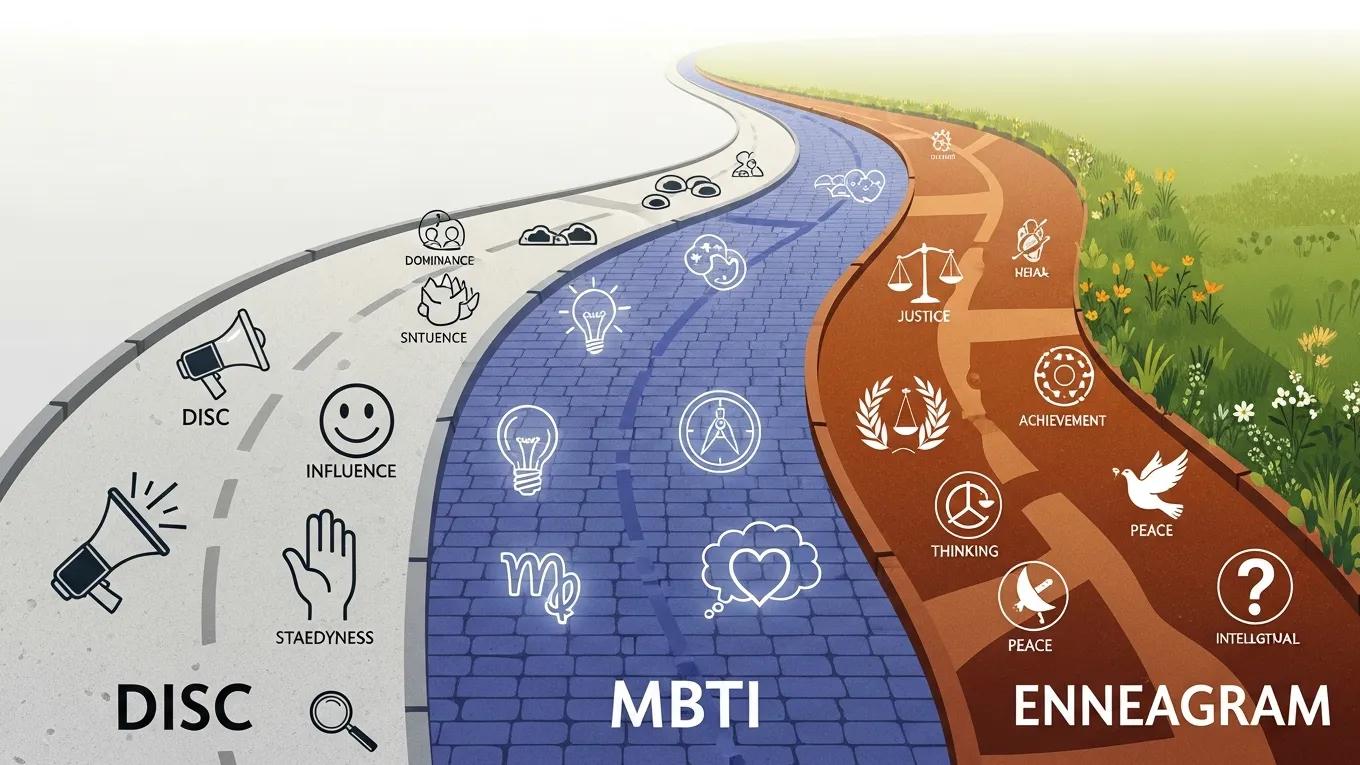
Each personality assessment boasts unique features that cater to different aspects of team dynamics. The DISC assessment categorizes individuals into four behavioral styles, providing a straightforward framework for understanding interactions. The MBTI identifies 16 personality types, offering a more nuanced view of cognitive preferences and decision-making styles. The Enneagram, with its nine types, delves deeper into emotional motivations, helping teams understand underlying drivers of behavior. These unique features allow organizations to tailor their approach to team building based on the specific needs and dynamics of their teams.
Advantages
The advantages of using personality assessments in corporate settings are manifold.
- Improved Communication: The DISC assessment enhances communication by helping team members understand each other’s behavioral styles, leading to more effective interactions.
- Enhanced Problem-Solving: The MBTI fosters better problem-solving by allowing teams to leverage diverse cognitive styles, encouraging innovative solutions.
- Fostering Empathy: The Enneagram promotes empathy among team members by highlighting emotional intelligence and understanding individual motivations.
One Dynamics Team Building specializes in team-building events designed to enhance collaboration and communication within organizations, utilizing these assessments to tailor their approach.
What Are the Key Differences Between DISC, MBTI, and Enneagram in Team Building?
The key differences between these assessments lie in their focus and application. DISC is primarily concerned with observable behaviors, making it practical for immediate team interactions. MBTI, on the other hand, provides insights into cognitive processes, which can be beneficial for long-term team development. The Enneagram offers a deeper understanding of emotional drivers, which can enhance interpersonal relationships and team cohesion. Recognizing these differences helps organizations choose the most suitable assessment for their specific team-building objectives.
How Does DISC Assessment Improve Team Communication?
The DISC assessment improves team communication by providing a clear framework for understanding different communication styles. By identifying whether team members are more dominant, influential, steady, or conscientious, teams can tailor their communication strategies accordingly. This understanding facilitates conflict resolution and promotes a more harmonious working environment. Additionally, DISC encourages team members to adapt their communication styles to better connect with others, ultimately enhancing overall team effectiveness.
Further research highlights the foundational role of the DISC model in understanding and improving communication styles for interpersonal effectiveness.
DISC Model for Communication Styles & Interpersonal Effectiveness
The chapter gives a brief overview of the individual characteristics (and disorders) of effective communication, as well as the personality typologies (e.g. DISC-model) that determines our communication style. Solutions that strengthen communication capabilities and support effective interpersonal communication, such as the 5C or 7C communication model, will also be presented.
Communication Models, Characteristics of Individual Communication, 2025
In What Ways Does MBTI Identify Team Roles?
The MBTI identifies team roles by categorizing individuals into 16 distinct personality types based on their preferences in perception and judgment. This categorization allows teams to understand how different personality types contribute to team dynamics. For instance, some individuals may excel in creative problem-solving, while others may be more detail-oriented and focused on execution. By recognizing these roles, teams can allocate tasks more effectively, ensuring that each member’s strengths are utilized to their fullest potential.
The MBTI’s utility extends to understanding how individual differences in cognitive styles influence problem-solving approaches within a team.
MBTI for Individual Differences in Problem Solving
Separate research on personality and cognitive styles has shown that individuals differ in their preferred approaches to problem solving, although there is less agreement as to appropriate techniques. This paper attempts to integrate a model of the problem-solving process to Jung’s theory of psychological types, as measured by the Myers-Briggs Type Indicator (MBTI).
Problem solving and decision making: Consideration of individual differences using the Myers-Briggs Type Indicator, 1992
Limitations
While personality assessments offer valuable insights, they also have limitations.
- Oversimplification: The DISC assessment may oversimplify complex human behaviors into four categories, potentially overlooking individual nuances.
- Binary Nature: The MBTI’s binary classification can lead to rigid thinking, where individuals may feel confined to their assigned type.
- Subjectivity: The Enneagram’s reliance on self-reporting can introduce subjectivity, making it challenging to achieve consistent results across different individuals.
Understanding these limitations is crucial for organizations to effectively integrate these assessments into their team-building strategies.
Team Dynamics
Personality assessments significantly impact team dynamics by fostering understanding and appreciation of individual differences. By utilizing tools like DISC, MBTI, and Enneagram, teams can cultivate an environment where diverse perspectives are valued. This appreciation leads to enhanced collaboration, as team members learn to leverage each other’s strengths and compensate for weaknesses. Furthermore, understanding personality dynamics can help teams navigate conflicts more effectively, ultimately improving overall performance and productivity.
Implementation Commitment
Implementing personality assessments in a corporate setting requires a commitment from the organization. This commitment includes providing training for team members to understand and apply the insights gained from the assessments. Follow-up workshops can reinforce learning and ensure that the assessments are integrated into daily interactions. Additionally, organizations must be willing to invest time and resources into the process, as the benefits of personality assessments often emerge over time with consistent application.
What Are the Benefits of Using DISC, MBTI, and Enneagram for Corporate Teams?
Using DISC, MBTI, and Enneagram assessments offers several benefits for corporate teams:
- Improved Communication: Enhanced understanding of communication styles leads to more effective interactions.
- Enhanced Problem-Solving: Diverse cognitive styles foster innovative solutions.
- Fostering Emotional Intelligence: Understanding emotional motivations promotes empathy and collaboration.
These benefits contribute to a more cohesive and productive team environment.
What Are the Advantages of DISC Personality Tests for Team Cohesion?
The DISC personality test offers specific advantages for team cohesion:
- Improved Communication: By understanding each other’s behavioral styles, team members can communicate more effectively.
- Enhanced Team Cohesion: Recognizing and appreciating individual differences fosters a sense of belonging and unity.
- Increased Productivity: Teams that communicate well and understand each other are more likely to achieve their goals efficiently.
These advantages make DISC a valuable tool for organizations seeking to enhance team dynamics.
How Does Enneagram Enhance Leadership Styles and Team Dynamics?
The Enneagram enhances leadership styles and team dynamics by promoting emotional intelligence and self-awareness. Leaders who understand their own Enneagram type can tailor their leadership approaches to better connect with their teams. Additionally, recognizing the Enneagram types of team members allows leaders to foster an environment of empathy and support. This understanding can lead to improved interpersonal relationships and a more cohesive team dynamic.
Studies have explored how Enneagram training can specifically cultivate empathy and self-awareness, particularly among leaders.
Enneagram Training for Empathy & Self-Awareness in Leaders
This thesis investigates the impact of Enneagram training on perceived empathy and self-awareness in college student leaders. The EQ-i 2.0 was used to assess the emotional intelligence of 16 student leaders, before and after the Enneagram training intervention. Qualitative methods, specifically open-ended journal prompts and semistructured interviews, added a rich description of the participants’ perceptions of the Enneagram training’s usefulness. The quantitative data and qualitative data seemingly contradict each other with the former showing no statistical relationship between the Enneagram and self-awareness and empathy, while the latter is saturated with examples of positive effects. Participants felt they were able to understand themselves and others better through learning about personality types. Their self-reported behaviors changed in many instances, exhibiting increased empathetic concern.
Leadership, Emotional Intelligence, and the Enneagram: A Study of the Effects of Enneagram Training on College Student Leaders, 2021
How Can Organizations Choose the Right Personality Assessment for Their Team Building Needs?
Choosing the right personality assessment involves evaluating the specific needs and goals of the organization. Factors to consider include the desired outcomes of the assessment, the existing team dynamics, and the resources available for implementation. Organizations should also consider the unique features of each assessment and how they align with their objectives. By carefully assessing these factors, organizations can select the most suitable assessment for their team-building initiatives.
Which Assessment Best Fits Different Corporate Team Types?
Different corporate team types may benefit from specific assessments based on their dynamics. For example, teams focused on communication and collaboration may find the DISC assessment particularly useful, while teams requiring innovative problem-solving may benefit more from the MBTI. The Enneagram can be advantageous for teams seeking to enhance emotional intelligence and interpersonal relationships. Understanding the unique needs of each team type is essential for selecting the most effective assessment.
What Are the Measurable Outcomes of Using These Personality Tests?
The measurable outcomes of using personality tests in corporate settings include:
- Enhanced Communication: Improved interactions among team members.
- Improved Decision-Making: Diverse perspectives lead to better-informed choices.
- Increased Emotional Intelligence: Greater awareness of individual motivations and behaviors.
These outcomes demonstrate the tangible benefits of integrating personality assessments into team-building strategies.
Conclusion
Utilizing personality assessments like DISC, MBTI, and Enneagram can significantly enhance team dynamics by improving communication, fostering empathy, and promoting effective problem-solving. These tools provide valuable insights that help organizations tailor their team-building strategies to meet specific needs and objectives. By understanding the unique features and benefits of each assessment, teams can create a more cohesive and productive work environment. Discover how these assessments can transform your team by exploring our resources today.