10 Corporate Event Ideas That Strengthen Teams in Singapore
Singapore has no shortage of corporate event ideas. It has a shortage of engaged employees. The Gallup Singapore Workplace Report 2026 found that only 14% of the country's workforce was engaged, against 25% across Southeast Asia and a 20% global average, and that managers account for 70% of the variance in team engagement. Read those two findings together and the brief writes itself: what you book has to change how managers run a room, not just how employees spend an afternoon.
The options are endless. Laser tag, escape rooms, cooking classes, yacht races, Bintan retreats, hotel ballrooms with a facilitator and a microphone. What separates a good event from a wasted budget is fit, and four constraints decide almost all of it: group size, weather exposure, budget per head, and whether you're buying an activity or a whole programme with rooms, transport and meals.
This guide walks through ten formats Singapore companies run, from facilitated indoor sessions and outdoor challenges to regional meeting packages, Bintan retreats and CSR projects. Each one covers what it involves, where it works best, and the practical detail that decides whether the day runs smoothly. If you're also working out how to split your calendar between planning galas, launches, and offsites, start with the format that matches your hardest constraint rather than the one with the best photos.
Table of Contents
- 1. Indoor Facilitated Team-Building Programmes in Singapore
- 2. Outdoor Team Challenges Across Singapore
- 3. Laser Clay Shooting Team Competition
- 4. The Tycoon Challenge: A Trading Simulation for Teams
- 5. Game-Show Inspired Challenges With Kin Ball and Running Man
- 6. DISC Personality Profiling Workshops for Teams
- 7. End-to-End Regional Meeting Packages in Singapore
- 8. Bintan Water Sports Park Challenge for Overseas Retreats
- 9. CSR Community and Conservation Team Projects
- 10. All-Inclusive Overseas Corporate Retreat Planning Across Asia
- Comparing the 10 corporate event ideas at a glance
- From Shortlist to Confirmed Event: How to Choose and Book
1. Indoor Facilitated Team-Building Programmes in Singapore
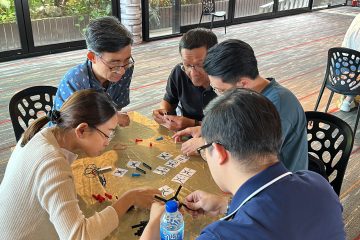
An indoor programme is the format most HR teams should book first, and the one most often booked badly. It's a facilitated session of group games and problem-solving challenges in a meeting room, ballroom or boardroom, run by a trainer who sets the rules, watches the group, and then opens the debrief. No travel time, no weather risk, and it works in a room you're already paying for.
The case for it is stress, not boredom. Gallup's Singapore country data reports that 43% of employees experienced substantial stress on the previous day (Gallup). A low-physical, high-structure session with a proper debrief gives that group something a party can't: a shared problem that isn't work, and a safe way to talk about how they solved it.
Room set-up does more than most organisers expect. Theatre-style seating kills a session before it starts, so push tables to the walls and set chairs in clusters.

Three things separate a session that changes something from one that's forgotten by Friday:
- Brief the facilitator on the actual problem. "Improve communication" is a wish. "Sales and ops still aren't talking after the restructure" is a brief.
- Mix the teams. If participants pick their own groups, you've paid for four separate team meetings.
- Book the right room. A function room with movable furniture beats an auditorium with fixed seats, every time.
The debrief is the product. Fifteen to twenty structured minutes after the last activity does more work than the two hours before it, so don't let lunch eat it.
Our indoor programmes start at $45 per participant and typically suit 5 to 50 participants in a conference room or office space, running from half a day to a full day, with outcomes targeted at communication, problem solving and creativity. A department of 30 before a reorganisation works well. So does a half-day morale session after a brutal project cycle. If the goal is celebration rather than development, planning offsites without the forced fun covers the softer end of the same decision.
2. Outdoor Team Challenges Across Singapore
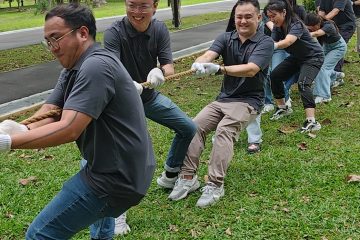
Outdoor challenges move the same cooperative structure into a park, a waterfront or a beach. East Coast Park, the Botanic Gardens, Labrador Nature Reserve, Sentosa and Marina Barrage give teams something an office never will: shared movement and a bit of mild discomfort to laugh about afterwards. Typical formats include obstacle courses, treasure hunts and relay races, scaled to the space and the group.
The mistake is treating the outdoors as a free upgrade. Heat, humidity and a 15-minute thunderstorm can turn a well-planned morning into a logistics exercise, and not everyone on your team can run for a checkpoint. Judge an outdoor idea on four things before you shortlist it: group size, weather exposure, per-head budget, and whether someone else handles the wet-weather backup and first aid.
Timing Windows That Beat the Heat
A 7.30am start finishing by 10.30am beats a 10am start every time. If you need an afternoon slot, 4pm onwards works, but check the venue's lighting and plan the finale under shelter. Build the rain plan into the contract, not into the morning-of phone call: a sheltered alternative at the same venue, or an indoor room held for the same window.
The inclusion question is the one briefs tend to skip. In a 2025 TELUS Health survey of Singapore employees, 45% reported little or no psychological safety at work, and more than 60% said they were uncomfortable sharing mental-health concerns with managers (TELUS Mental Health Index.pdf?hsLang=en-sg)). If a meaningful share of your group would rather not discuss a knee injury or a panic attack, design roles that don't require disclosure: scorer, navigator, photographer, timekeeper.
Group size changes the answer too. Small teams can rotate through stations in a single park zone. Headcounts in the hundreds need parallel activities so nobody queues for the fun, which is where a combined format like the Corporate Activity Challenge earns its keep for groups over 300. Our outdoor programmes are customised to group size, fitness levels and venue, and a quote request costs nothing. For a mid-sized company staff day, pair the games with a team lunch on site. For a department offsite, send the health and mobility declaration out with the invitation rather than the day before, so quieter participants can flag limits in private.
3. Laser Clay Shooting Team Competition
Laser clay shooting replaces lead shot with an infrared beam. Participants use modified shotguns that fire a light pulse at a standard clay target, and a sensor on the trap scores the hit. Nothing leaves the barrel, so it runs in a hall, on a rooftop or on a sheltered field, and it suits groups that want competition with a scoreboard rather than a circle of trust.
The format does one thing extremely well: it puts a running score where everyone can see it. That produces strategy talk between rounds, quiet coaching from the better shots, and a conversation topic that survives into the following week. Teams of five to eight work best, deliberately mixed across departments, with three or four rounds and a short tactics huddle between each.
Competition amplifies whatever culture already exists. In a 2024 Ipsos survey of 1,000 Singapore employees, 68% reported experiencing positive workplace behaviours (HRD Singapore). For the rest, an openly competitive format can sharpen old frictions. If your team is mid-restructure, choose scoring that rewards the team rather than the individual marksman.
- Mix seniority deliberately. Let a junior staff member captain a team containing a director. It's the cheapest hierarchy-flattening move on the market.
- Confirm who delivers the safety briefing. Ask how long it takes and whether there are age or health restrictions before you publish the invitation.
- Close with a tactics debrief. Ten minutes linking the between-round huddles to how the team shares information on a normal Tuesday.
A sales team tournament followed by a debrief on coordination works as a half-day event. A cross-department tournament makes a good centrepiece for a staff day, provided you have a covered area and a plan for the group that would rather watch.
4. The Tycoon Challenge: A Trading Simulation for Teams
The Tycoon Challenge is a trading simulation. Teams start with resources, negotiate with each other, respond to market conditions announced by a facilitator, and finish with a scoreboard based on what they built and what they spent. It borrows the shape of a game-show format, but the behaviour it surfaces is ordinary commercial behaviour: who plans, who persuades, who panics, and who keeps the whole table organised.
Run it for 24 to 80 people at tables of six to eight, over three to four hours including briefing and debrief. It suits management retreats and commercial teams because they recognise the dynamics immediately, and the post-game conversation writes itself. A sales team session focused on negotiation and resource allocation is the most common shape; a leadership retreat using it to test strategy under pressure is the most useful.
Practical rule: publish the scoring before the first round. Simulations only teach strategy when people know how they're being measured. Change the rules mid-game and you've taught the room that the environment is arbitrary, which is the opposite of the lesson.
The debrief is where the value sits. Ask each table to name the one decision they'd take back, then map it onto a live issue: a pricing call, a supplier negotiation, a resourcing trade-off the team is currently stuck on. A management retreat can run the simulation in the morning and the actual problem in the afternoon.
Rotate roles between rounds. The natural negotiator who takes every conversation gets less out of the exercise than the analyst who has never been asked to persuade anyone, and moving people out of their default position for a few hours is the whole point.
5. Game-Show Inspired Challenges With Kin Ball and Running Man
Kin Ball and Running Man are the two formats HR teams request by name after seeing them at another company's staff day. Kin Ball uses a 1.2-metre inflatable ball, three teams on court at once and a call-and-response start to each rally. Running Man is a station-based chase format built from puzzles, physical tasks and a name-tag finale.
Choose between them by constraints: group size, venue height, weather exposure and how much production support you want to buy. A sports hall, hotel ballroom with a high ceiling or indoor expo space will take 50 to 400 people. Outdoor running elements only make sense when permits are booked and the weather risk is acceptable; in Singapore that usually means a wet-weather plan rather than a hopeful forecast. Budget goes into production more than props: facilitators, emcee, sound, scoring, safety marshals and reset time between stations.
Which Format Suits Which Group
- Kin Ball suits mixed ages and mixed fitness, because the ball is enormous and technique matters more than speed. Three-way play keeps every team involved in each round.
- Running Man suits groups that already know each other a little, since it rewards coordination and bluffing between teams. It works well as an opener for a regional meeting where half the room met at breakfast.
Large-scale incentive programmes are held in Singapore, so capacity is rarely the blocker. Japan's Katsumata Group brought about 2,200 employees on a five-day, three-night programme that generated about 3,400 hotel room nights (The Straits Times). Use that as evidence that scale is possible, not as a reason to overscale your own event.
Assign a neutral facilitator to keep scoring fair and the banter respectful, and pick the activity mix against your group's average fitness rather than its fittest three people.
6. DISC Personality Profiling Workshops for Teams
DISC is a behavioural assessment built on four dimensions: Dominance, Influence, Steadiness and Conscientiousness. In a workshop, each participant completes a short questionnaire in advance, receives a profile, then works through how their preferences show up under pressure, in conflict and in decision-making.
It's the least physical item on this list and often the most useful, especially for teams that have already done the games. The minimum group size that makes the patterns meaningful is about ten participants, and our DISC offering recommends at least that. Below ten, you're profiling individuals in front of each other. Above ten, people start seeing the shape of the team rather than their own result.

What Makes a DISC Session Land
Three design choices decide whether the workshop changes anything:
- Frame it as preference, not capability. Say it plainly at the start. DISC describes how someone prefers to work, not what they're able to do. Without that line, the high-D half of the room treats it as a leadership contest.
- Test the insights in a practical activity. A short problem-solving task straight after the profiles turns theory into observable behaviour. Our complete guide to the DISC personality assessment covers the four dimensions in more detail if you need to brief a leadership team beforehand.
- Leave with one or two commitments. A department of twelve might agree to circulate written agendas before decisions, and to give the Steadiness half of the room 24 hours' notice of a change.
Book three hours for a team of 20, or a full day if you're pairing DISC with a practical activity and a planning session. Then reissue the profiles at the 60-day mark. Most of the value comes from the second read, when people have watched the theory play out in a real meeting.
7. End-to-End Regional Meeting Packages in Singapore
A regional meeting is a different animal from a team-building day. You're moving people across borders, holding rooms for three nights, feeding a group with six sets of dietary requirements, and fitting a team activity into a business agenda that's already full. Doing it with five separate suppliers is where the week disappears.
The demand side is well documented. MICE visitor arrivals reached 1.1 million in 2024, up from 730,000 in 2019, with another 560,000 in the first half of 2025 (Ministry of Trade and Industry). Singapore's MICE tourism receipts reached S$2.3 billion in 2025, a 35% increase from S$1.7 billion in 2024 (Singapore Tourism Board). The infrastructure here is sized for exactly this kind of programme.
An end-to-end package bundles hotel rooms, airport and venue transfers, meeting space, a facilitated team activity and group dining under one contract and one operations lead.
The Brief That Saves Two Weeks
- Send arrival and departure times first. They determine the entire schedule, and they're the last thing most organisers collect.
- List dietary and accessibility needs by name. "Three vegetarian" becomes a problem at the gala dinner.
- Put the team activity on the lighter agenda day. A three-hour challenge after a six-hour strategy session gets the energy it deserves.
- Ask for a consolidated quote with line items. Hotel, transport, activities and meals priced separately let you trade scope without renegotiating everything.
For 40 to 250 people, two nights with one full meeting day and one activity day is the pattern that works. A typical regional sales meeting combines the hotel block, a team-building session and a group dinner, with transfers timed around the last arrival. Below 40 people, you can usually self-manage with a venue and a facilitator.
8. Bintan Water Sports Park Challenge for Overseas Retreats
Bintan is the shortest real trip out of Singapore: a ferry from Tanah Merah, a resort setting, and enough distance to reset the conversation. The Water Sports Park Challenge uses that setting for water-based team tasks, which is the point. A team coordinating a raft or a relay in open water behaves differently from the same team around a meeting table.
Two logistics decide whether it works. The first is tide and weather, because water activities need a window rather than a slot in a schedule, so build in a backup. The second is swimming confidence. Collect declarations before you book, provide life jackets as standard, and run the safety briefing whether or not the group looks capable.
Don't schedule the water activity on the last morning. Ferries leave on a fixed clock, so a delayed challenge becomes a missed boat rather than an anecdote.
A typical shape is two days and one night: travel and a strategy session on day one, the water challenge and a facilitated debrief on day two, then dinner and reflection before the return ferry. Our Bintan team-building retreat planning guide covers ferry timing, venue options and programme flow in more detail.
On budget, standard mid-tier packages of three days and two nights, typically to Bintan or Langkawi, sit in the SGD 350 to SGD 600 per person range. Ask for an itemised quote so you can see what sits inside that range and what doesn't before you compare two proposals.
9. CSR Community and Conservation Team Projects
A CSR day does two jobs at once, and both need designing. The community job is the project itself: senior engagement, community interaction, area improvement or conservation work, in Singapore or at overseas destinations including Bali, Bintan, Batam and the Philippines. The team job is what happens between participants while they do it.
Participation has become a baseline expectation rather than a bonus. The National Volunteer & Philanthropy Centre reported that the median employee volunteer participation rate among companies rose from 50% in 2021 to 70% in 2025 (NVPC). Use it as a benchmark for your own programme rather than a guarantee, since it describes a company-level median, not universal adoption.
Judge a CSR day on the same constraints as any other idea on this list. Indoor sorting and packing tasks weatherproof the event; outdoor conservation work needs a rain plan. Group size decides the project type, because 20 volunteers can engage one beneficiary site well while 150 need parallel stations or they will queue for tools. Budget mostly buys facilitation and transport, so the cheapest CSR day is often the one hosted at the partner's own venue.
Measuring a CSR Day Properly
Registration is the least interesting number. Track four instead:
- Sign-up conversion: how many of those invited registered.
- Attendance: how many of the registered turned up, which tells you about scheduling and manager sponsorship.
- Completion rate: how many stayed for the full session and finished the task.
- Post-event usefulness: whether participants felt the project helped the community partner rather than looking good.
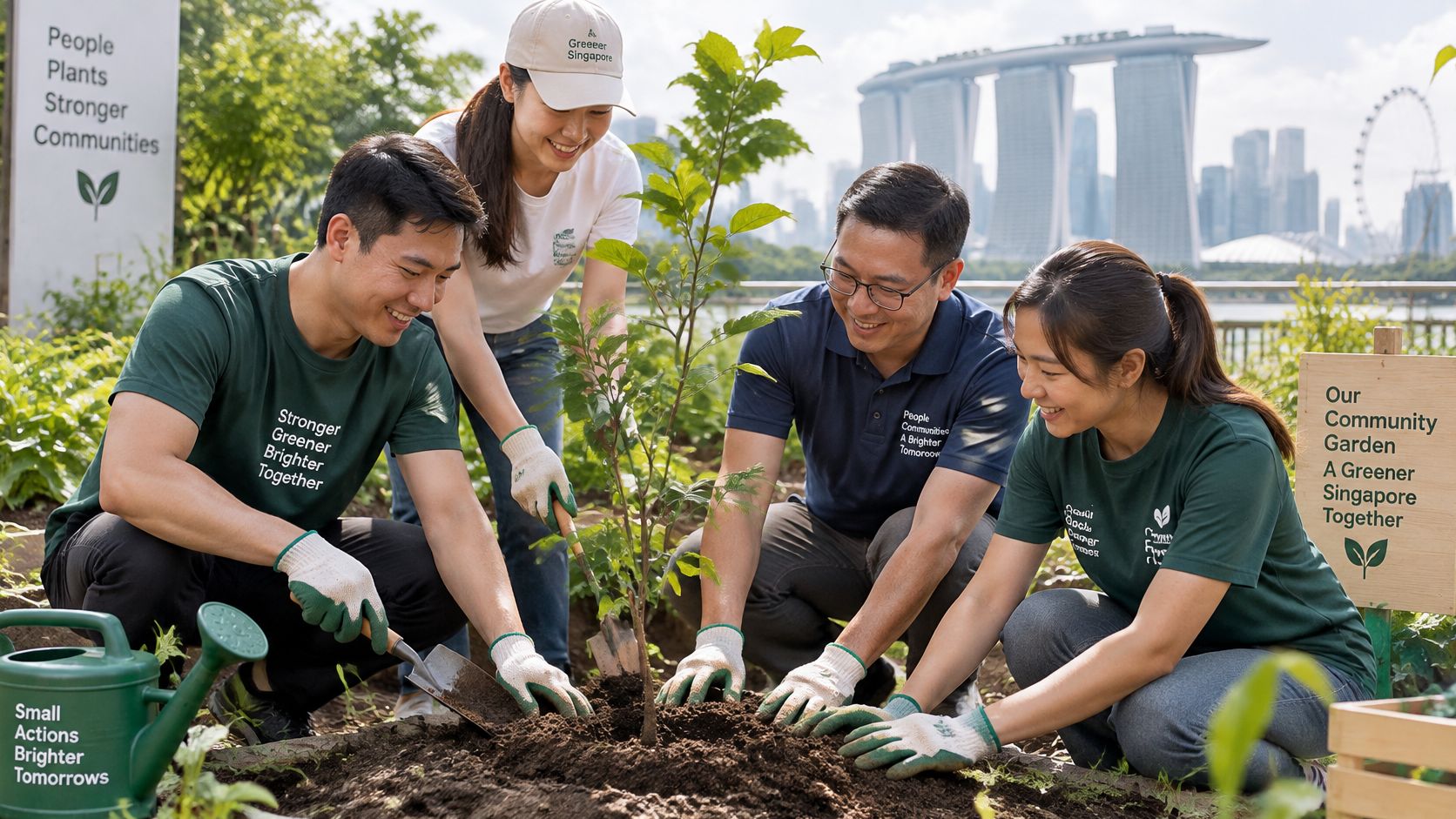
Operationally, divide the group into small units with explicit outputs: a defined area cleared, a stated number of beneficiaries engaged, a quantity of materials sorted. Vague volunteering turns into standing around. Close with a facilitated debrief that links the work to how the team operates, or you have run a pleasant morning with gloves on.
Our CSR team building packages in Singapore combine team bonding with socially responsible initiatives, and we run the same formats in Bali, Bintan, Batam and the Philippines for companies pairing volunteering with a retreat.
10. All-Inclusive Overseas Corporate Retreat Planning Across Asia
An overseas retreat is the most expensive item on this list and the one most likely to be approved on instinct. The case for it is simple: distance changes behaviour. Teams that share a flight, a meal and an unfamiliar setting build a familiarity that no hotel ballroom in town can produce.
The case against it comes down to money and carbon. Moving a full team overseas (flights, transfers, equipment, catered events) adds meaningfully to the company's travel footprint, so the environmental cost belongs inside the decision, not as a footnote to it. The budget line is just as direct: a group of 80 on a standard mid-tier package to Bintan or Langkawi, three days and two nights, typically runs SGD 350 to 600 per pax, which puts programme spend at SGD 28,000 to 48,000 before anything else.
When an Overseas Retreat Is Justified
Ask three questions before you pick a destination.
- Is the objective impossible locally? A reset after a hard year, a strategy offsite that needs three uninterrupted days, or a reward trip for a team that hit its number. If the honest answer is "we want something different", a strong local programme will do it for less.
- Does the format need the destination? Water challenges need water. A trading simulation doesn't need a beach.
- What's the follow-through? A retreat with no 30-day check-in is a holiday with a slide deck.
Two constraints sit under all three. Weather sets the calendar: water-based programmes depend on the season, so check the destination's wet months before fixing dates. Scale sets the operating model: the larger the group, the less forgiving the logistics, and travel coordination, accommodation, activities, meals, safety protocols and emergency contingencies need one accountable operator rather than six vendors.
Business events of this kind are an established economic category rather than a fringe perk. Before the pandemic, Singapore's MICE industry supported more than 34,000 direct and indirect jobs and generated S$3.8 billion in value-added activity, close to 1% of gross domestic product (Singapore Economic Development Board). Treat the retreat as a strategic intervention with its own budget line, not the default premium option.
Our overseas retreat planning arm builds all-in packages out of Singapore across Asia, covering travel coordination, accommodation, facilitated activities and meals in a single programme. For Bintan the service runs end-to-end, handling logistics, venue coordination and programme delivery, so a regional management retreat with a strategy session, team challenges and a farewell dinner arrives as one plan. Batam packages follow the same structure, designed around collaboration and organizational development goals; the practical first step is a discussion on programme design, resort selection and logistics matched to your team's size.
Comparing the 10 corporate event ideas at a glance
Read this table with three constraints in hand: your headcount, your tolerance for weather exposure, and how much coordination you want handled for you.
| Event Idea | Setting | Best For | Group Size / Minimums |
|---|---|---|---|
| Indoor Facilitated Team-Building Programmes | Meeting rooms, ballrooms or other indoor venues in Singapore | Structured team bonding, communication and problem-solving | 5 to 50 participants |
| Outdoor Team Challenges | Parks, waterfronts and open spaces across Singapore | Active, high-energy bonding and large-group activities | Scales from small teams to groups of over 300 |
| Laser Clay Shooting Team Competition | Organised activity venue | Teams that enjoy friendly competition and strategy | Teams of five to eight |
| The Tycoon Challenge: A Trading Simulation | Indoor-friendly facilitated setting | Managers and teams practising negotiation and commercial thinking | 24 to 80 participants |
| Game-Show Inspired Challenges: Kin Ball and Running Man | Spacious indoor or outdoor venue | High-energy, inclusive team play across departments | 50 to 400 participants |
| DISC Personality Profiling Workshops | Facilitated workshop setting | Teams focused on communication, leadership and development | Minimum of 10 participants |
| End-to-End Regional Meeting Packages | Singapore hotels, venues and activity locations | Regional gatherings needing coordinated logistics | Scaled to the group's headcount and agenda |
| Bintan Water Sports Park Challenge | Water sports park in Bintan | Active overseas retreats and team bonding | Retreat-sized groups, such as a full department offsite |
| CSR Community and Conservation Team Projects | Singapore or overseas community and conservation sites | Teams seeking shared purpose and social impact | Small teams through to company-wide groups, sized to the project site |
| All-Inclusive Overseas Corporate Retreat Planning | Destinations across Asia | Companies seeking managed retreats with activities and logistics | Quoted per group; standard packages run three days and two nights |
The last three rows arrive with venues, transport and programme delivery coordinated for you, which makes them operations projects as much as activities. Budget accordingly: mid-tier overseas packages to Bintan or Langkawi typically run SGD 350 to SGD 600 per pax for three days and two nights. Every outdoor row needs a wet-weather plan. The indoor ones do not.
From Shortlist to Confirmed Event: How to Choose and Book
Ten formats, one decision. Before you compare anything on style, write down four constraints: headcount, budget per head, weather exposure, and whether you're buying an activity or a whole programme with rooms, transfers and meals. That last one reshapes the shortlist more than anything else. A 30-person indoor session is a booking. A 150-person regional meeting is an operations project.
Then map each shortlisted idea against what the business needs this year. If the pressure is cross-department friction, indoor facilitation, a trading simulation or DISC will outperform a party. If it's manager capability, put managers in the room as participants rather than hosts. If it's retention after a punishing quarter, a retreat earns its budget. If it's visibility for a CSR commitment, a community or conservation project does both jobs at once.
Booking is where good plans fail on logistics. Singapore hotel occupancy reached 81.9% in the first nine months of 2025, with an average room rate of S$273.56 and revenue per available room of S$224.04, while capacity grew by 644 rooms (STB tourism receipts data). At that occupancy, peak-period room blocks and function space go early. If your dates land in a major event week, hold rooms before you finalise the agenda.
There's public support worth knowing about too. STB's MICE Experience Programmes offer eligible delegates conference room rates for extended stays of up to five days before and after a conference, plus exclusive discounts on ancillary services such as dining and spa treatments (Singapore Tourism Board). For a regional meeting, that turns a two-day agenda into a four-day trip without a second negotiation.
The direction of the market isn't subtle. The Ministry of Trade and Industry has set a MICE tourism receipts target of S$4.5 billion by 2040, against S$1.4 billion in 2019 (MTI), a projection rather than a current figure. More venues, more formats and more operators will compete for your budget, which makes a clear brief more valuable, not less.
One Dynamics has run corporate team-building and retreat programmes from Singapore since 2010, with more than 1,500 corporate events delivered for over 50,000 participants across Singapore and overseas, and testimonials from teams at OCBC Bank, Tetra Pak and Schneider Electric. HR teams can request a free quote and compare customised indoor, outdoor, retreat and CSR options before committing to a date.
Three steps close this out:
- Define the objective in one sentence your finance approver would recognise.
- Confirm headcount and two possible dates before you request anything.
- Ask for a consolidated quote that prices activities, logistics and meals separately.
One Dynamics plans and delivers indoor, outdoor and overseas team-building programmes for Singapore companies, and handles the logistics that keep a regional meeting or a Bintan retreat on schedule, from hotel rooms and transfers to facilitated activities and group meals. If you're weighing formats for a group of 20 or 300, we can put together a consolidated proposal so you can compare options like for like before committing to a date. Visit One Dynamics to see the programme range, then send through your headcount, dates and objective.