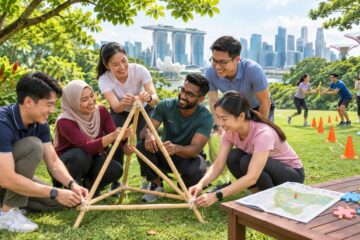
Treasure Hunt Singapore: A Team Building Planning Guide
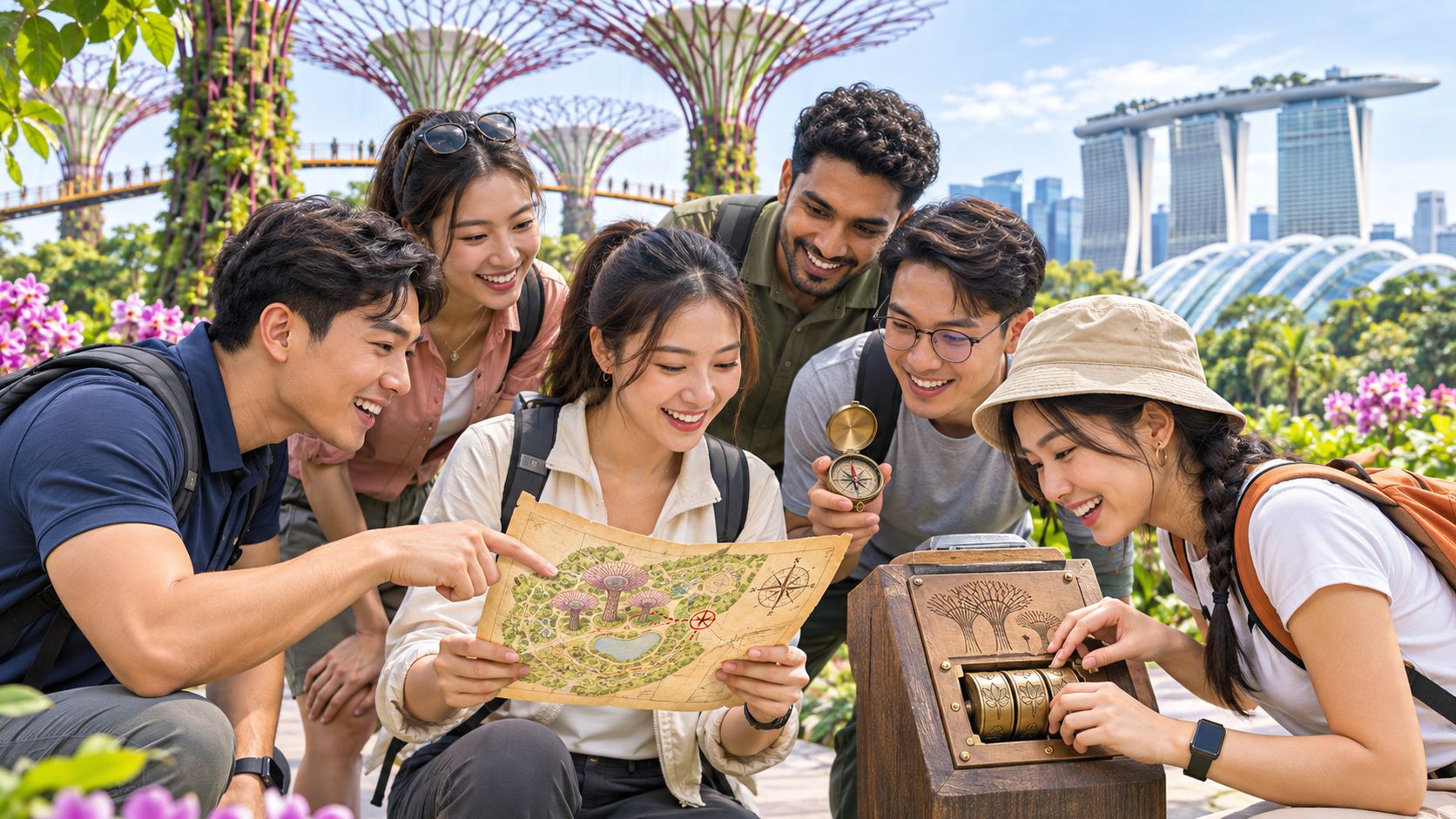
Your operations team has just been reorganised, the next regional meeting is approaching, and HR needs an activity that does more than fill an afternoon. A treasure hunt in Singapore could get colleagues talking, but only if the route, challenges and scoring encourage teamwork rather than reward whoever runs fastest.
The useful decisions come before the booking: what employees should practise, who needs an alternative way to participate, how much travel the timetable can absorb, and what happens when outdoor conditions become unsuitable.
Table of Contents
- What a Treasure Hunt Team Building Event Delivers
- Treasure Hunt Formats Compared by Group Size and Effort
- Learning Goals Every Task Should Serve
- Planning Group Logistics for a Full Team Offsite
- Making the Hunt Work for Every Employee
- Heat, Rain and When to Postpone the Hunt
- Confirm Your Format and Budget Before You Book
What a Treasure Hunt Team Building Event Delivers
Say a 40-person operations team in a Tanjong Pagar office is two weeks into a reorganisation. Colleagues recognise names from weekly reports, but they haven't worked together outside their reporting lines. A well-designed treasure hunt gives them a shared problem without the usual meeting-room hierarchy.
For this hypothetical group, teams of five to eight could receive a route, decode clues, complete checkpoint missions and collect points. Each task should need contributions from at least two people. Otherwise, a confident puzzle-solver can finish the hunt while everyone else follows.
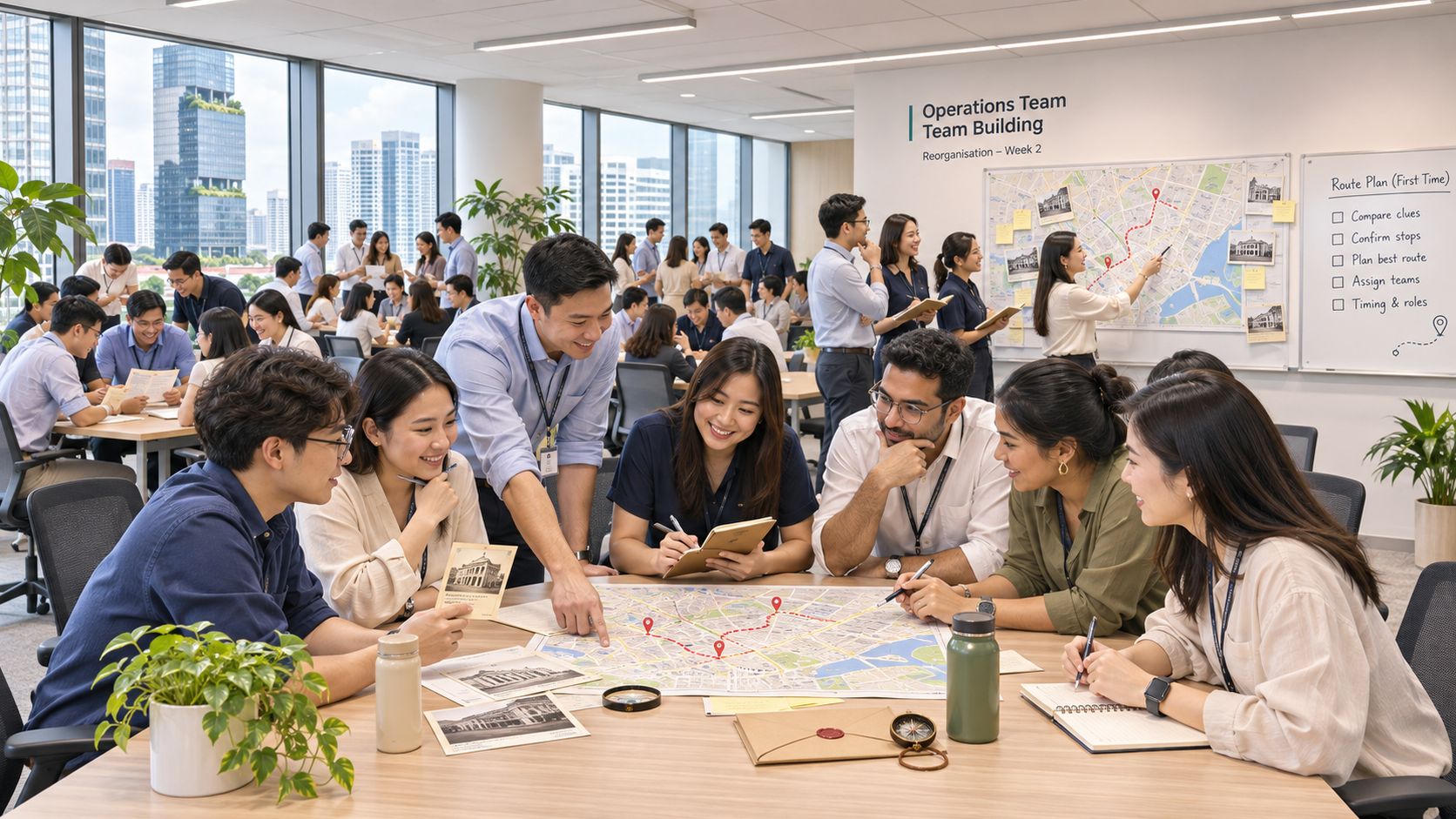
Think of one clue sheet as a single ship's chart in a crew of eight. The crew reaches the treasure only when people read different parts aloud, compare interpretations and agree on the next move. Handing the chart to the most senior person and following without discussion defeats the purpose.
What the facilitator should notice
The format tests sharing information, deciding under time pressure and noticing who is quiet. A facilitator should observe who explains their reasoning, who checks understanding and whether the team changes direction when someone spots a mistake.
Singapore offers useful settings: heritage districts, MRT stations, Sentosa beaches and Gardens by the Bay provide recognisable, mapped checkpoints. However, convenient access doesn't remove the need to inspect crossings, public-space congestion and assembly areas.
A successful hunt gives colleagues a useful conversation afterwards, not just a winning photograph.
Before choosing it, answer these questions:
- Outcome: What should the team gain beyond an enjoyable afternoon?
- Time: How many hours can employees spare, including travel and reflection?
- Participation: Who must be included, and what could prevent them from contributing?
If the answers point towards collaboration and shared discovery, the format fits. If everyone mainly needs rest, a competitive race may be the wrong intervention.
Treasure Hunt Formats Compared by Group Size and Effort
Treasure hunt formats by length, group size and effort
| Format | Typical length | Group size | Best for |
|---|---|---|---|
| Fort Siloso Treasure Hunt | 1 hour to half day | Small teams to 500+ | Heritage checkpoints and clue decoding, low to moderate effort |
| Island Wide Amazing Race | Half day to full day | 20 to 1,000+ | Multi-precinct race across Sentosa, walking effort set by route |
| SMART Race | Set by MRT journey and station-task timings | Set by station capacity and departure waves | MRT-linked themed stations, walking and public-transport transfers |
| Garden Odyssey | Set by mission count and route | Set by checkpoint throughput | Gardens by the Bay missions, outdoor walking |
| Singapura Heritage Escapade | Set by selected stops and meal arrangements | Set by public-space and food-stop capacity | Central Singapore historical, cultural and food tasks |
| Running Man Challenge | Set by mission sequence and transfer plan | Set by mission capacity and Sentosa finish arrangements | iPad mission cards and a Sentosa finale |
Choose by group size first, effort second and travel third. For programmes without a fixed published duration or capacity, require those details in the proposal rather than treating the table as a capacity guarantee.
Match the route to the working day
Fort Siloso Treasure Hunt combines strategic checkpoints, decoded clues and themed challenges at the historic site. Its adjustable duration makes it useful when a meeting agenda leaves a limited activity window.
Island Wide Amazing Race covers multiple Sentosa precincts. Its larger operating range needs deliberate departure waves, transport planning and checkpoint capacity, not just more identical clue sheets.
SMART Race sends each participant to five designated stations on an MRT line, with themes such as Sports, Nature, Heritage or Art. Train journeys become part of the programme, so walking to platforms and regrouping must count towards elapsed time.
Garden Odyssey uses Gardens by the Bay for navigation, missions and a race against the clock. Keep the challenge in the missions rather than making speed between locations the main advantage.
Singapura Heritage Escapade combines tasks with historical, cultural and food spots around central Singapore. The Katong / Joo Chiat Culture & Food Race offers a neighbourhood-focused alternative involving murals and food stops.
Running Man Challenge delivers mission cards through iPads and ends at Sentosa. Check where the activity starts and how the final transfer works before fitting it around dinner.
Set a spending ceiling
Our advertised starting prices are $75 per person for Singapura Heritage Escapade and $50 per person for Connecting Singapore. One Dynamics also lists starting prices of $45 per participant for indoor programmes and $35 for outdoor programmes; custom quotations reflect group size, venue and programme requirements.
Treat these as starting points, not complete offsite budgets. Separate facilitation from transport, venue arrangements, meals and accommodation in the quotation.
- Stay near the office: Choose a city-centre format when travel would consume the activity window.
- Plan larger movements: For a proposed group larger than 100, confirm that an island-wide race fits the actual timetable, including departures and regrouping.
Learning Goals Every Task Should Serve
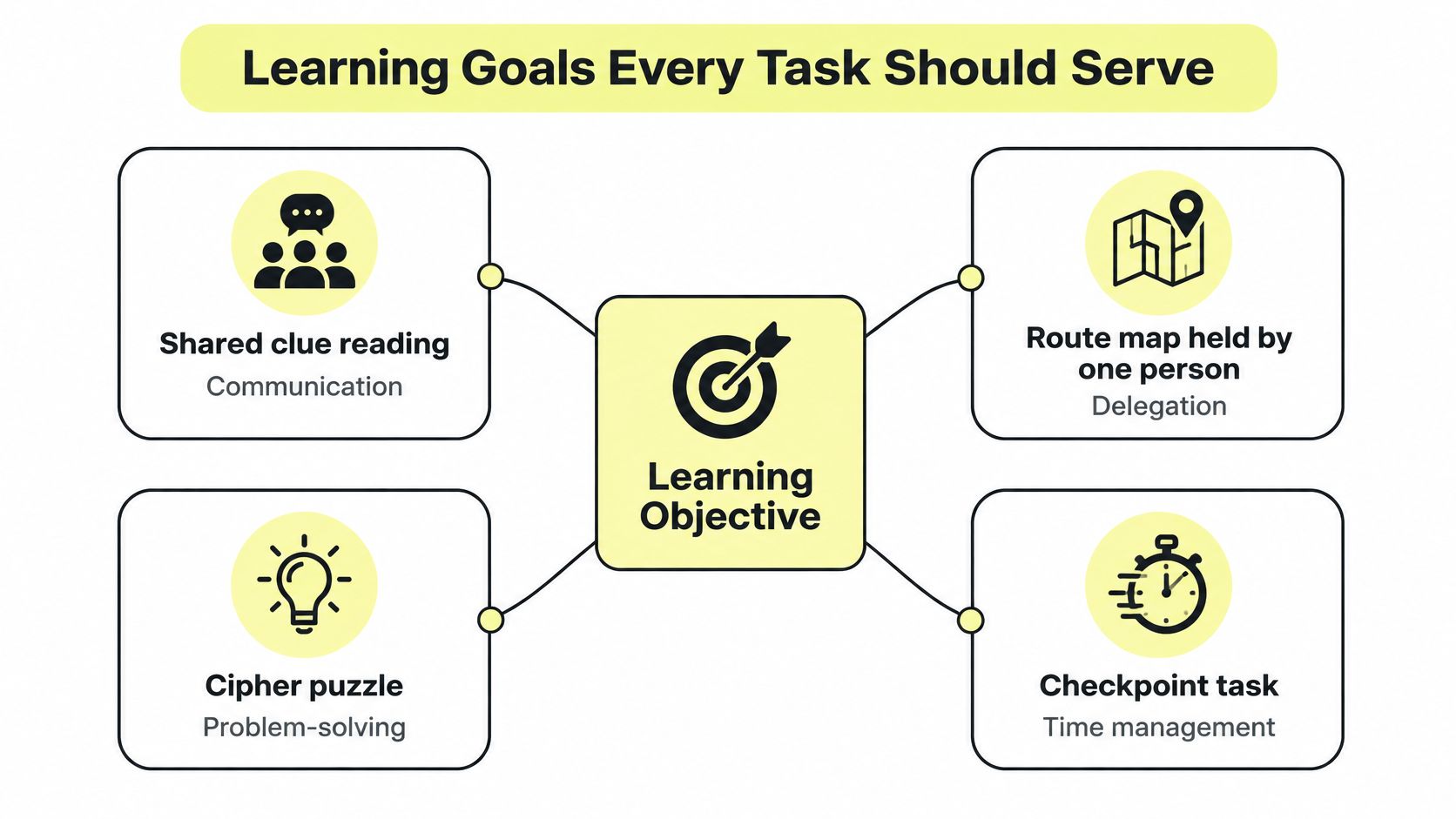
Start with the behaviour employees should practise, then build the task. A difficult clue isn't automatically a useful learning exercise. If one person can solve it privately and announce the answer, the team has practised dependency rather than collaboration.
The Ministry of Manpower's reply on workplace mental wellness reports that approximately one in three employees in a 2022 iWorkHealth dataset of about 11,500 workers experienced work stress or burnout. That dataset shouldn't be treated as a universal workforce rate, but it supports a cautious approach to challenge intensity.
Turn objectives into observable actions
| Learning goal | Task design | What the facilitator records |
|---|---|---|
| Communication | Divide clue information between participants | Whether people explain and check understanding |
| Delegation | Give one person the route map while others hold task instructions | Whether the team distributes decisions instead of creating a gatekeeper |
| Problem-solving | Create a cipher requiring three complementary knowledge fragments | Whether participants combine evidence before guessing |
| Inclusion | Let quieter members choose how to present a checkpoint answer | Whether teammates invite and support their contribution |
Time management belongs inside these tasks. Give teams a clear deadline and ask them to decide when to stop debating, request help or move on.
Weight communication quality, delegation, evidence sharing and inclusive participation heavily. Speed should be only one scoring component. Publish observable criteria so marshals aren't awarding points merely because a team appears enthusiastic.
Measure connection without diagnosing employees
A practical programme brief could specify 90 to 120 minutes, mixed-department teams, shaded or indoor checkpoints and opt-out alternatives for demanding stations. Rotate movement with low-pressure observation tasks, then facilitate reflection on a specific decision: what information was missing, who supplied it and how the group responded.
Use a short anonymous pulse survey before and afterwards, with consistent five-point scales for belonging, cross-team interaction and psychological safety. Compare department-level patterns only where anonymity can be preserved. An improved event rating isn't proof that a single activity reduced burnout.
Before approving the game design, draft three measurable objectives and one matching task for each. For example, replace “improve communication” with “each team explains its evidence before submitting an answer”.
Planning Group Logistics for a Full Team Offsite
Planning timeline for a team treasure hunt
| Lead time | Task | Owner |
|---|---|---|
| 8 to 12 weeks | Confirm budget, headcount and format | HR lead |
| 4 to 6 weeks | Collect access needs and book transport | Events coordinator |
| 2 weeks | Confirm meals, water points and heat or rain plan | Provider and marshals |
| 1 day before | Send run sheet and checkpoint contacts | Lead facilitator |
Use this as a recommended planning schedule, not a guaranteed booking lead time. Regional travel, venue availability and internal procurement can require earlier decisions.
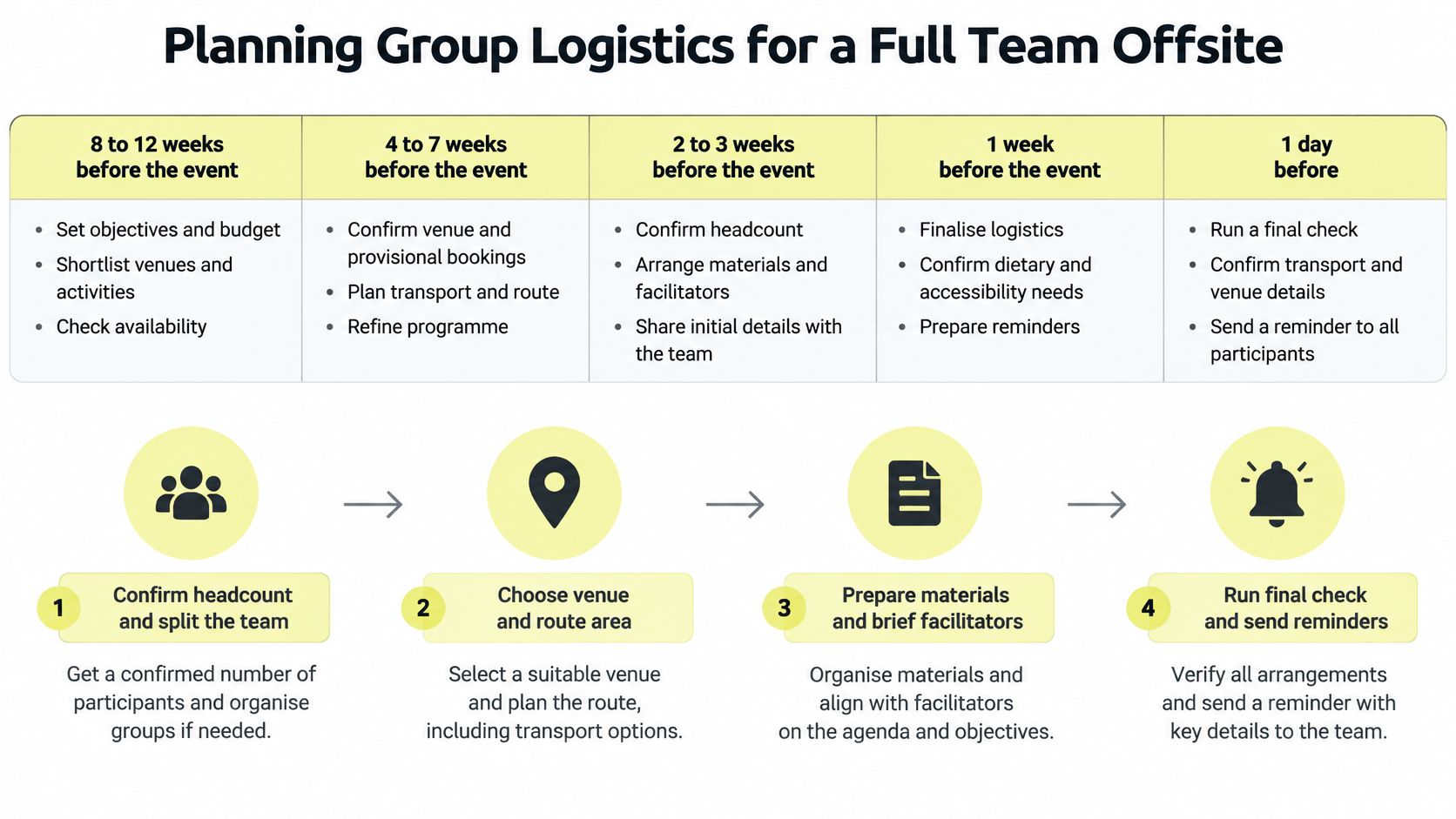
Build one operating itinerary
Confirm attendance and team allocation. For a worked planning model, use mixed-department teams of five to eight. Separate confirmed delegates from tentative attendees, and avoid leaving team allocation until people arrive.
Match the programme to usable hours. Deduct transfers, registration, toilets and briefing from the calendar slot before choosing a route. A half-day booking doesn't mean every minute is available for missions.
Plan transport and checkpoint flow together. Use the MRT for SMART-style stations and assess coach movements for island-wide hunts. Stagger arrivals or rotate checkpoint order so teams don't queue behind one another. We can advise on Sentosa admission passes and arrange transport-inclusive options.
Book meals and water deliberately. For a full-day offsite, place lunch midway and finish with a seated debrief meal. Assign replenishment at every checkpoint, confirm dietary requirements and avoid making employees compete for access to food.
Bundle regional meeting arrangements. Put accommodation, meeting rooms, transfers, activities and meals into one itinerary. Block hotel rooms early and connect rooming-list deadlines to delegate confirmations.
Name the delivery roles. Assign a marshal to each staffed checkpoint, a lead facilitator and a timekeeper. Give someone explicit responsibility for late arrivals, lost devices and participants who leave the route.
Prepare the debrief space. Confirm seating, presentation equipment and the survey link before departure. Otherwise, the closing discussion is easily lost when delegates head straight for transport.
Keep supplier handovers visible
Singapore recorded 1.1 million MICE visitor arrivals in 2024, according to the Ministry of Trade and Industry's parliamentary reply on MICE statistics. For regional planners, accommodation and delegate movements deserve the same attention as the activity itself.
One organiser reduces the number of handovers the corporate team must manage. We combine event planning and programme delivery, allowing delegate schedules and operational responsibilities to sit together rather than across disconnected supplier emails.
For internal approvals, the Formals event management workflow guide is a useful companion when documenting owners and dependencies. Larger delegations can also use our guide to team-building activities for large groups in Singapore when assessing movement and delivery requirements.
Operational test: If a coach arrives late, everyone should know who changes the checkpoint order and who informs the meal venue.
Finish with a one-page run sheet containing timings, owners, assembly points and a contact for every checkpoint. Keep detailed task instructions separate so the operating document remains usable on a phone.
Making the Hunt Work for Every Employee
Route maps and rain plans don't answer the harder participation questions for colleagues who can't manage stairs, have visual or hearing impairments, are neurodivergent, are older, or are less confident in English. Suitable for everyone needs an operating definition, not a reassuring sentence in a proposal.
The Get Out treasure-hunt planning guide highlights practical measures including alternatives to stairs and uneven ground, plain-language clues and shared devices. Apply those principles to every checkpoint, not just the starting venue.
Audit the complete participant journey
Collect access requirements confidentially. Ask what arrangements would help someone participate, rather than requiring a medical explanation. Restrict access to responses and confirm agreed arrangements privately.
Walk the actual route. Check step-free paths, accessible toilets and transport boarding points. A destination may be accessible while the planned shortcut isn't.
Create equivalent checkpoint options. A seated evidence puzzle can replace a physical search if it requires comparable teamwork, time and reasoning. Test both versions before approving the scoring.
Use readable clues and shared devices. Write direct instructions, provide legible contrast and avoid making audio the only way to receive essential information. Where helpful, let two participants share a device without assigning one permanent control.
Offer buddy arrangements. Agree the role with the participant. A buddy supports navigation or communication; they shouldn't take over answers.
Provide quiet or low-sensory options. Keep these connected to the same game, rather than sending participants to an unrelated waiting activity.
Preserve scoring influence. Non-mobile team members should contribute to the same categories through analysis, evidence checking, coordination or presenting solutions.
Preserve challenge parity
An alternative shouldn't be an easier substitute or carry a lower points ceiling. Either approach can make access arrangements feel like a competitive advantage or a penalty.
The accessible campus design principles from Waymap offer a useful lens for considering navigation across an entire environment. Our inclusive team-building guidance can support the corresponding programme discussion.
HR's procurement checklist should request the audited route, toilet and transport arrangements, sample clue formats, equivalent tasks, quiet-space options and the scoring method. Require written confirmation of who will deliver each adjustment, not just acknowledgement that the request was received.
Heat, Rain and When to Postpone the Hunt
An outdoor hunt isn't automatically more engaging. In high heat, employees may withdraw, older or less fit colleagues may face greater difficulty, and a teamwork activity can become a health risk.
Wet-bulb globe temperature, or WBGT, is a heat-stress measure accounting for temperature, humidity and radiant heat exposure. Singapore's heat-stress management guidance identifies 31–33°C WBGT as moderate heat stress and advises minimising outdoor activity at 33°C or higher; it also includes Sport Singapore's advice to reduce unsheltered intensity and duration between 11 a.m. and 4 p.m. where possible.
Heat thresholds and the action each one calls for
| Condition | Official guidance | Action for the hunt |
|---|---|---|
| WBGT 31–33°C, moderate heat stress | Reduce outdoor activity; regular shaded or indoor breaks | Shorten walking, add shaded checkpoints and move unsheltered tasks to cooler hours |
| WBGT 33°C or higher | Minimise outdoor activity; longer breaks and active cooling during rest | Switch to indoor equivalents or invoke an agreed no-penalty postponement |
| 11 a.m. to 4 p.m. | Avoid or limit unsheltered intensity and duration where possible | Schedule the outdoor run before 11 a.m. or after 4 p.m. |
The overlapping boundary should never become an argument for continuing. At the higher threshold, apply the more protective action.
Write the go/no-go decision before event day
- Choose cooler operating hours. Put outdoor movement before the midday window or later in the afternoon.
- Cap walking distance. Set the cap after auditing shade, participant needs and transfer options, rather than copying another event's route.
- Remove exposed stretches. Space shaded checkpoints so rest isn't available only after a long walk.
- Prepare indoor equivalents. Keep the learning objective and scoring intact when changing the setting.
- Name water and first-aid owners. Give marshals replenishment duties, emergency contacts and a clear escalation route.
- Allow acclimatisation. Don't move arriving overseas delegates directly from transfers into strenuous outdoor missions.
- Agree postponement terms. Seek a no-penalty postponement clause and identify any separate supplier charges before signing.
Treat rain as an operating change
Most Sentosa team-building packages have contingency plans involving sheltered venues or indoor alternatives. Confirm the assigned fallback, activation decision and movement plan in writing; shelter capacity matters as much as shelter availability.
Our outdoor-versus-indoor team-building guide helps frame that choice. For participant packing reminders, employees can find packable bottle tips for summer from HYDAWAY, but personal bottles don't replace organised water provision.
Weather-related route changes shouldn't cost a team points. Stop or relocate the activity consistently, then restart under the same scoring rules.
Confirm Your Format and Budget Before You Book
Lock in these decisions before requesting a quotation:
- Format: Select a programme that matches the available activity window and intended learning outcome, not just the most appealing destination.
- Group and team size: Confirm attendance and the mixed-department allocation. For the hypothetical operations group, teams of five to eight would provide a workable starting model.
- Budget per person: Set a ceiling using the advertised starting prices, then identify what must be included. Custom quotations reflect group size, venue and programme needs.
- Travel and overnight requirements: Decide whether employees need transfers, a meal stop or hotel accommodation.
For regional meetings, we combine event planning and programme delivery so hotel stays, transport, activities and meals can sit in one itinerary. Our overseas retreat planning arm specialises in corporate packages originating from Singapore across Asia, including destinations such as Bintan, Bali and Langkawi.
Send your preferred format, headcount, dates, accessibility requirements and budget when requesting a quotation. Request the run sheet and heat plan in writing before confirming, alongside a clear statement of inclusions and contingency costs.
One Dynamics offers facilitated Singapore team-building programmes and coordinated offsite arrangements, with overseas retreat planning for companies taking their teams abroad. Visit One Dynamics to request a treasure-hunt proposal built around your team's objectives, participant needs and complete event itinerary.