Team Building Activities for Introverts: 8 Ideas for 2026
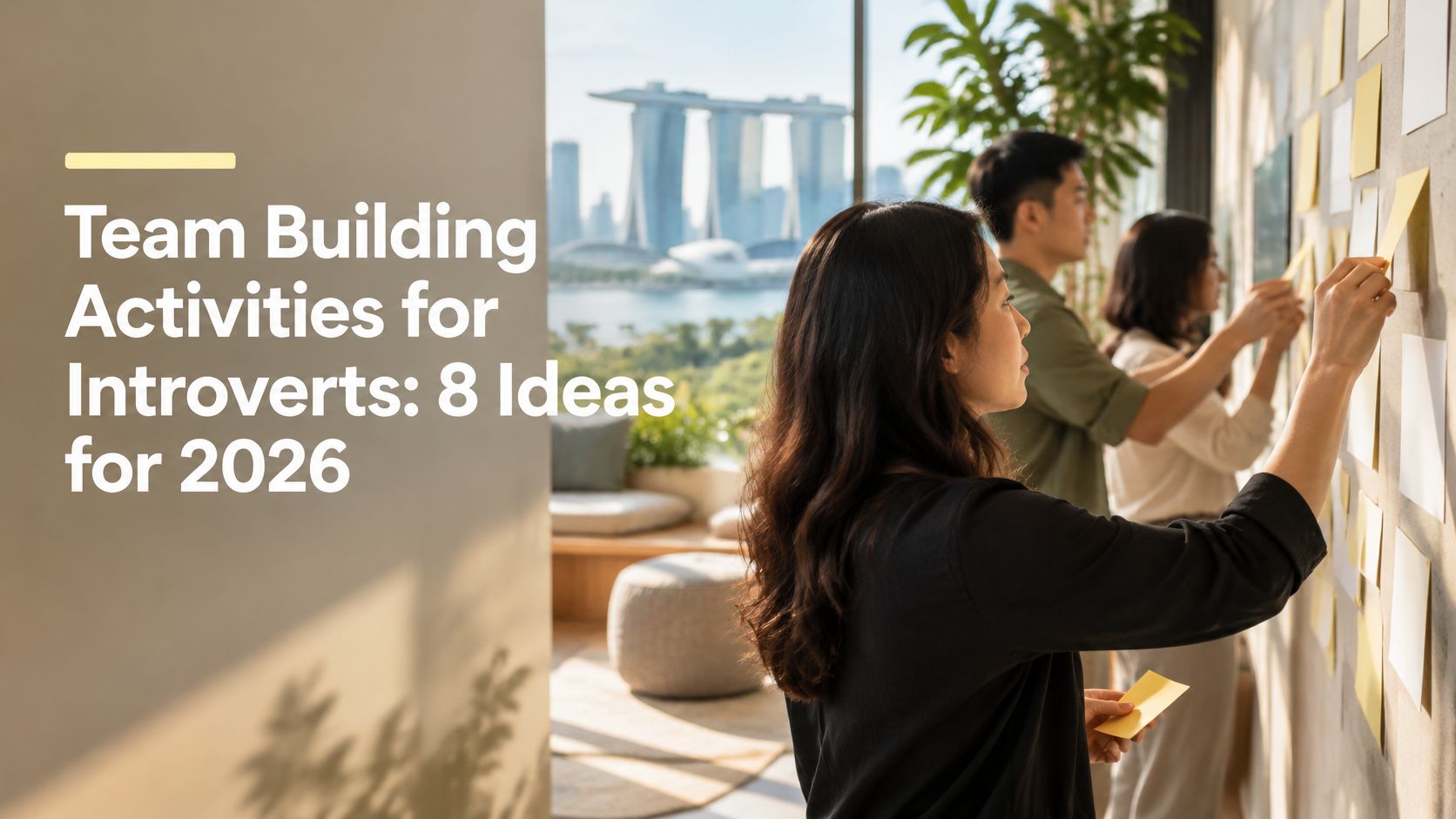
The planning meeting is going well, which is the problem. Four people are talking, the whiteboard fills with whatever gets said fastest, and the quarter's team day gets decided inside forty minutes. In the corner, the analyst who spent last week working out why two departments keep producing the same report has the answer. She doesn't say it. The meeting moves to lunch.
Nothing in that scene is unusual, and that's exactly why the default team day disappoints. The people who shape the agenda are the people who talk first. Introverted employees usually contribute later: after processing time, with a defined role, on a task that doesn't depend on small talk at a drinks table.
Judge any team building activities for introverts against three tests. Is anyone pressured to speak first? Does every person hold a named role? Does the debrief treat careful observation as a result rather than as silence?
Each of the eight formats below gets a setup, a job for the quietest person in the room, and an honest note on where it still rewards extroverts. Choose by objective, not by energy level.
Table of Contents
- 1. Brainwriting and Silent Ideation Workshop
- 2. Escape Room Team Challenge
- 3. DISC Personality Profiling and Team Mapping Workshop
- 4. The Tycoon Challenge Simulation
- 5. Laser Clay Shooting Team Challenge
- 6. Running Man-Style Game-Show Relay
- 7. Community Conservation and Volunteer Day
- 8. Bintan Water Sports Park Challenge for Overseas Retreats
- How the eight introvert-friendly activities compare on format, price guide and venue
- Building a Team Day Everyone Can Join
1. Brainwriting and Silent Ideation Workshop
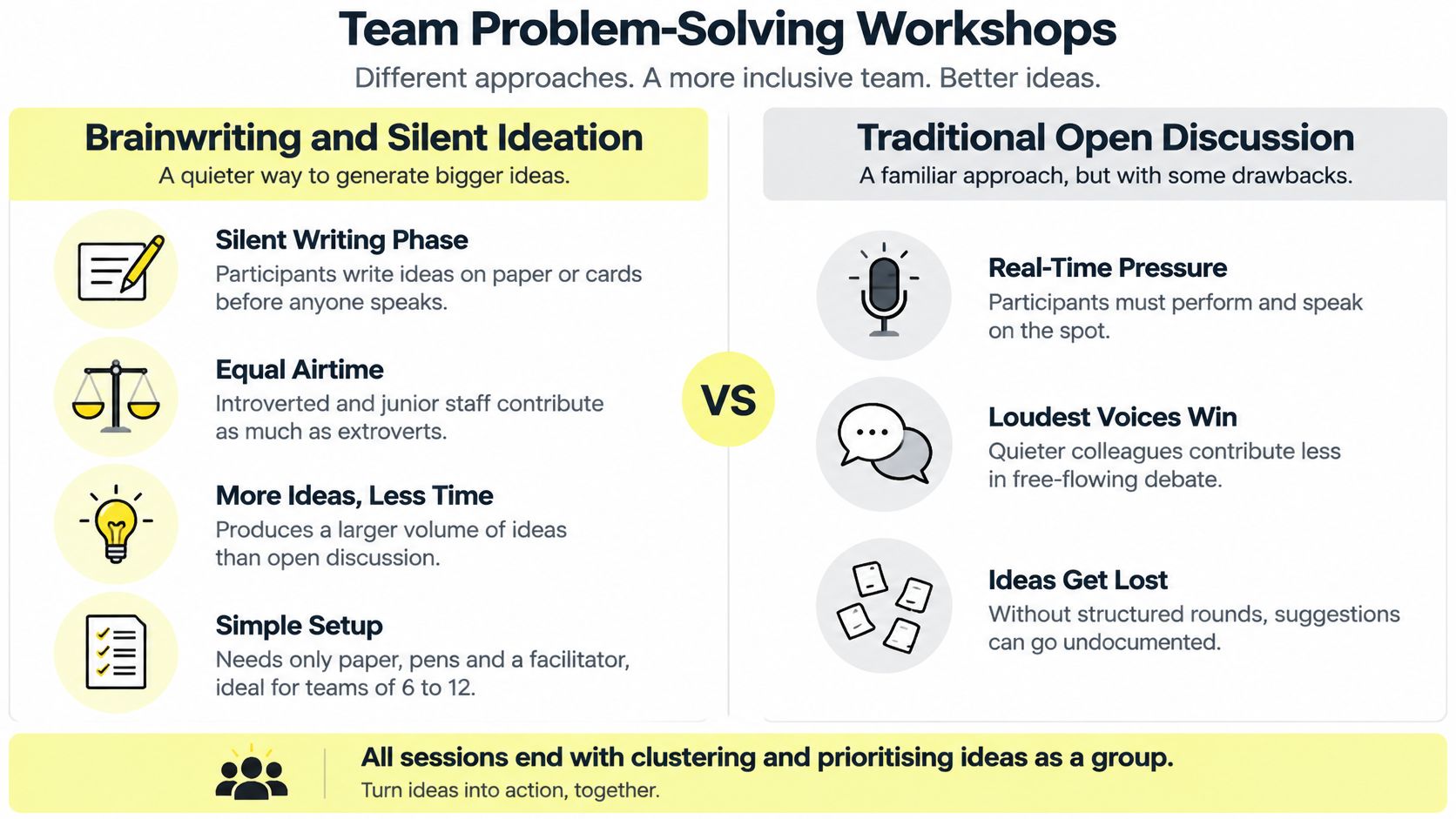
Six people, three ideas each, five minutes per round, then the sheets move clockwise. That's the 6-3-5 brainwriting structure, and its value is that idea generation happens before anyone speaks. A quiet analyst gets the same number of slots as the loudest person at the table, and no thought gets lost to an interruption.
Setup That Makes the Silence Productive
Put the problem statement on the wall before people sit down, phrased as something the department owns, such as why handovers between sales and operations stall. Give everyone an A5 sheet with three columns. Round one, three ideas. Round two, each person builds on the ideas in front of them. Five rounds, then a clustering pass where the team groups duplicates and picks three to take forward.
The comparison below is the argument for running it this way. It shows what open discussion and silent ideation each produce when a team needs to solve a real problem.
Where It Still Favours the Extrovert
The read-out. Whoever summarises a cluster becomes the voice of that cluster's work, and a confident summariser can sharpen someone else's idea into their own. Rotate the synthesiser every round, and have the facilitator read every shortlisted card rather than only the ones the loudest table championed.
Practical rule: if an idea needs a spoken defence to survive, the format has already failed the quieter half of the room.
A Singapore workplace well-being study measured psychological safety at an 88.4% correlation with a positive well-being climate, against 76.3% for teamwork (Well-Being in SG study). Run three 1 to 5 items before and after the session: "I can express a different view", "I can ask for clarification", "I can contribute without being interrupted".
- Lock the prompt: vague questions produce vague cards.
- Protect the five minutes: phones face down, no talking.
- Pair it with a physical session after lunch: the room balances out.
- Transcribe every card: contributors need to see their input survive the day.
Department heads use this in quarterly planning off-sites to surface communication gaps. Product teams run 6-3-5 routinely for the same reason.
2. Escape Room Team Challenge
An escape room is the most reliable format I know for getting a quiet person to own a decision. The clock forces choices, the clues force comparison of evidence, and the person who spotted the pattern gets listened to regardless of volume.
Why Decision Speed Matters More Than Enthusiasm
Mercer's 2018 Singapore Employee Engagement Index found 72% of employees at least somewhat engaged and 80% proud to work for their companies, yet about 40% were less positive about the speed of decisions (Mercer's 2018 Singapore Employee Engagement Index). Pride doesn't produce fast decisions. A timer does, and the debrief shows exactly how the team reached its calls.
Set the roles before anyone enters the room. Each participant gets a clue set they own, which stops one person from sweeping every puzzle. Add a timekeeper, a quartermaster for props and a silent observer who takes notes for the debrief.
Where It Still Favours the Extrovert
Hands. The confident player grabs the lock someone else is working on, and the room reorganises around that person. Make it a rule: nobody touches another person's clue without asking. Then hold a 20-minute structured debrief on communication patterns rather than on how close the team came to escaping.
- Book flexible slots: shift-based teams can't always start at 3pm.
- Add a breakout space: the learning happens in the debrief, not the room.
- Pair with dinner: conversation after the puzzle is often better than before it.
- Capture the observer's notes: they usually describe the authentic team dynamic.
Commercial escape operators across Singapore take corporate bookings, and the format works best when the debrief is booked as part of the slot, not squeezed into the car park afterwards.
3. DISC Personality Profiling and Team Mapping Workshop
Most team days ask people to perform a personality. DISC asks them to describe one. The assessment sorts communication and working style across four dimensions: Dominance, Influence, Steadiness and Conscientiousness. Participants complete the profile, review their result privately, then build a team map showing where the styles sit.
The Map Is the Output
The report tells one person their preference. The map tells the group where the handoffs break. Put it on a wall, mark which pair handles urgent escalations, and ask what happens when a high-D manager sends a same-hour request to a high-S analyst who needs preparation time. That conversation is the actual deliverable.
A team map is worth more than a personal report. One describes a preference. The other explains why the weekly meeting runs the way it does.
We run DISC as a facilitated workshop and recommend groups of at least ten, since the mapping exercise needs enough spread to show real differences. Our complete guide to the DISC personality assessment covers the four dimensions in detail if you're briefing a manager beforehand.
Where It Still Favours the Extrovert
The sharing circle. High-I participants tend to narrate their profile with stories, and the room rewards that. Ask people to write two lines about their result first, then invite voluntary sharing. Nobody has to disclose a type they'd rather keep to themselves.
Workplace engagement makes the case for spending the hour. Gallup reports that only 14% of Singapore employees are engaged, against 25% across Southeast Asia and 20% globally (Gallup's Singapore workplace report). A shared language for how people work is one of the cheaper responses to that gap.
- Say upfront that DISC describes preferences, not fixed traits.
- Use the map to redesign meetings: written pre-reads for reserved members, agendas sent a day ahead.
- Follow up at four to six weeks: ask whether communication changed.
4. The Tycoon Challenge Simulation
Give a team a market, a budget and three trading rounds, and the quietest person often ends up holding the numbers. The Tycoon Challenge is a trading-style simulation where teams buy, sell and plan toward a financial goal. The introverted contribution isn't optional here. Forecasting and record-keeping decide the score.
Roles Decide Whether It Builds Trust or Confirms Politics
A Straits Times survey on workplace friendships found 12% of respondents had difficulty forming them, with shyness or introversion among the cited reasons, while 34% pointed to difficulty trusting colleagues and 38% to concerns about gossip or office politics (Straits Times survey on workplace friendships). That's the barrier a competitive format has to clear.
Assign a forecaster, an analyst, a recorder and a trader, and rotate the negotiator each round so the fast talker isn't the only voice in the market. If you leave roles open, the simulation becomes a status contest within ten minutes.
Where It Still Favours the Extrovert
The negotiation window. Deals get done by whoever speaks fastest, which is why sealed written bids work better than open floor trading. Score record-keeping accuracy alongside profit too, or the team that shouted loudest wins on presentation alone.
Debrief question worth using: who changed their mind, and what evidence did it, not who argued hardest?
We develop these formats in-house, which means rules can be adjusted for group size and objective rather than played as fixed script. That matters when a finance team wants decision-making under pressure and a sales team wants negotiation practice.
- Assign roles deliberately: every member needs a measurable contribution.
- Judge the process, not the score: ask how the last trade was decided.
- Confirm minimum group size before booking.
- Close by linking one lesson to a real departmental decision that month.
5. Laser Clay Shooting Team Challenge
A team day can run well with almost no talking. Laser clay shooting uses laser-equipped guns aimed at clay-style targets on a controlled range, with teams scoring for accuracy. It is physical, competitive and nearly free of small talk, which is why some quiet employees rate it highest.
A Shared Experience Without a Networking Requirement
Connection does not only come from conversation. In a May 2021 survey of 585 full-time employees in Singapore, one in four felt less connected to their company because of working from home, and 45% named lack of social connection as a drawback of remote work (Singapore Business Review's report on the 2021 survey). A shared physical challenge rebuilds that connection without asking anyone to work a room.
Structure beats raw talent here. Rotate shooter, spotter, scorer and safety marshal each round, so the spotter calls the correction and the shooter executes it. The scorer role suits the member who prefers tracking numbers over calling shots, and it still shapes the result. The pair that communicates cleanly usually beats the pair with the best aim.
Where It Still Favours the Extrovert
Between rounds. The banter, the mock rivalry, the posturing after a good sequence. Someone will also assume physical confidence equals competence. Pair a talkative spotter with a quieter shooter and let the spotter's coaching show up in the score. Rotating roles every round stops one confident shooter from holding the gun all session.
Setup note: brief safety rules and collect health declarations before anyone handles a gun, and confirm the venue's minimum numbers when you book.
We offer Laser Clay Shooting as one of our featured team-building activities, with format and equipment adjusted to budget and venue. Groups of mixed ability are fine, provided the marshal keeps the rotation moving.
- Mix departments into teams: cross-team pairing is where the value sits.
- Score improvement as well as totals: the first-time shooter who doubles their hit rate has earned the points.
- Cap squad size so everyone shoots several rounds: long waits cool a group faster than a low score.
- Schedule a short reflection over a meal: ten minutes of guided questions beats an hour of unstructured drinks.
6. Running Man-Style Game-Show Relay
Group size decides the format: a department of 20 can run one circuit, while a regional group of 200 needs stations, timed rotations and dedicated trainers. Get that wrong and the day either bottlenecks at one station or spreads so thin nobody shares a moment.
Designing Stations for a Mixed Team
A game-show relay sends teams through a sequence of physical and mental challenges: puzzles, quick decisions, timing tasks, group stunts. Rotation is the design feature that matters for introverts. If each station rewards a different skill, the person who's useless at the sprint can be decisive at the logic lock.
Give out roles before the first whistle: timekeeper, scorekeeper, route planner, station specialist, observer. Write the assignments on a card for large groups, because the quieter member rarely claims a role aloud. The scorekeeper who tracks points and timings usually becomes the person the team consults by station three.
Where It Still Favours the Extrovert
Anything scored on visible enthusiasm. Sprint-and-shout stations reward the loudest team, and camera-friendly moments draw more attention than accurate answers. Include at least one low-physical-demand station per circuit, and award points for precision rather than noise. A correct answer written on a card should score the same as one shouted at full volume.
Our Running Man game rules and challenge ideas set out station formats you can adapt, and we modify these concepts in-house to fit corporate objectives and group sizes.
- Publish the rules in writing as well as briefing them aloud.
- Reserve a shaded or indoor backup venue for outdoor days.
- Keep teams to five or six so nobody can hide at the back.
- Debrief at the last station: ask which roles people took when they weren't told what to do.
7. Community Conservation and Volunteer Day
A shared task removes the need for small talk. Beach clean-ups, habitat restoration and senior engagement visits give a team something to do together, and the conversation arrives on its own while people sort equipment or plant seedlings. Quiet employees often describe these days as the easiest company event they've attended.

Roles for People Who Don't Want the Spotlight
Assign a team lead, a logistics coordinator, a safety lead and a documenter who photographs and records the day for the impact report. Give the same scoring weight to the documenter as to the front-line volunteers. That's how you value contribution without demanding performance.
Where It Still Favours the Extrovert
The closing circle, and the senior engagement conversations. One volunteer ends up leading every chat while another hands out tea in silence. Pair people for conversations, give a written reflection prompt, and let anyone who prefers to contribute behind the scenes take the logistics lane.
Volunteering works as team building because contribution is visible in the work rather than in how many sentences someone said.
We run CSR programmes in Singapore and overseas, covering senior engagement, community interaction, area improvement and conservation work in destinations such as Bali, Bintan, Batam and the Philippines. Read more on how volunteering strengthens corporate teams before you pick a cause.
- Align the project with the company's existing CSR priorities.
- Pair the work with a 20-minute reflection session.
- Confirm transport, insurance and permits early for cross-border projects.
- Offer parallel contribution paths: photography, coordination, translation, recording.
8. Bintan Water Sports Park Challenge for Overseas Retreats
An overseas team day changes the logistics, not the design principles. Teams work through water-based tasks that need coordination and trust, with rotating roles so nobody is stuck holding a rope while one person drives everything. Run well, it's the least pressured bonding format a mixed team can do.
Singapore Is the Natural Launch Point
Singapore's MICE tourism receipts reached S$2.3 billion in 2025, a 35% increase from S$1.7 billion in 2024, and the city hosted 156 international association meetings that year while holding the International Congress and Convention Association's top Asia-Pacific position for the 23rd consecutive year (Singapore Tourism Board's business events update). That's why a regional meeting here often continues into an offsite elsewhere in the region.
We design and facilitate end-to-end Bintan retreats, handling logistics, venue coordination and programme delivery, and our overseas programmes can run indoors or outdoors at whichever destination the client chooses. Island retreats usually combine facilitated breakout discussions, shared meals and a reflective debrief.
Where It Still Favours the Extrovert
Water confidence and the evening programme. The pool and the bar reward the socially bold, and shore jobs can look like the consolation prize. Weight shore roles equally in the scoring, and put a free-time block in the itinerary so people can recharge before dinner.
- Book several weeks ahead to secure accommodation and transport.
- Ask for one quotation covering meals, transfers and facilitation.
- Brief water safety and health requirements beforehand.
- Build in a quiet block between activities, not after them.
How the eight introvert-friendly activities compare on format, price guide and venue
The eight options split two ways on cost: indoor programmes start from $45 per participant, outdoor programmes from $35, and CSR days, simulations and overseas retreats are quoted per programme because group size and logistics move the figure more than the activity itself. For a quiet employee, the venue column matters as much as the price. Indoor rows run in a controlled room where a facilitator can protect written and station-based roles, while outdoor and resort rows need named jobs assigned before the day so nobody is left improvising in front of the group.
| Item | Best For | Pricing Guide | Venue Type |
|---|---|---|---|
| Brainwriting and Silent Ideation Workshop | HR teams and managers needing structured problem solving with low social pressure | Indoor programmes from $45 per participant; quoted on group size and venue | Indoor meeting room or hotel venue |
| Escape Room Team Challenge | Event coordinators planning a 90-minute to two-hour indoor session | Quote-based; varies by venue and group size | Indoor escape room |
| DISC Personality Profiling and Team Mapping Workshop | Managers focused on communication and working styles | Quote-based; suited to groups of at least 10 | Indoor workshop or meeting room |
| The Tycoon Challenge: Trading Simulation | Sales, finance and operations teams wanting a competitive indoor session | Indoor programmes from $45 per participant | Indoor venue |
| Laser Clay Shooting Team Challenge | Companies wanting an active session with minimal verbal demands | Quote-based; depends on group size, session format and venue | Dedicated shooting venue |
| Game-Show Relay: Running Man-Style Challenge | Mixed departments organising outdoor staff activities | Outdoor programmes from $35 per participant | Indoor or outdoor venue |
| Community Conservation and Volunteer Day | CSR teams combining engagement with community contribution | Quote-based; depends on project type, location and group size | Community or environmental project site |
| Bintan Water Sports Park Challenge for Overseas Retreats | Companies running multi-day retreats in Asia | Quote-based; depends on group size, duration, accommodation and transport | Bintan resort and water-sports venue |
I would shortlist by venue first and headcount second. The Bintan row only makes sense once the company is already budgeting for travel days, not the session alone.
Building a Team Day Everyone Can Join
Match the format to the objective and the roles follow. If the team needs fresh thinking on a stuck problem, run brainwriting. If decisions crawl, an escape room exposes the bottleneck inside an hour. If colleagues misread each other's working style, DISC gives them shared vocabulary. If judgement needs pressure-testing, use a trading simulation. If the room is tired of talking, go shooting. If the group is large and mixed, build stations and rotate. If the team wants meaning, volunteer. If it's a regional gathering, take it to Bintan and make a proper retreat of it.
Every format on that list still has moments that reward the loudest voice. Escape room debriefs get dominated by whoever spoke first. Trading floors get noisy. Relays get loud by design. The fix is structure rather than activity choice: assign the note-taker, timekeeper and observer roles before the session starts, let written input count alongside spoken input, and have facilitators call on the quietest role first during the debrief.
Treat the day with the discipline of a business event. Singapore's MICE sector supported more than 34,000 direct and indirect jobs and generated S$3.8 billion in value-added activity, close to 1% of the country's GDP, according to the Singapore Economic Development Board's MICE update. A brief, named roles and a working debrief are what separate an event that changes how a team operates from an afternoon nobody references again.
Flexibility belongs in that brief. In a 2025 APAC workforce study, 72% of workers preferred hybrid work while only 46% had access, and Singapore ranked first in the region for employers offering it at 68% (People Matters report on the APAC flexibility study). Send the agenda ahead so quieter staff arrive prepared. Keep the mandatory block compact, and make the social segment optional without turning attendance into a loyalty test.
Then close the loop. Ask every participant which role they held, what made contributing easy or hard, and what the team should carry into ordinary meetings. Write the answers down. Six weeks later, check whether the quiet analyst is speaking in the planning meeting. That is the only outcome worth scoring.
One Dynamics designs indoor and outdoor programmes in Singapore, with indoor programmes from $45 per participant and outdoor programmes from $35, and custom quotations reflect group size, venue and programme requirements. For overseas retreats, the team designs and facilitates Bintan retreats end to end, covering logistics, venue coordination and programme delivery, and can build indoor or outdoor programmes at your chosen destination across Asia. If you're mapping out the year's engagement calendar, see Turn On Work's planning framework for a sensible sequence of events.
Quiet employees don't need a gentler version of team building. They need formats with defined roles, thinking time and a debrief that counts observation as contribution. One Dynamics builds those programmes in-house, from brainwriting workshops and DISC mapping to Laser Clay Shooting, The Tycoon Challenge and Bintan retreats delivered end to end, and adapts each one to your group size, venue and objectives. Tell us what your team needs to fix and we'll shape the day around it at One Dynamics.