Corporate Training Singapore: Options, Costs and Planning
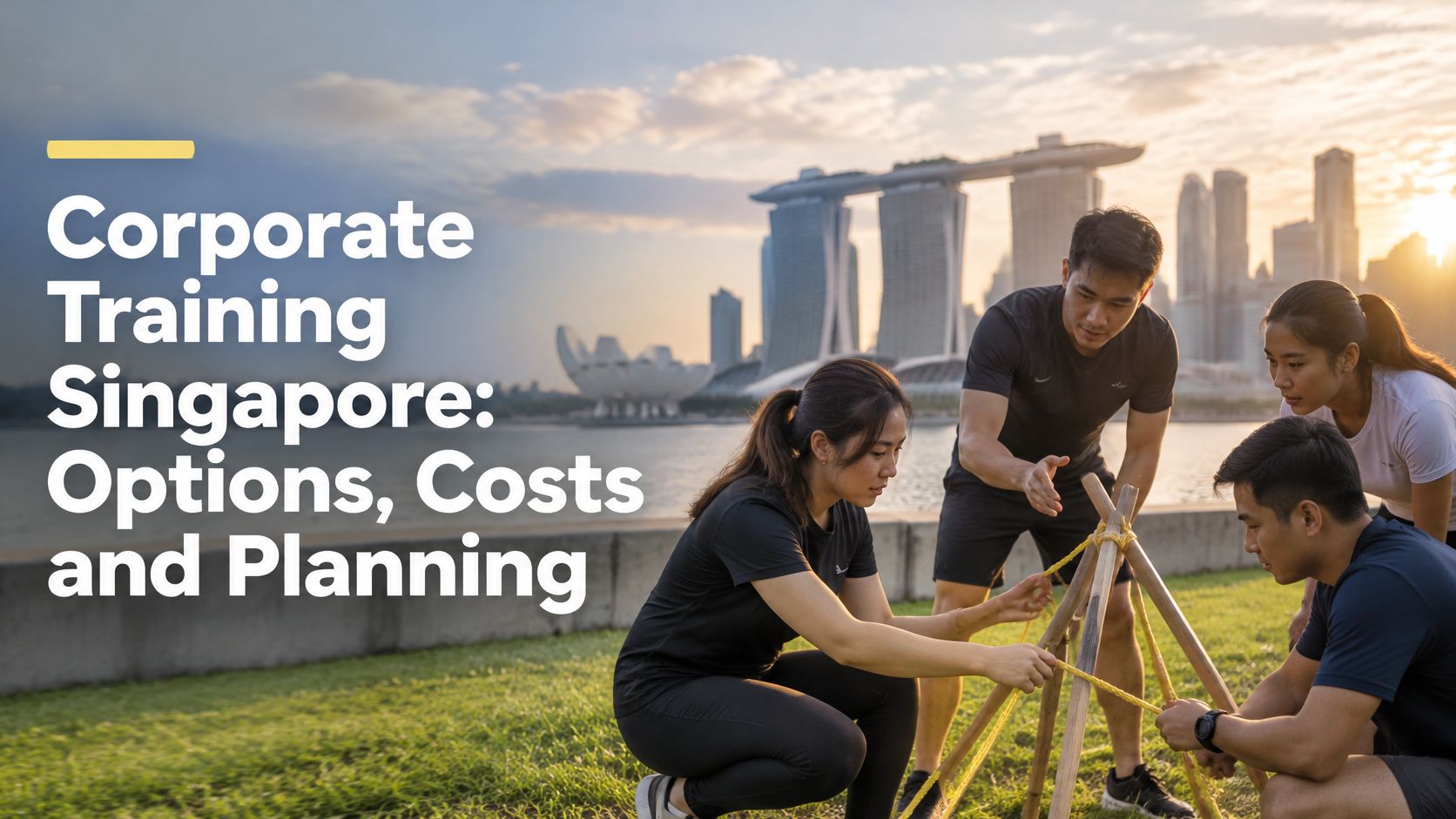
Your regional leads land on Thursday, the hotel block is still unconfirmed, and someone from HR has asked for a team activity that will “change how people work”. You have a decent budget, a mixed group of Singapore staff and visiting colleagues, and a calendar that will not give you a full week off the floor. That is the usual brief for corporate training in Singapore, and the format you pick has to fit the hours people can leave their desks, the headcount, and the behaviour you want back in the office.
A fun afternoon is easy to buy. A programme that changes a meeting habit is harder, because the activity is only the rehearsal. The debrief, the manager follow-through, and a simple measure decide whether Monday looks any different.
Table of Contents
- Corporate Training Options in Singapore Compared
- How Facilitated Activities Build Real Workplace Skills
- Choosing a Format by Company Size and Budget
- Planning a Regional Meeting or Retreat End to End
- Measuring Whether Training Changed How Teams Work
- Booking Checklist, Common Mistakes and Provider Quotes
Corporate Training Options in Singapore Compared
| Format | Typical length | Main skills built | Planning effort |
|---|---|---|---|
| Facilitated indoor challenge | 2 to 4 hours | Communication, problem solving | Low |
| Outdoor challenge or scavenger hunt | Half day | Coordination, trust, leadership | Medium, needs a weather plan |
| Water-based or sailing programme | Half day | Navigation, communication, teamwork | Medium to high |
| Personality profiling workshop (DISC) | Half day | Behavioural awareness, team roles | Low to medium |
| Overseas or regional retreat with hotel and transfers | Two to three days | Strategy, relationship-building, alignment | High |
Pick the row by three filters: how long people can leave their desks, how many people attend, and what the programme must change.
A facilitated indoor challenge, such as a business simulation or a scored game with a structured debrief, fits a two to four hour block in an office or hotel room. Planning stays light because you are not moving people across the island. It suits a department that needs clearer communication, not a day out of the building. A 30-person team with a two-hour window should start here.
An outdoor challenge or scavenger hunt across a Singapore landmark or a Sentosa beach needs a half day. We run outdoor scavenger hunts across key Sentosa landmarks and beaches, and the skills that show up are coordination, trust and leadership under a clock. Planning effort is medium because you need a weather plan, not because the activity itself is complicated.
A water-based or sailing programme on Marina Bay suits teams that want one shared physical task with clear roles. Our corporate sailing sessions are guided by experienced skippers, and teams learn the basics of navigation, communication and teamwork. Tide windows, safety briefings and pier transfers push the planning effort to medium or high, so book the half day early.
A personality profiling workshop such as DISC suits teams that are new to each other and still lack a shared language for working styles. A half day is enough for a profile, a paired discussion and a short action list. Groups of at least ten make the contrasts useful. If leadership language is the gap, a DISC profiling workshop belongs in the design, not as an add-on after the games.
An overseas or regional retreat of two to three days suits strategy sessions and leadership alignment, with hotel stays and transfers in the same plan. Effort is high because rooms, flights or ferries, meals and the working agenda have to land on one timeline. A regional leadership team meeting in Singapore, or flying out from here, points to this row rather than a two-hour game.
How Facilitated Activities Build Real Workplace Skills
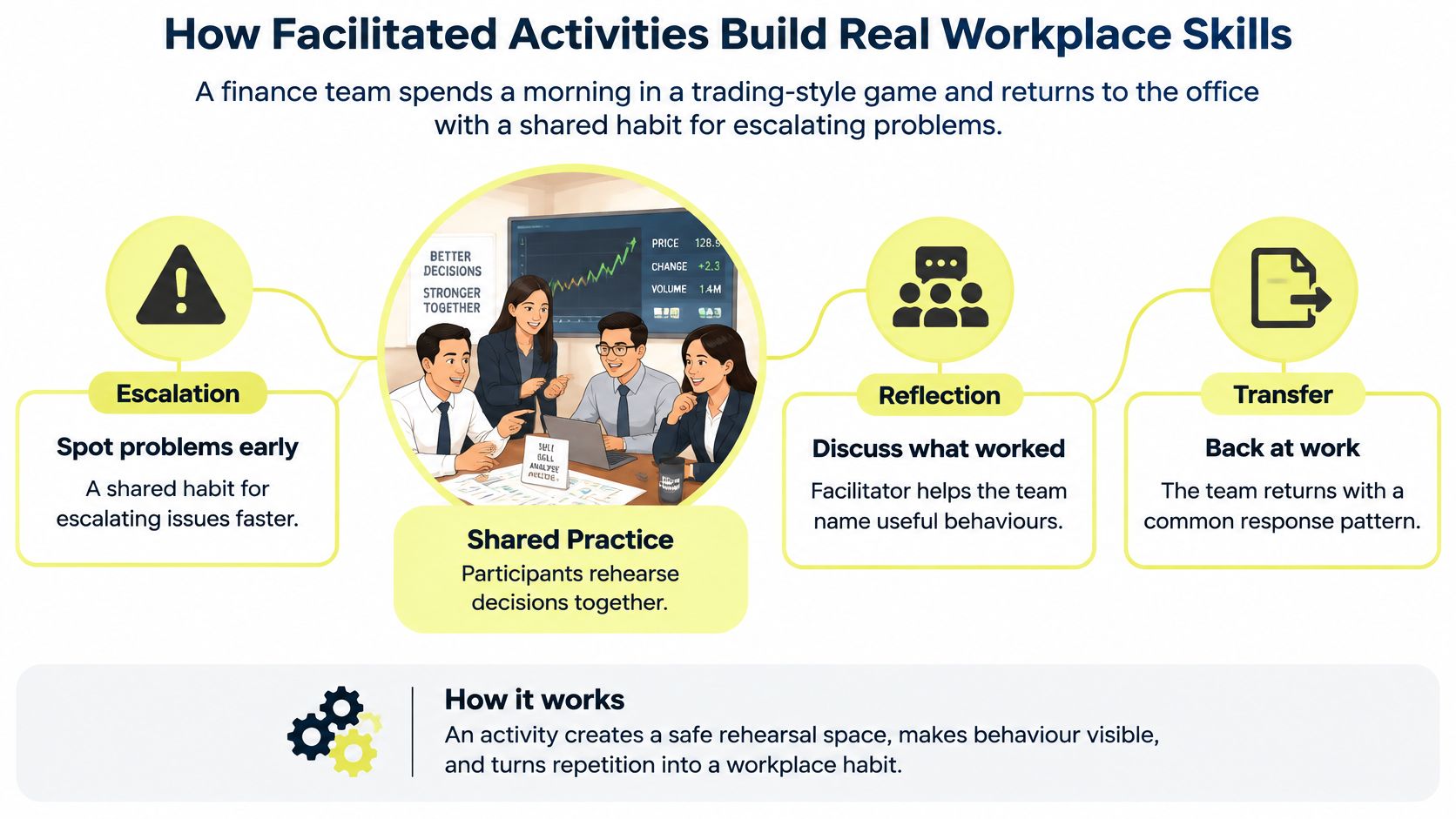
A finance team spends a morning in a trading-style game and leaves with a shared habit for escalating problems early. That habit is the outcome worth buying. The game itself is only the rehearsal.
The mechanism
An activity creates a shared task under pressure. The facilitator watches who speaks, who hoards information, and who waits too long to flag a problem. The debrief then ties that moment to a real work situation, such as a late risk note in a deal review. Safe rehearsal makes the behaviour visible, and repetition under a name the team agrees on turns it into a workplace habit.
The name matters more than people expect. A short call like "flag it by noon" survives in a meeting where a competency label would not, because anyone can use it in the moment the behaviour is needed.
In a 2025 Singapore survey of 750 talent, 39% reported an increase in training opportunities during the preceding six months, while 28% said their employer was not helping them develop practical, future-proof skills, according to Randstad. A debrief that names one real skill answers that gap better than another hour of play.
Match the task to the skill
Each activity below earns its place because the task forces the behaviour you need. Pick the behaviour first.
The Tycoon Challenge, a live urban strategy game, forces negotiation, budgeting and handling disagreements in the open. Use it when the team avoids hard conversations about trade-offs.
Laser Clay Shooting and Kin Ball build coordination under time pressure. Roles are obvious, mistakes are public, and the group has to reset quickly. They suit teams that freeze when the pace picks up.
Running Man style challenges build role clarity and quick decisions. People cannot hide in a large circle, which is useful when meetings have too many spectators and too few owners.
Scavenger hunts across landmarks build information sharing between sub-groups. One squad always finds the clue the others need, the same failure mode as a handover between two functions.
When the gap is a missing shared vocabulary, work a DISC profiling workshop into the design so the team has terms for working styles before anyone sits in a debrief.
Where the learning actually happens
Activities rarely build skills without a debrief. The facilitator asks what the team did, what it cost in time or trust, and what it would do differently at the office on Monday. Skip that conversation and people remember the score, not the habit.
A skilled facilitator will also stop a round mid-play when a pattern shows up, name it while the sting is fresh, and restart. That interruption is the lesson.
Practical rule: Choose two skills the team lacks, then pick the activity whose tasks force those behaviours. Do not start from the activity that looks most entertaining.
Choosing a Format by Company Size and Budget
| Company size | Median training days | Mean training days |
|---|---|---|
| Large enterprises | 8.0 | 10.8 |
| Medium enterprises | 6.0 | 8.0 |
| Small enterprises | 6.4 | 8.1 |
Those are the 2024 figures for resident trainees from the Ministry of Manpower. Large enterprises sit at a median of 8.0 training days and a mean of 10.8. Medium enterprises sit at a median of 6.0 and a mean of 8.0. Small enterprises sit at a median of 6.4 and a mean of 8.1. Larger firms can fund longer programmes. Smaller firms need shorter interventions with a payback people can see in the same month.
The format I would use at any size is the same spine, scaled to the hours you have. Run a 2 to 4 hour facilitated module. The manager then leads a 10-minute after-action review, assigns one team behaviour to practise for 30 days, and repeats a short pulse check. Length changes. The follow-through does not.
SkillsFuture Singapore reported that 24,000 enterprises supported employees in SkillsFuture-supported training in 2024, up from 23,000 in 2023, and small and medium-sized enterprises accounted for 95% of those employers. Smaller firms are a core buyer, not an edge case. One Dynamics adapts its programmes to Singapore's corporate culture through localised design that respects the team dynamics of each client, so the task fits working style, language and seniority mix, not only headcount.
Three budget tiers
Cost drivers, in order of impact, are group size and venue, then transport and hotel nights, then meals, then facilitator time and customisation.
- Lean budget: One in-office module. No coach, no hotel, one facilitator, one behaviour to practise.
- Middle budget: Add a half-day outdoor or water-based session, with transport and a wet-weather indoor room held.
- Larger budget: Add an overnight retreat so strategy time and the activity sit on the same trip.
Large groups should split into smaller teams so everyone gets a turn. A room of 80 watching 12 people play is not training. For headcount above a single circle, ask about package deals for larger groups or extended events before you lock a venue.
Write down headcount, budget per person and available hours, then pick the tier that matches all three. If one of the three does not fit, drop a night or a venue, not the debrief.
Planning a Regional Meeting or Retreat End to End
Buyers now expect one planner to hold the whole trip. MICE visitor arrivals reached 1.1 million in 2024, up from 730,000 in 2019, and the first half of 2025 added another 560,000. Splitting hotels, coaches and activities across three vendors is how agendas slip.
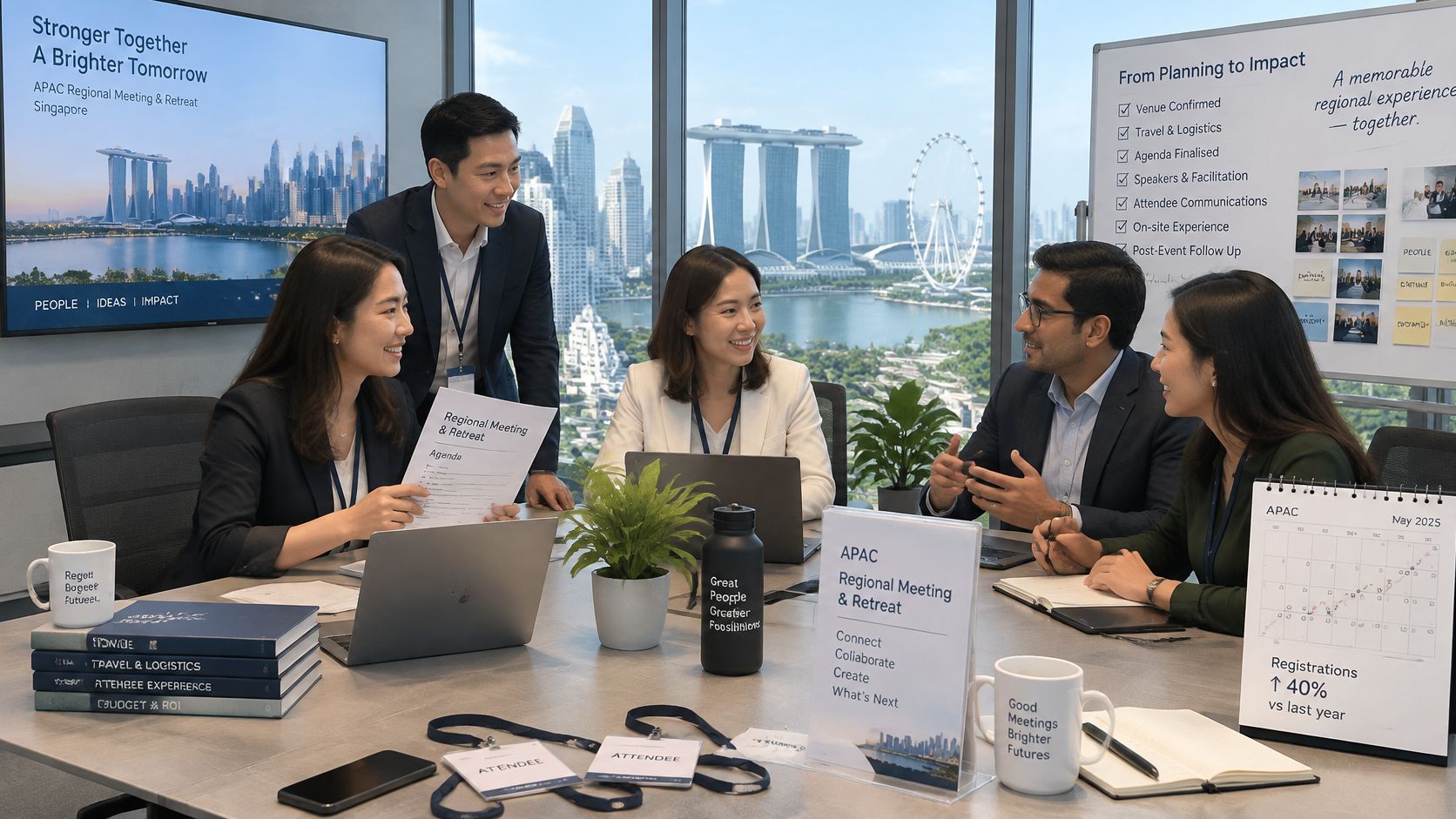
Singapore works as the gathering point because transfers, meals and meeting rooms stay inside a compact city, with efficient public transport, strong hotels and a wide choice of event spaces. One Dynamics Team Building specialises in overseas team building packages that start from Singapore and focus on corporate retreats across Asia. For multi-day trips, Bintan, Bali and Langkawi are the three destinations we run most often for Singapore companies, each paired with a structured team programme rather than a free afternoon.
- Arrival. Airport transfers and group pickups need flight numbers, a holding point, and a named person on the coach. Late bags should not stall the first session.
- Accommodation. Room blocks, allocation and early check-in matter more than the hotel brand. Ask who gets the early rooms if the first flight lands before 14:00.
- Meeting venue. Confirm layout, audio-visual kit and breakout rooms against the agenda, not against a brochure photo. A U-shape fails if you need table work in pairs.
- Meals. Collect dietary needs before the trip and put hosted lunches and dinners on the same run sheet as the sessions. A missing vegetarian count is the most common last-minute failure.
- Team activities. Place indoor or outdoor sessions between meeting blocks, not after a three-hour strategy debate when energy is gone. Keep the facilitated task short enough that people can still talk afterwards.
- Debrief and departure. Transfers back, plus a one-page summary of agreed actions, should leave with the group. Capture actions while people are still in the room. AI meeting assistant articles are a useful extra if you want a clean record of decisions without a second note-taker.
One provider means one planner, one invoice and one contact. Our guide to planning overseas corporate retreats from Singapore walks through the sequence if the trip leaves the island.
Before you brief anyone, lock five items: headcount, room-block dates, transfer times, meeting-room needs, and the person who signs off the food and beverage order.
Measuring Whether Training Changed How Teams Work
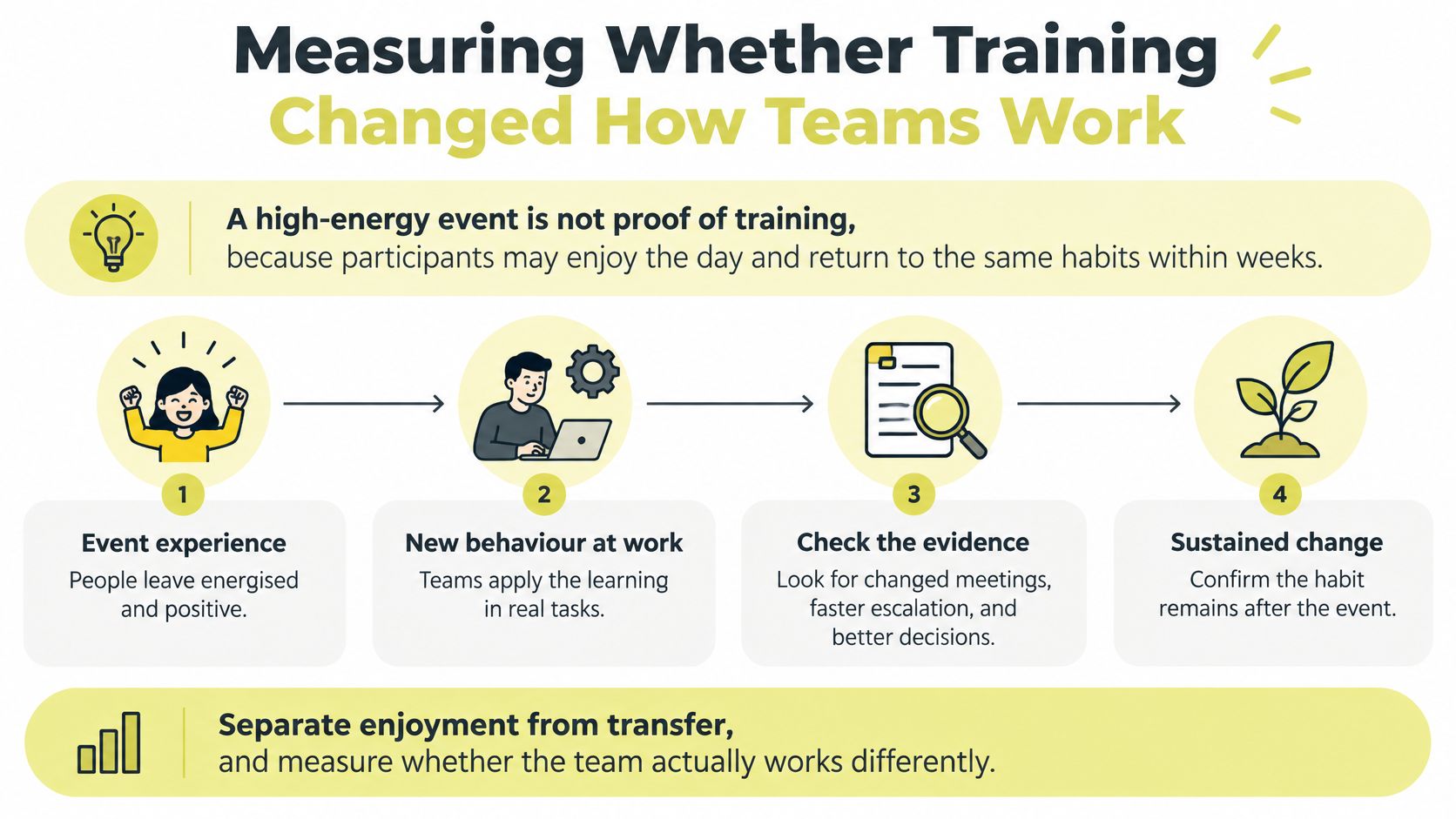
A high-energy event is not proof of training. People can enjoy the day and be back in the same habits within weeks. Enjoyment is a feeling at 17:00. Transfer is a different meeting three weeks later.
Separate the two, then walk a timeline. Agree one or two target behaviours before the event, or the numbers will not mean anything.
| Stage | What to measure | How to collect |
|---|---|---|
| Before the event | Communication, psychological safety, cross-team familiarity | Short pre-event rating survey |
| During the event | Information sharing, escalation quality | Facilitator observation sheet |
| 30 days after | Meeting participation, cross-functional collaboration | Manager check-in and team log |
| 60 to 90 days after | Onboarding speed, employee pulse scores | Follow-up pulse survey compared with the baseline |
Read the timeline in order
Before the event, a short rating of communication, psychological safety and cross-team familiarity gives you a baseline. Five questions is enough. A long survey gets ignored.
During the event, the facilitator uses an observation sheet for information sharing and escalation quality. Watch whether a stuck sub-group asks for help, and how long that takes. Satisfaction stickers do not capture that.
Thirty days after, managers log meeting participation and cross-functional collaboration against the one behaviour you named. A 10-minute check-in beats a forgotten portal login.
At 60 to 90 days, compare onboarding speed and a pulse survey with the baseline. If the scores have slid back, the habit did not stick, and you need a shorter refresher, not another full day out.
Report results by team or function, not one average satisfaction score. A finance team and a client-services team need different fixes, and an average hides both. If you want a wider set of metrics that prove training works, use them to choose indicators, then keep your own sheet to three lines so managers will fill it in.
Name the workplace problem, the behaviour that should change, and the number that will show it. If you cannot name all three, you are booking a morale event.
Booking Checklist, Common Mistakes and Provider Quotes
Send organisers one page before you ask for a price.
- Headcount range: Give a minimum and a maximum, not a single hopeful number.
- Budget per person: State it in SGD so the quote does not come back in a different shape.
- Dates and hours available: Include the latest end time, not only the start.
- Location: In the office, on Sentosa, outdoors in Singapore, or overseas.
- Hotel, transport and meals: Say yes or no for each, so they are not assumed.
- Behaviours to measure: One or two, written in plain language.
- Weather plan: Required for every outdoor session.
Mistakes that break the programme
Treating the event as the training fails because people revert. Fix it with a 10-minute after-action review and a 30-day behaviour target. Running a 50-person activity built for 12 people fails because half the group stands and watches. Fix it by checking the recommended group range before you book. Outdoor sessions with no weather plan fail at 07:00 on the day. Fix it with an indoor alternative and a fixed decision time the evening before. Budgeting only for the activity fails when coaches and lunch appear as extras. Fix it with a line-item quote covering transport, meals and venue.
For a price anchor, standard mid-tier corporate packages from One Dynamics cost SGD 350 to SGD 600 per pax for three days and two nights, typically to Bintan or Langkawi. The company has served more than 50,000 participants across Singapore and overseas. Outdoor activities in Singapore carry a 100% Weather Assurance guarantee, with an indoor venue or a reschedule if the weather turns. Those points let you compare scope, not slogans. Ask every organiser to itemise activities, venue, transport, meals and accommodation so two or three quotes sit on the same lines.
This week, do three things. Send the checklist to two or three organisers. Request a quote at two group sizes, because per-person cost moves when you add a second coach. Agree the measurement plan on a short call before you sign anything.
One Dynamics plans corporate training in Singapore as facilitated indoor, outdoor and overseas programmes, with hotels, transfers, meals and a debrief on one plan when your regional team needs the full trip. If you want the format matched to your headcount, hours and the behaviour you will measure, visit One Dynamics and send your dates.