Corporate Volunteering Singapore: How to Plan a Programme

About 50% of employees were interested in employer-organised volunteering, but only 20% of employers organised it, according to an MCCY/NVPC survey discussed in MCCY's roadmap for corporate giving. That's an employee-operations gap, not a shortage of goodwill. Corporate volunteering in Singapore becomes workable when HR gives people an approved route out of the office, managers arrange cover, and community partners receive the help they need.
Table of Contents
- Corporate Volunteering in Singapore Today
- How to Plan a Volunteering Programme in Eight Steps
- Matching Activities to Team Objectives
- Community Partners and Example Formats
- Logistics, Leave and Budget to Arrange
- Measuring Whether the Programme Works
- Adapting Volunteering for SMEs and Small Teams
- Outbound Volunteering on Overseas Retreats
- Confirm Your Partner and Book the First Volunteer Day
Corporate Volunteering in Singapore Today
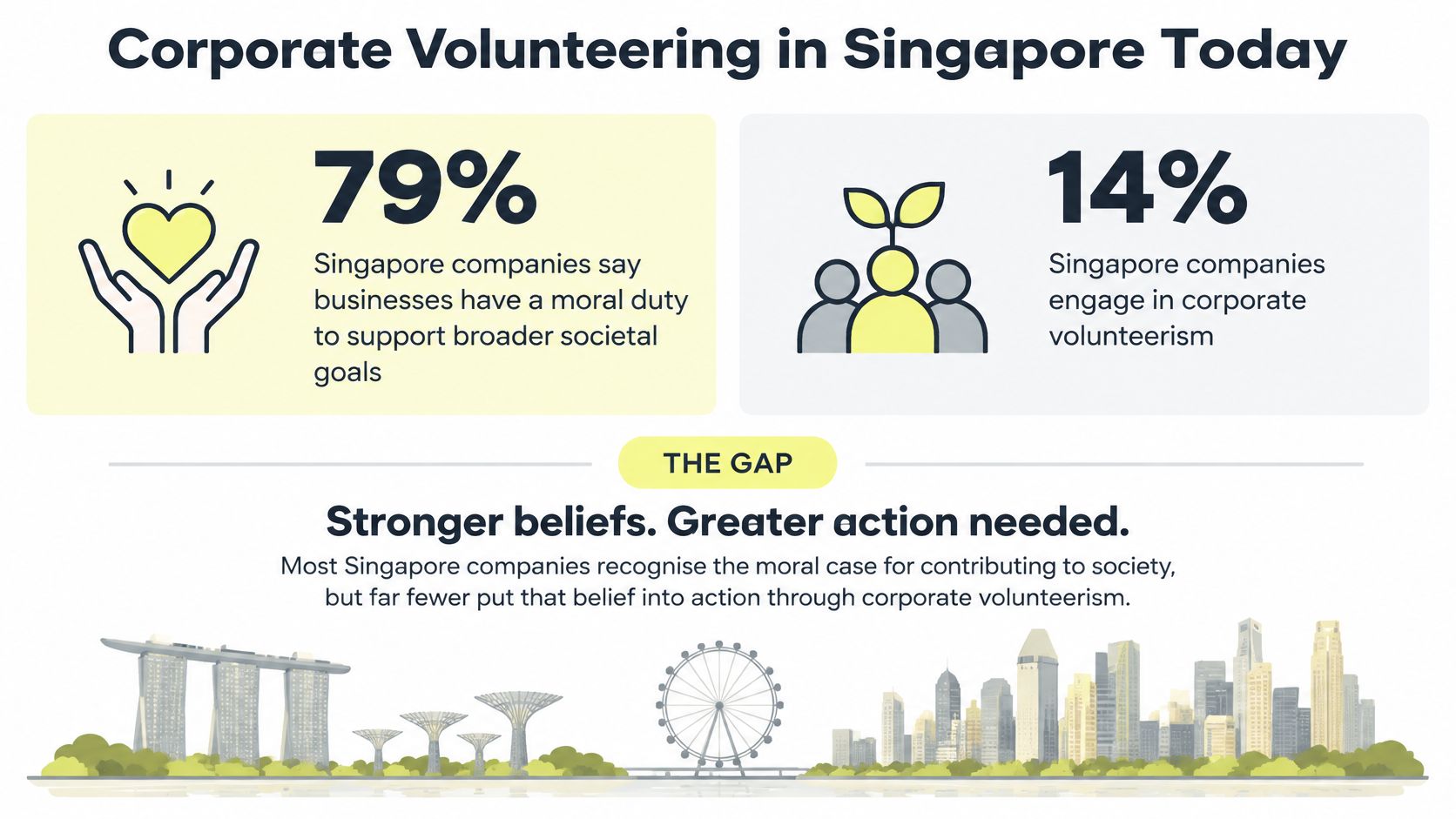
79% of Singapore companies said businesses have a moral duty to support broader societal goals, yet only 14% engaged in corporate volunteerism, according to NVPC's National Corporate Purpose & Impact Study 2025, which surveyed 1,100 companies across nine industries. Among companies that did volunteer, median employee participation reached 70%, up from 50% in 2021.
Interest is the crowd; the programme is the playbook. Many employers have the crowd without the playbook.
Singapore corporate volunteering benchmarks
The historical corporate-giving benchmarks below come from NVPC's Corporate Giving Study, while the latest volunteering measures come from its national corporate-purpose study. Corporate giving is broader than volunteering: it can include donations, advocacy and policies embedded in business operations.
| Measure | Singapore benchmark | Year |
|---|---|---|
| Companies giving in some form | 52% | 2017 |
| Companies conducting at least one form of corporate giving | 75% | 2021 |
| Median share of employees volunteering | 25% rising to 50% | 2017 to 2021 |
| Businesses saying they have a moral duty to support societal goals | 79% | 2025 |
| Companies actually engaged in corporate volunteerism | 14% | 2025 |
| Median employee participation at companies that volunteer | 70%, up from 50% | 2025 |
These aren't interchangeable measures or a continuous trend line. Use them to ask separate questions: does your company contribute, does it organise volunteering, and can employees realistically participate?
A programme can look healthy on an annual calendar while remaining difficult to access. Employees may receive an invitation but still need to negotiate workload, leave and transport individually. Managers may support the cause without knowing who will cover customer-facing duties.
The practical response is to connect activity selection with team objectives, partner capacity, approved time and measurable delivery. Larger employers can build recurring partnerships; smaller firms can use a lighter operating model without weakening safeguarding.
Readiness test: Do we have a named owner, a date and a leave route?
If any answer is missing, fix that before circulating an enthusiastic sign-up email.
How to Plan a Volunteering Programme in Eight Steps
Leadership should remove obstacles, not merely appear in the group photograph. NVPC's Corporate Giving Study findings found that companies whose senior leaders were personally involved were more likely to give at least twice yearly, 27% compared with 19% among companies without that involvement.
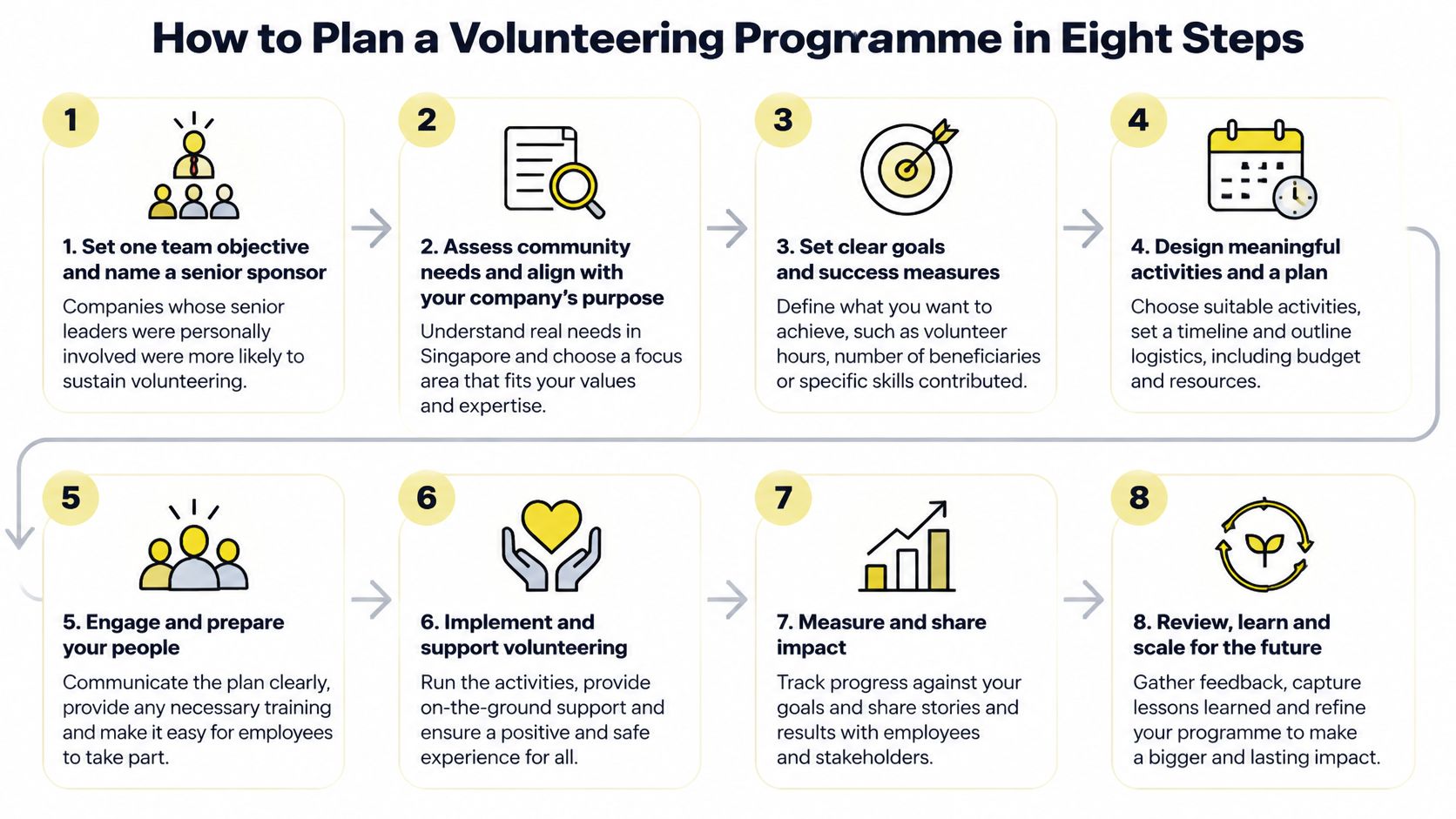
Set one team objective and name a senior sponsor. Choose a specific outcome, such as better handovers between functions, and give the sponsor responsibility for resolving resource conflicts. The common slip is treating sponsorship as a welcome speech rather than an operational commitment.
Define eligibility and headcount. Specify participating departments, the workable group range and whether registration is open to all staff. Don't invite everyone before checking whether shift workers and frontline teams can access the opportunity fairly.
Choose the partner and format. Match the community organisation's requested task with employees' capabilities and your team objective. The usual mistake is choosing an attractive activity before establishing whether the partner needs it.
Secure approved time. Agree paid volunteer leave or working-hours participation, manager sign-off and, as a planning target, a sign-up deadline about four weeks ahead. Confirming a venue before approval leaves employees holding places they can't use.
Arrange logistics and safety. Assign transport, meals, insurance checks, materials and the briefing to named owners. A supplier booking isn't complete until someone has checked its inclusions and exclusions.
Brief volunteers for the actual setting. Explain roles, clothing, photo consent and respectful conversation with seniors, including allowing people to decline interaction. Don't assume goodwill substitutes for preparation.
Run the session with a named lead. Give that person authority to adjust tasks, manage attendance and activate the rain or backup plan. Avoid leaving the charity to coordinate your employees while also supporting beneficiaries.
Debrief and schedule the next session. Aim to review attendance, hours and feedback within a week, then agree what to change before fixing another date. The common slip is publishing photographs while leaving operational problems unresolved.
The process is working when registrations become actual attendance and the next date has an owner. A polished launch without either isn't a sustained programme.
Matching Activities to Team Objectives
Choosing an activity is like choosing a prescription: the symptom matters, and so does the dose. Weak cross-department contact needs a different design from poor listening or unclear ownership. A generic day of goodwill rarely addresses all of them.
Choose the behaviour first, then the task. Packing care bags can encourage collaboration, but not if colleagues remain in their usual departmental groups and one confident person controls every decision.
- Cross-department collaboration: Mix functions in a packing session and split responsibility for checking contents, replenishing supplies and completing bags. Require handovers between roles rather than rewarding individual speed.
- Communication and empathy: Lunch-pack distribution and conversations with seniors create opportunities to listen without rushing towards a solution. Brief employees to ask permission, avoid intrusive questions and let the beneficiary set the pace.
- Ownership and leadership: Rotate responsibility for an assembly line or clean-up zone so junior colleagues can allocate tasks and raise problems. Give them genuine decisions, not a title while a manager continues directing everything.
- Purpose and morale: An outdoor clean-up offers a visible result within the session. Keep the task achievable and explain how the partner will handle collected waste, so employees understand what happens after they leave.
Make the learning usable at work
A hands-on task alone won't change workplace communication. Facilitation matters because employees need to identify the behaviour they practised and where they'll use it next.
Our guide to how community service projects strengthen corporate teams provides context for connecting volunteering with team development. For a broader engagement calendar, FLYP LTD.’s FLYP employee engagement ideas can help HR place community activity alongside other employee initiatives rather than expecting it to solve every engagement problem.
Close the session with a short reflection:
- Coordination: Where did we make another person's work easier or harder?
- Listening: What assumption did we change after hearing someone else?
- Transfer: What will we do differently in our next work handover?
Keep beneficiary dignity separate from employee learning. Seniors aren't training props, and a charity shouldn't have to stage an emotional moment for your debrief.
Before booking, write a sentence naming the behaviour you want. Then write another describing what colleagues should be saying differently a month later, such as knowing whom to approach in another department rather than passing a request around.
Community Partners and Example Formats
Partner capacity matters more than cause appeal. A compelling cause doesn't tell you whether an organisation can absorb your group, supervise unfamiliar volunteers or provide meaningful work throughout the session.
Start with a written vetting checklist:
- Actual needs: What task has the partner requested, and what would useful completion look like?
- Accountability: Who is the named contact, and who can make decisions on the day?
- Capacity: What headcount can the organisation accommodate without diverting staff from essential services?
- Safeguarding: What rules apply when working with seniors, children or other vulnerable beneficiaries?
- Accessibility: Can beneficiaries and volunteers with mobility limitations participate comfortably?
- Continuity: Is there a useful repeat role rather than a visit designed solely around your preferred date?
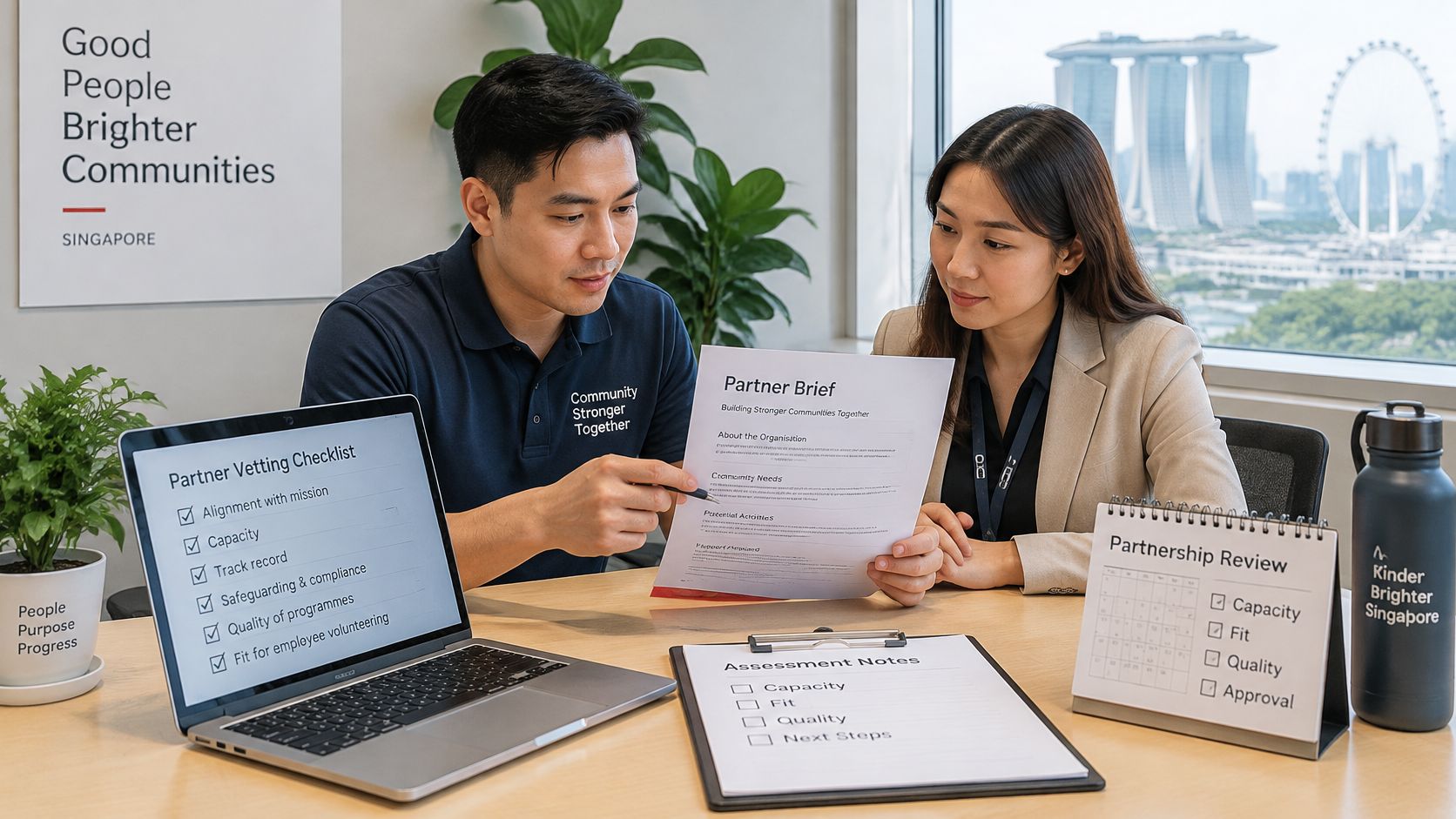
Structured collaboration with social-service agencies is the practical standard to aim for. Give the partner room to reject an unsuitable format, reduce your headcount or suggest a less visible but more useful task.
Volunteering formats, partners and fit
| Format | Typical partner | What volunteers do | Best fit |
|---|---|---|---|
| Packing and assembly | Eldercare or community charity | Pack care bags and sort donations | Large groups, low skill, short set-up |
| Befriending and conversation | Senior-care centre or community centre | Distribute lunch packs, talk and listen | Small groups that need a briefing on sensitivity |
| Environmental clean-up | Beach or park conservation group | Beach clean-up, litter pick, recycling sort | Teams comfortable outdoors, needs gear and a rain plan |
| Skills-based support | Non-profit with a specific need | Mentoring, admin help or digital skills | Smaller teams with a clear brief |
| Overseas community or conservation project | Partner in Bintan, Bali or Batam | Waste management and area improvement | Retreats that already include travel and leave planning |
Packing is comparatively easy to divide into roles, but storage and distribution still require agreement. Befriending needs fewer materials but more sensitive preparation. Skills-based volunteering can be useful without a large event, provided the charity can maintain whatever employees create.
In our Project CARES, corporate volunteers begin by packing essential care bags for seniors. Community sessions may then include lunch-pack distribution, casual conversation and listening to seniors' stories, combining a practical task with personal connection.
Our Bag of Love CSR programme overview offers another format to consider when assessing community-support activities.
A group visit is useful only when the partner receives more value than the coordination effort it takes to host it.
Before confirming, request a one-page partner brief covering the task, beneficiary needs, staffing, limits and completion criteria. If the brief is vague, resolve it before asking employees to register.
Logistics, Leave and Budget to Arrange
Volunteering programmes stall more often at the approval stage than at sign-up. Employees register interest, then wait while a manager works out whether the department can spare them and whether the day counts as paid volunteer leave, approved working hours or personal time. Until HR records the answer and managers confirm cover, every registration stays provisional.
Use the following as a working checklist. The lead times are recommended planning allowances, not statutory requirements.
Volunteering logistics checklist
| Item | What to arrange | Owner | Lead time |
|---|---|---|---|
| Volunteer leave | Paid volunteer leave or approved working hours, with a sign-up deadline | HR | 4 weeks before |
| Manager approval | Confirm department cover for the day | Department managers | 3 weeks before |
| Transport | Coach, MRT or walking route, with an accessible vehicle where beneficiaries need it | Event coordinator | 3 weeks before |
| Meals | Volunteer lunch and any beneficiary lunch packs agreed with the partner | Event coordinator | 2 weeks before |
| Insurance and safety | Check cover for off-site volunteering, first-aid kit and safety briefing | HR and partner | 2 weeks before |
| Materials | Bags, sorting gear, gloves and packing supplies | Partner or coordinator | 1 week before |
| Consent and media | Photo consent and handling of beneficiary information | HR and partner | 2 weeks before |
| Contingency | Rain plan, backup indoor space and minimum headcount | Lead organiser | Day before |
The day-before entry on contingency is the final activation check; the plan itself should be drafted at booking. Walking a team to a nearby community centre takes little coordination, while a coach with multiple pick-up points or accessible transport needs a confirmed route and buffer time in the schedule.
Compare the complete cost
Ask each provider for separate lines covering staff time, transport, meals, materials, facilitation and contingency. Compare quotations only where headcount, duration and inclusions match, and pin down who absorbs the cost of unused materials or late cancellations.
Accommodation deserves its own budget line whenever a programme involves overnight stays, with room rates taken from current hotel quotations rather than assumed figures. Rates vary by property, season and negotiated terms, so the only reliable number is the one on the quote in front of you. Apply the same discipline to transfers, meeting-room hire and any meals outside the volunteering block.
For an end-to-end Singapore programme, put one itinerary owner in charge of the full day, from hotel departure through volunteering, meal service and the return to business sessions. Leave realistic transition time for changing clothes, washing up and delayed boarding.
A concise joining email prevents most day-of confusion. Include the approval route, meeting point, clothing, dietary deadline and emergency contact; guidance on writing clear emails for volunteer groups covers how to structure those instructions.
Go/no-go rule: If transport or insurance remains unconfirmed two weeks out, move the date rather than rush the arrangements.
Measuring Whether the Programme Works
Headcount alone is incomplete. It tells HR who attended, but not how much they contributed, whether registrations became attendance or whether the programme can survive a change of organiser.
MCCY's volunteerism and philanthropy publications report that the 2021 corporate-giving framework classified 67% of companies as making direct investment contributions, including volunteering, cash and in-kind donations, while 43% had institutionalised mechanisms such as paid volunteer leave or payroll deductions. The same publications report that 60% of volunteers in the 2025 National Giving Study used formal channels, and employees with volunteer leave tended to volunteer more frequently.
Five metrics for a volunteering programme
Separate reach, intensity and institutionalisation rather than combining them into a single success score. The worked examples below are hypothetical calculations, not national benchmarks.
| Metric | How to calculate | What it tells you | Worked example |
|---|---|---|---|
| Reach | Participating employees divided by eligible employees, times 100 | Whether volunteering spreads across the company | 40 ÷ 200 × 100 = 20% |
| Intensity | Volunteer hours divided by participants | How much time each person gives | 120 hours ÷ 40 participants = 3 hours |
| Conversion | Attendees divided by registrations, times 100 | Whether sign-ups turn into attendance | 40 ÷ 50 × 100 = 80% |
| Repeat participation | Employees joining two or more sessions in a year | Whether volunteering is becoming a habit | 12 of 40 participants is 30% |
| Institutionalisation | Recurring policy, budget or annual target in place | Whether the programme survives staff changes | Paid volunteer leave adopted and budgeted: yes or no |
Keep registrations and attendance separate, and count unique employees when calculating reach. Record leave usage alongside participation so HR can distinguish low demand from an approval bottleneck.
Use a short pre- and post-session pulse on cross-team contact, perceived collaboration and sense of purpose. Compare responses against the baseline, but don't claim a single day caused long-term engagement gains.
Ekipa's retrospective techniques for agile teams offer a useful structure for turning feedback into named actions. Ask the partner what was useful and what created extra work, not just whether employees enjoyed themselves.
Review reach and conversion quarterly. Assess policy, budget and recurring commitments annually.
Adapting Volunteering for SMEs and Small Teams
Only 13% of micro-businesses had undertaken corporate volunteering, compared with 60–65% of large companies, according to the Singapore Business Federation/KPMG Corporate Volunteering Study 2025, which recorded 40% participation overall. The study also found 95% had implemented a social-sustainability initiative, while companies typically contributed about 40 volunteer hours annually, with some large organisations exceeding 1,000 hours.
That contrast points towards execution and capacity constraints rather than awareness alone. A small business needs a starter kit, not a full kitchen.
A minimum viable volunteering model
- Start with a half-day per quarter. Treat this as a proposed operating rhythm, not an obligation to fill the calendar.
- Rotate a manageable group. Six to ten volunteers can be a useful planning scenario where staffing permits. If you want each person to participate only once annually, check that your workforce can support that rotation; a very small firm should reduce frequency instead.
- Use a partner-run session. Let the organisation define the task and provide the operating instructions rather than designing a bespoke event from scratch.
- Decide the time arrangement in writing. State whether participation is paid or personal, and don't let managers give inconsistent answers.
- Keep reporting light. Record participants, hours and a feedback question about usefulness.
A small firm can offer continuity through a modest recurring task rather than competing with a large employer's annual hours. Nearby activities also reduce the amount of staff time spent travelling.
Small doesn't mean informal on safety. Insurance checks, photo consent and a named lead still apply, even when everyone knows each other.
Outbound Volunteering on Overseas Retreats
Compare an overseas retreat with a Singapore programme on full delivered cost, not room rate alone. The Business Times' Singapore hotel market report recorded a Q2 2025 average room rate of S$263.83, down 1.1% from S$266.89 a year earlier, with 77.76% average occupancy.
Use matching quotation columns for rooms, airport or ferry transfers, meals, meeting facilities, activities, volunteering-partner fees and contingency support. Then follow this sequence:
- Confirm the destination partner. For Bintan, Bali or Batam, obtain a written brief covering headcount, dates, useful work and safeguarding.
- Protect the business agenda. Place the volunteering activity in a half-day slot with enough time for transfers and preparation.
- Check the whole journey. Confirm leave, travel insurance and group transfers before fixing the date.
- Compare like for like. Request two all-in quotations using identical headcount, nights and inclusions.
Our overseas retreat planning arm can quote on that same basis. For a conservation-led option, consider the Batam CSR retreat format, while checking the partner's current work requirements before shaping the itinerary.
An overseas volunteering block should add community value, not merely provide a themed excursion between meetings.
Confirm Your Partner and Book the First Volunteer Day
A first volunteer day succeeds or stalls on operations: whether leave is approved before registration opens, whether the partner has agreed the work in writing, and whether anyone records what happened. A modest date that repeats will do more for a programme than an ambitious one-off.
Shortlist two or three partners and send each the same brief: headcount, date window, budget range, accessibility needs and safeguarding questions. Comparable answers make the decision clearer than contrasting polished brochures. Confirm the partner's capacity before announcing the date internally, because a team that arrives to find no planned work learns the wrong lesson about volunteering.
A provider-led route
At One Dynamics, Project CARES is a National Day-inspired CSR initiative connecting corporate teams with seniors in Singapore's communities. Volunteers begin by packing care bags, then join community sessions where they may distribute lunch packs, talk with seniors and hear their stories.
Our CSR Giving Initiatives take place at community centres or local neighbourhoods, running half-day to full-day, with outcomes in social responsibility, empathy and collaboration. Partnerships with charities and non-profits support activities including Bags Of Love, Senior Beach Clean Up and community outreach programmes.
We also combine team bonding with socially responsible initiatives for companies that want employee connection and community contribution in one programme. Keep the two objectives distinct. A bonding agenda that crowds out the community work leaves the partner under-served and gives staff nothing durable to report back.
Before committing, request these practical documents:
- Partner brief: the agreed task, beneficiary requirements and capacity limits.
- Leave summary: the approved time arrangement and manager responsibilities.
- Post-event report: attendance, hours, partner feedback and follow-up actions.
I recommend booking the first date at least four weeks ahead, with the approval route settled before registration opens.
One Dynamics offers customised CSR and team-bonding programmes in Singapore, alongside overseas retreat planning for corporate groups. Visit One Dynamics with your headcount, preferred dates, team objective and budget to discuss a volunteering programme or an end-to-end arrangement covering hotel stays, transport, activities and meals.