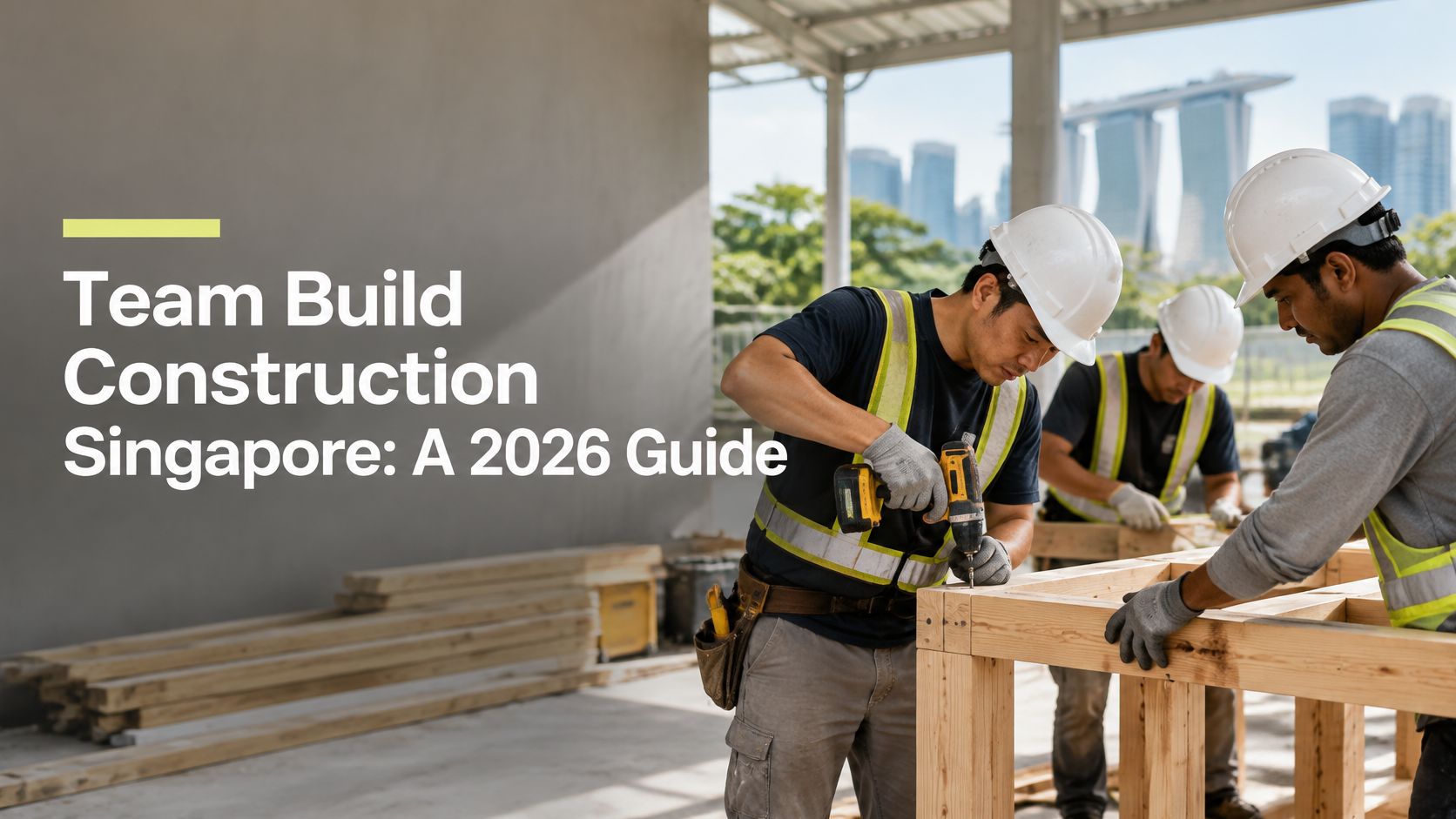
Team Build Construction Singapore: A 2026 Guide
Your planning retreat is four weeks out and the budget slide is due on Friday. Sixty people are attending: site engineers, quantity surveyors, a contracts team, two project managers and a cluster of office staff who've never worn a hard hat. Half of them have already sat through a rope course, a cooking class and a personality quiz. Your project director doesn't want another bonding day. He wants the thing that keeps costing him money fixed: handoffs between trades slip, and a floor sits idle while one crew waits on another.
Those two problems can be solved by the same event, but only if the event is designed like a site operation rather than a party. That means defined roles, a fixed brief, measured rounds and a debrief that names the behaviours you want to see on the next project.
Singapore employers already buy that logic. SkillsFuture Singapore reported that participating employers doubled from 12,000 in 2015 to 24,000 in 2024, and the number of employees supported by their employers for training rose from 160,000 to 241,000 over the same period, according to the SkillsFuture Singapore decade review. HR teams in construction now procure a facilitated session the way they procure training: with an objective, a facilitator brief and some evidence it landed.
Table of Contents
- What a Construction Team Challenge Involves
- Construction Challenge Formats Compared
- Skills That Carry from the Challenge to the Site
- Designing Challenges for Mixed-Age and Mixed-Ability Teams
- Safety and Weather Controls for Outdoor Builds
- How to Run a Build Challenge from Briefing to Debrief
- Plan Your Singapore Build Challenge End to End
What a Construction Team Challenge Involves
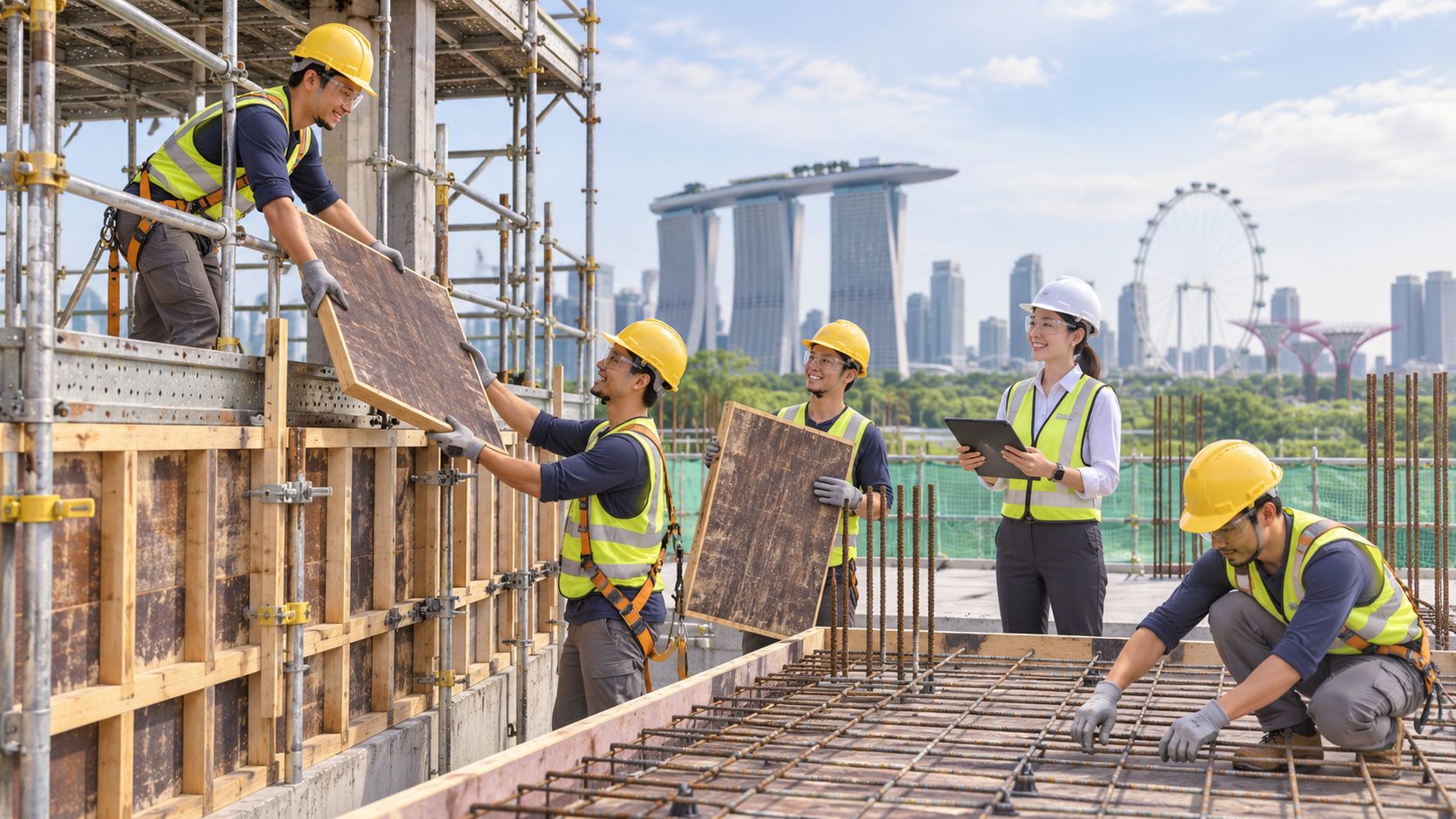
Picture a floor plate on a Singapore site. The formwork crew can't strike until the steel fixer has finished. The steel fixer can't start until the surveyor has set out. The supervisor signs off the inspection before the pour. Miss the sequence and the whole floor waits a day.
A team build construction Singapore programme copies that dependency and removes the risk. Participants take roles such as planner, builder, inspector and runner, then deliver a structure, a plan or a safety check together under time and material limits.
Every format runs the same loop, and the loop is what makes it teachable:
- Brief the objective, the roles and the safety rules.
- Build in timed rounds, with the clock visible to everyone.
- Observe handoffs, waiting time and errors rather than personality.
- Score against a fixed card, not against who finished first.
- Debrief what carried over to daily work and who owns the follow-up.
Formats run from a half-day indoor session to an outdoor event on Sentosa or at Marina Bay, and on to an overseas retreat. Judge all of them on whether the lessons transfer to site, not on whether the afternoon was fun. Singapore's training culture supports the framing: a SkillsFuture survey conducted between September 2016 and January 2017, covering 1,587 employers and 9,416 individuals, found that 96.7% of employers said the skills learned were applied at work (SkillsFuture Singapore annual report). If you're kitting the group out with event kit, a guide to team event merchandise covers what's worth printing and what ends up in a drawer.
Construction Challenge Formats Compared
Scan the table for the skill your teams keep missing, then use the paragraphs underneath for the trade-offs.
| Format | What Teams Do | Skills Tested | Best Fit |
|---|---|---|---|
| Block tower build | Stack a fixed set of materials to a drawn plan within a time limit | Planning, division of labour, pacing | Newly formed teams |
| Blueprint relay | Pass drawings and instructions between stations, with one person building from the plan | Clear handoffs, accuracy of information | Teams with designers and site staff |
| Site hazard hunt | Walk a mock site, identify and report hazards before each task | Observation, safety communication | Safety-led or HR-led programmes |
| Structure under constraints | Build a load-bearing structure with limited materials and a fixed budget | Trade-offs, budgeting, constraint management | Project and procurement teams |
| Urban development game | Acquire and develop properties on a city map, negotiating and allocating resources | Negotiation, strategy, resource allocation | Cross-department teams that must trade resources |
Matching the Format to the Gap
Pick from the gap, not from the most exciting photo on a supplier's page. A team that loses information between design and site suits a blueprint relay, because the failure repeats in front of everyone within twenty minutes and nobody can blame the drawing register.
A newly formed team does better starting with a block tower build. It's simple enough that every person can hold a job in round one, so the quiet estimator and the loud site manager both contribute. Project and procurement teams get the most from a structure built under material and budget constraints: give each team a fixed budget, a supplier list with prices and a load test at the end, then let them argue about whether to spend on stronger columns or an extra pair of hands.
The rule we use: choose the format that recreates the failure you already have on site, then adjust for group size, space and physical demand.
What a Real Programme Looks Like
Named formats make the choice concrete. Corporate Sailing runs on the waters of Marina Bay with experienced skippers, and teams learn navigation, communication and teamwork while a boat that isn't crewed properly doesn't sail well. The Tycoon Challenge puts teams on a city map to negotiate and allocate resources across properties, which suits cross-department groups that compete for the same crane time. Outdoor scavenger hunts run across Sentosa's landmarks and beaches, and they work when you want movement and conversation rather than a table.
Indoor builds have their own slot. Our Bricks Master Lego team building programme uses interlocking bricks so a team must plan, divide the work and reconcile four different instruction sets before the timer runs out, which is a closer match to a coordination problem than most outdoor games.
Four questions settle the final choice. Group size decides how many facilitators you need. Space decides whether you can run a hazard hunt or only a table build. Physical demand decides who can take part fully. Venue type decides whether you're indoors, on Sentosa, at Marina Bay or on a ferry to Bintan.
Skills That Carry from the Challenge to the Site
Round two is where the useful evidence appears. In round one, teams are still learning the rules; by round two, the fixed scorecard shows whether anyone changed how they ask, check and hand over work. Speed alone is a weak judge, because a fast build with a wrong joint would fail on site. The better question is simpler: which behaviour from the exercise would raise output or prevent a stop-work call next week.
Five Skills and the Behaviour That Proves Them
- Communication across handoffs. The clearest sign is someone asking for a dimension to be confirmed before anything is cut, rather than assuming and correcting later.
- Sequencing and cycle time. Watch who waits on whom. In a strong second round the waiting time drops because the team agrees the order before the whistle.
- Constraint management. Limited materials force a trade-off conversation. Note who argues for extra stock and who argues for a simpler design that can be finished.
- Trust and speaking up. A junior stopping the build because a joint looks wrong is the behaviour that prevents rework and, on a live site, injury.
- Leadership under pressure. The useful sign is quieter than volume: who restates the plan when the clock runs low and who reassigns people without being asked.
How the Sector Measures the Same Thing
Construction already has a productivity measure you can borrow. BCA defines site productivity as total constructed floor area in square metres divided by total site-worker mandays (BCA productivity measurement guide). Every hour a crew stands idle waiting for information shows up in that number, which is exactly what a poorly sequenced build round produces.
Off-site assembly makes the same dependency easier to explain. A component made away from the worksite only fits if designers, fabricators, logistics teams and site supervisors hand over exact dimensions, tolerances and timing. That is the same relay the table measures, compressed into a shorter game with fewer places to hide a bad handoff.
| Metric | How to Score | Observable Sign |
|---|---|---|
| Cycle time | Minutes from brief to final check, per round | Waiting time logged between handoffs |
| Specification accuracy | Share of the build matching the plan | Team confirms a dimension before cutting |
| Defect rate | Defects per build caught at inspection | Inspector flags errors before handover |
| Safe completion | Pass or fail on controls and stop-work calls | Stop-work called and respected |
Show the card to every team before round one. Scores revealed between rounds change behaviour in round two, which is the reason to run more than one round at all.
Then give the results somewhere to land. Fifteen minutes in the next project meeting, two behaviours the team wants to keep and one it wants to drop, and the event stops being a day out.
Designing Challenges for Mixed-Age and Mixed-Ability Teams
A Singapore project team rarely arrives with matching fitness, confidence or communication styles. A graduate engineer may prefer fast, hands-on tasks, while a senior contracts manager adds more value through sequencing, drawings and risk checks. Engagement and stress levels can also vary across age groups, so a format designed around one “average” participant leaves useful capability unused.
A well-designed challenge works like a real site crew: physical labour is only one station. Planning, information control, inspection and timekeeping carry equal weight. The fixed scorecard should settle the result. A team that checks dimensions, hands over cleanly and respects stop-work calls has learned behaviours that transfer to site productivity and safety, even when another team finishes sooner.
Roles That Keep Everyone in the Game
Start with the work, then match people to responsibilities. Give every role a visible output, such as a checked drawing, an accurate materials count or a completed inspection, and rotate roles between rounds so physical ability does not decide status.
| Participant Situation | Suitable Role | Why It Keeps Them Involved |
|---|---|---|
| Older staff who prefer less physical activity | Site planner or quality checker | Uses experience and judgement without heavy handling |
| Employees who don't want to compete physically | Timekeeper or information controller | Central to the handoffs without physical demand |
| Pregnant employees | Blueprint designer or debrief lead | Seated, low-exertion role with a clear contribution |
| Employees with disabilities | Build-plan co-designer or observer with a scoring role | Participates through planning and analysis, with accessible stations confirmed in advance |
| Younger or stressed staff | Materials coordinator or runner with defined tasks | Bounded, clear tasks reduce pressure and build confidence |
An observer still needs authority. Let that person record handoff delays, confirm specification checks or feed evidence into the scorecard, rather than standing at the edge with nothing to influence.
Handling Access Needs Without Awkwardness
Collect preferences privately before the event through a short voluntary form offering practical choices: a seated role, lighter load, indoor station or quiet space. Then check the venue against those choices. Confirm step-free routes, the nearest shelter and the easiest way for someone to leave an activity without giving an explanation.
Treat access arrangements as ordinary logistics, in the same category as transport and equipment. A participant should never have to discuss a condition in front of teammates, and the programme should avoid turning a seated role into a public moment.
One Dynamics programmes can be customised around diverse abilities, backgrounds and communication styles, following the same principle behind this inclusive team building approach designed for full participation. The practical benefit reaches beyond accessibility: a role suited to a pregnant engineer can work equally well for a senior project director managing a knee injury.
A debrief order that works: observers speak first, then the quieter role holders, then the team leads. The people checking the work often saw more than the people directing it.
Safety and Weather Controls for Outdoor Builds
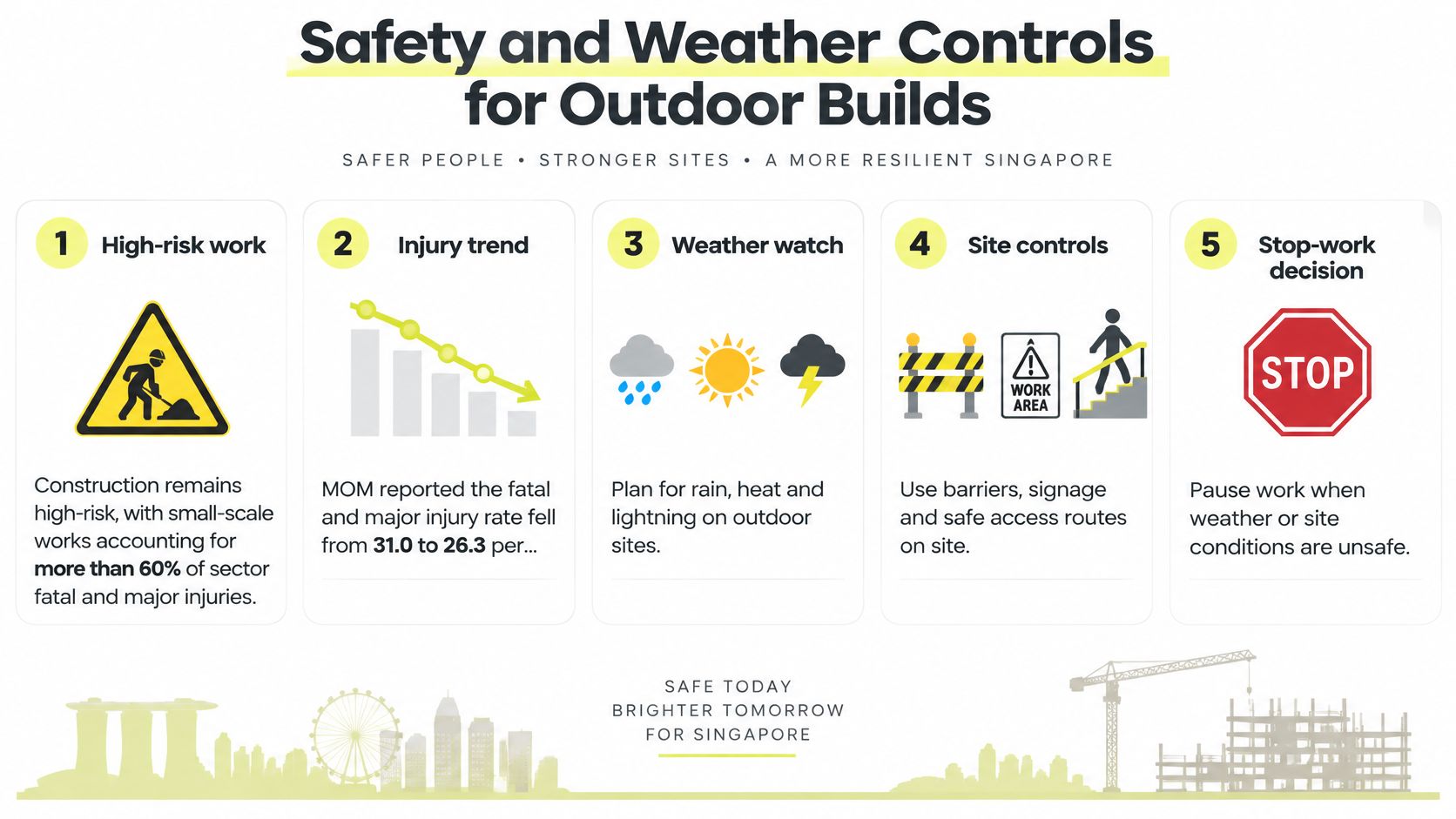
A build challenge borrows its risks from actual site work. Any activity that mimics site work needs site-level controls, because the injuries it imitates are real ones. The trend in Singapore construction is improving: fatal and major injuries fell from 31.0 per 100,000 workers in 2024 to 26.3 per 100,000 in 2025, per the Ministry of Manpower's workplace safety report. Smaller jobs still carry a disproportionate share of serious harm, and a team challenge sits at exactly that scale. Across all sectors, the MOM national workplace safety statistics recorded 22,710 injuries in 2025, up 2.5% on 2024, even as the fatal injury rate fell to a record-low 0.96 per 100,000 workers.
Before any outdoor build, confirm six things in writing:
- A documented risk assessment for the specific venue, not a generic template.
- Competent facilitators with first-aid cover and a named person in charge.
- Equipment inspection before each round, logged.
- Marked activity zones with barriers and safe access routes.
- Emergency procedures briefed to every team and repeated back.
- A medical-limitations form that asks whether a restriction exists, not what it is.
Singapore-specific hazards each get their own line: heat and hydration, lightning, uneven terrain, water activities and manual handling. The first two catch organisers out most often. Equatorial heat builds faster than participants expect, and afternoon lightning can arrive on a day that looked clear at setup, so forecasts need monitoring right through the event rather than once in the morning.
Then fold safety into the scorecard itself. A build challenge judged only on finishing time teaches teams to cut corners, so award points for hazard identification before the first block moves and apply penalties or an automatic stop for unsafe shortcuts. A slower team that ran clean handoffs and flagged a wobbling stack should outscore a fast team that muscled through it, because that is the behaviour you want transferred back to site.
Finally, ask the weather question and put the answer in the contract. If you are issuing branded PPE for the day, check ANSI-compliant branded hard hat options before printing for the full group, since compliance matters more than the logo. On contingency, we provide a 100% Weather Assurance guarantee on outdoor programmes in Singapore, with alternative indoor venues or rescheduling built in, and the reasoning behind weather-proof team building as a smarter investment is worth reading before you sign anything.
How to Run a Build Challenge from Briefing to Debrief
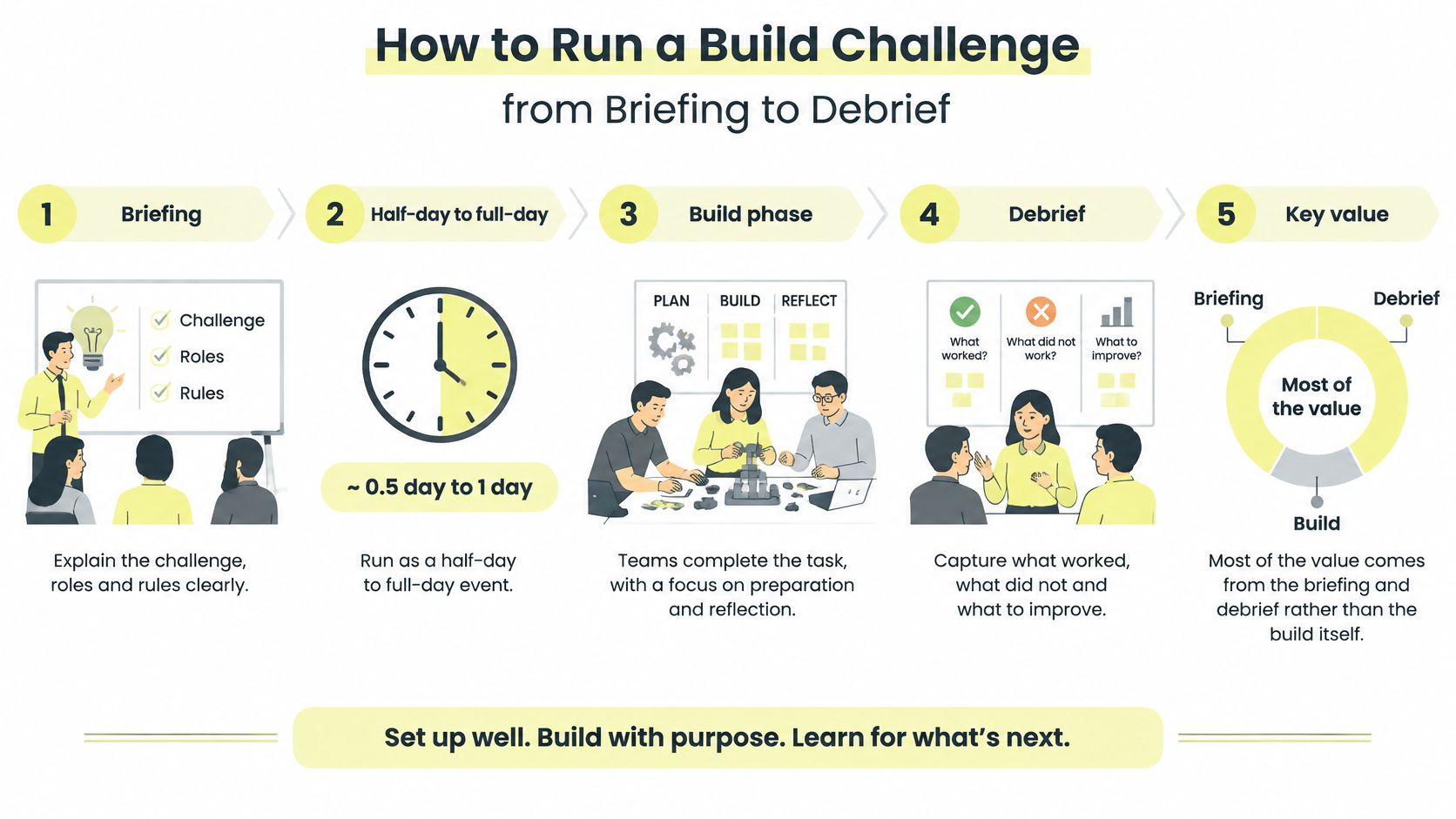
A well-run challenge takes about half a day to a full day. Most of the value sits in the briefing and the debrief, not in the twenty minutes when everyone is stacking material.
Seven Steps from Briefing to Debrief
- Set one measurable objective with the sponsor. Fewer handoff errors is a usable objective; better teamwork isn't. Three objectives on one brief means the debrief question can't cover any of them properly.
- Mix the teams by function and seniority. Put a designer, a site person, a quantity surveyor and a coordinator in each group so the handoff problem appears on its own. The common slip is letting the most confident person claim the planner's role in every team, which flattens the exact behaviour you're trying to see.
- Brief the safety rules before anyone touches material. Walk the zone, explain who can call a stop and how, and check that each team can repeat it back. It mirrors a pre-task briefing on site and costs four minutes.
- Run rounds with a timekeeper and an observer in every team. The timekeeper calls the clock; the observer logs handoffs, waiting time and errors on the card. A facilitator who tries to do both ends up coaching, which contaminates the result.
- Reveal scores after every round, not at the end. Teams change their planning when they see a defect count, and that change is the learning. Holding scores until the closing session turns the exercise into a competition.
- Debrief with three questions and let people answer in their own words. Where did information get lost? Who decided when the plan changed? What would you do differently on a real project next Monday?
- Assign follow-up to named owners with a date. "Site manager to trial a two-minute pre-pour handoff check for six weeks" beats "improve communication", and the owner should be confirmed in the room rather than by email afterwards.
The trade-off nobody warns you about: a tighter build is more exciting and teaches less. Leave slack in the timetable for the second round, because the improvement between rounds is where the lesson becomes visible.
The build itself should take the least time of the three phases. If the material comes out, the blocks go up and the debrief compresses to ten minutes at the end, you've bought entertainment with a hard hat on.
Plan Your Singapore Build Challenge End to End
Book nothing until five things are fixed: the objective, the headcount, the budget per head, the date window and the venue type. Each one changes the shortlist, and settling them in that order saves a week of quotations. Judge the objective by transfer, not applause: the useful measure is whether next Monday's pre-pour handoff, lift briefing or defect check gets cleaner.
Decisions to Settle Before You Call Anyone
- Objective. One sentence, agreed with the person paying. If the sponsor is the project director, the objective is usually coordination, rework or handoff discipline, and the scorecard should name that behaviour before any game is chosen.
- Headcount and mix. A fifty-person group with six subcontractor representatives behaves differently from fifty in-house staff, and the team composition should be planned rather than random.
- Budget. A per-head figure plus a contingency line for transport, venue and wet-weather alternatives. Sorting this after the proposal stage wastes everyone's time.
- Date window and weather. Two or three candidate dates, with an indoor fallback already identified.
- Venue type. Indoor, Sentosa or overseas, which decides travel time, supervision load and whether the day needs transport-inclusive options.
What Packages Cover and What They Cost
Customised indoor, outdoor and CSR programmes are the core offer, and the starting prices sit at $45 per participant for indoor programmes and $35 per participant for outdoor programmes. Custom quotations reflect group size, venue and programme requirements. Sentosa activities can be scaled and customised for groups from 20 participants to over 1,000, and food and beverage can be coordinated to complement the activity rather than booked as an afterthought.
| Programme | Starting Price | Notes |
|---|---|---|
| Indoor team challenge | from $45 per participant | Custom quote by group size and venue |
| Outdoor team challenge | from $35 per participant | Weather contingency confirmed in writing |
| Overseas retreat (Bintan) | Quoted per group and programme | End-to-end logistics, venue coordination and programme delivery |
For Bintan, the overseas work covers the parts that usually drain an operations lead: ferry scheduling, group check-in and transfer coordination at both ends, with venue coordination and programme delivery handled in the same plan. Ask early how much of the day is activity and how much is movement. A retreat that looks generous on paper can lose its learning time to queues, late boats and scattered arrivals.
Send a request that states group size, budget per head, the objective in one sentence and two or three preferred dates. Ask for the risk assessment and the weather contingency inside the written quotation, not explained on the day. A provider that plans properly answers both without hesitating, and that answer tells you more about the programme than any brochure. Also ask what the scorecard counts: handoffs, waiting time, defects, stop-work calls and whether teams changed their plan after seeing the first result.
One Dynamics has been designing and running corporate team-building in Singapore since 2010, with indoor builds, outdoor challenges on Sentosa and end-to-end Bintan retreats covering logistics, venue coordination and programme delivery. If you're building a construction-themed challenge for sixty people or six hundred, the programme can be written around a fixed scorecard, safety controls and a debrief that ties the rounds back to site habits. Visit One Dynamics with your dates and group size, and expect a programme, a quotation and the weather plan in writing.