Dragon Boat Singapore Team Building: A Planning Guide
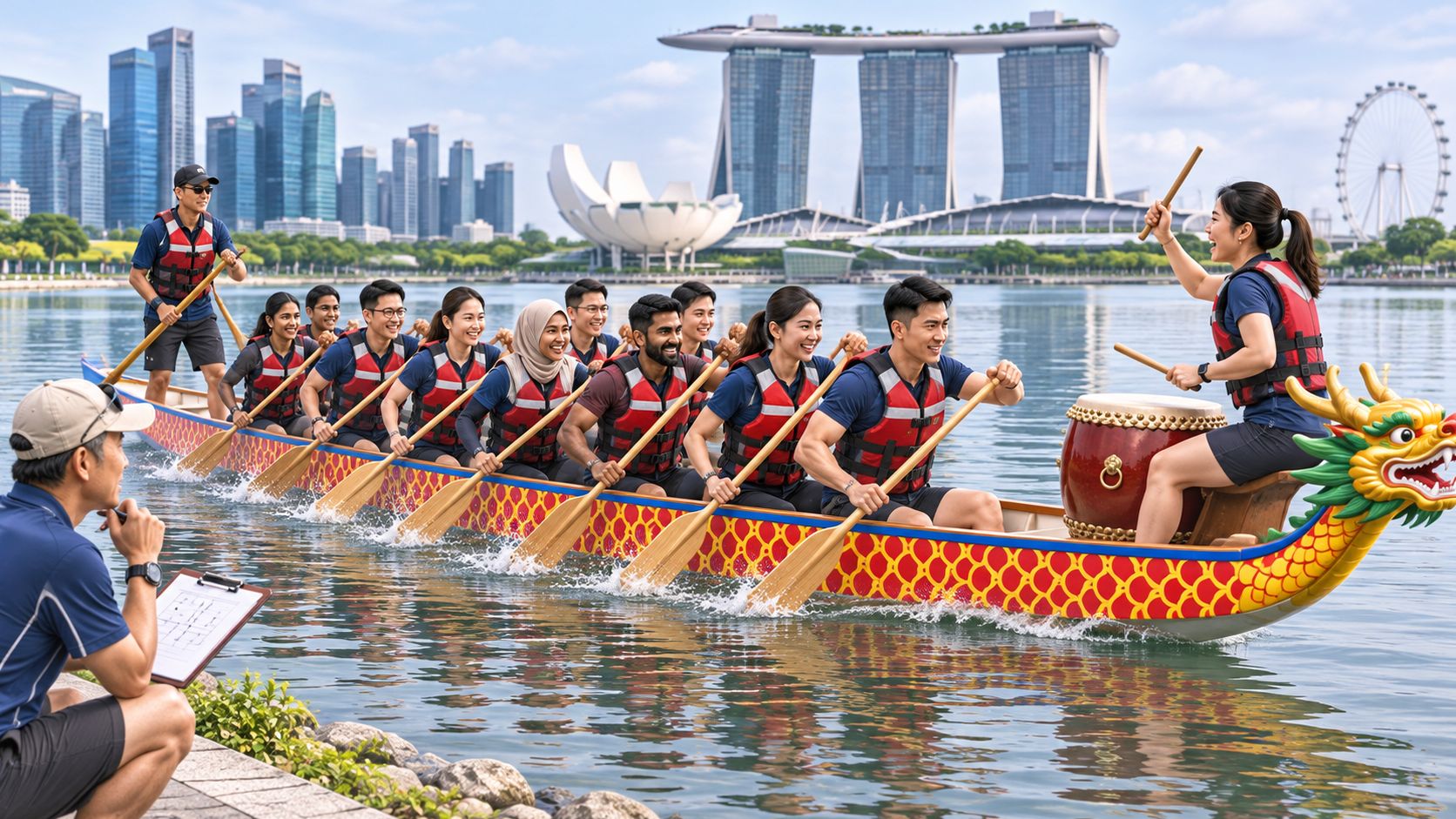
Three quotes land in your inbox for the same half-day dragon boat session. One prices per person, one prices per boat, and one is a single figure with no breakdown at all. None of them says how many trainers turn up, what happens when lightning stops the session at 9am, or what the colleague who can't swim is expected to do.
That gap between the sales page and the booking sheet is where corporate dragon boat programmes either work or waste a morning. The activity itself is simple. The planning around it isn't, and the details that decide the outcome are the ones suppliers mention last.
Pin down five things before you sign anything: crew format, trainer cover, inclusion, weather terms, and whether the session sits inside a full itinerary for people flying in.
Table of Contents
- Does Dragon Boating Suit Your Team
- Crew Formats That Fit Your Headcount
- Trainer Ratios and Safety Staffing for Corporate Groups
- Checking Whether Every Employee Can Take Part
- How to Plan a Dragon Boat Session Step by Step
- Weather Risk and Backup Plans for Outdoor Sessions
- Full Packages for Regional Meetings and Retreats
- Confirm Your Crew Format Before You Book
Does Dragon Boating Suit Your Team
Say you're the HR lead for a 40-person team that mostly communicates by email and has met in person twice since the last reorganisation. You want a session that builds working trust, not a lecture with a slide deck. A dragon boat gives the group one shared, measurable goal, which is the boat's speed and the race result, and the team sees the outcome in real time.
That matters more than it sounds. Gallup reported that 14% of employees in Singapore were engaged at work in 2025, while 71% were not engaged and 15% were actively disengaged, according to Gallup's country data for Singapore. A morning on the water won't fix that number. A format where a late call visibly costs the crew speed does something a town hall can't.
Singapore also has the structure to run it properly. The Singapore Dragon Boat Association was formed in 1987 to organise racing, develop athletes and set safety standards, and its crews are built around paddlers plus a drummer and a steersperson. Communication, rhythm and role clarity aren't soft extras in that setup. They're the mechanism.
Four skills get trained, whether or not anyone names them:
- Verbal signalling: the call that lifts or holds the rate, made loudly enough for the stern to hear it.
- Stroke timing: matching the pair in front rather than paddling at your own comfortable pace.
- Role hand-offs: reserves swapping in between heats without losing the rhythm.
- Recovery after a missed stroke: resetting together instead of everyone compensating individually.
What the boat does faster than a workshop: a dropped stroke slows the hull within seconds. Nobody needs a facilitator to explain that the crew was out of sync.
If you're weighing this against other formats, compare it with the wider set of outdoor team building activities for work on the one criterion that matters here, which is how quickly the group sees the consequence of its own coordination.
Dragon boating works best when coordination is the actual objective and when every employee can take part or has a meaningful alternative. The rest of this guide is about checking both before you commit a date.
Crew Formats That Fit Your Headcount
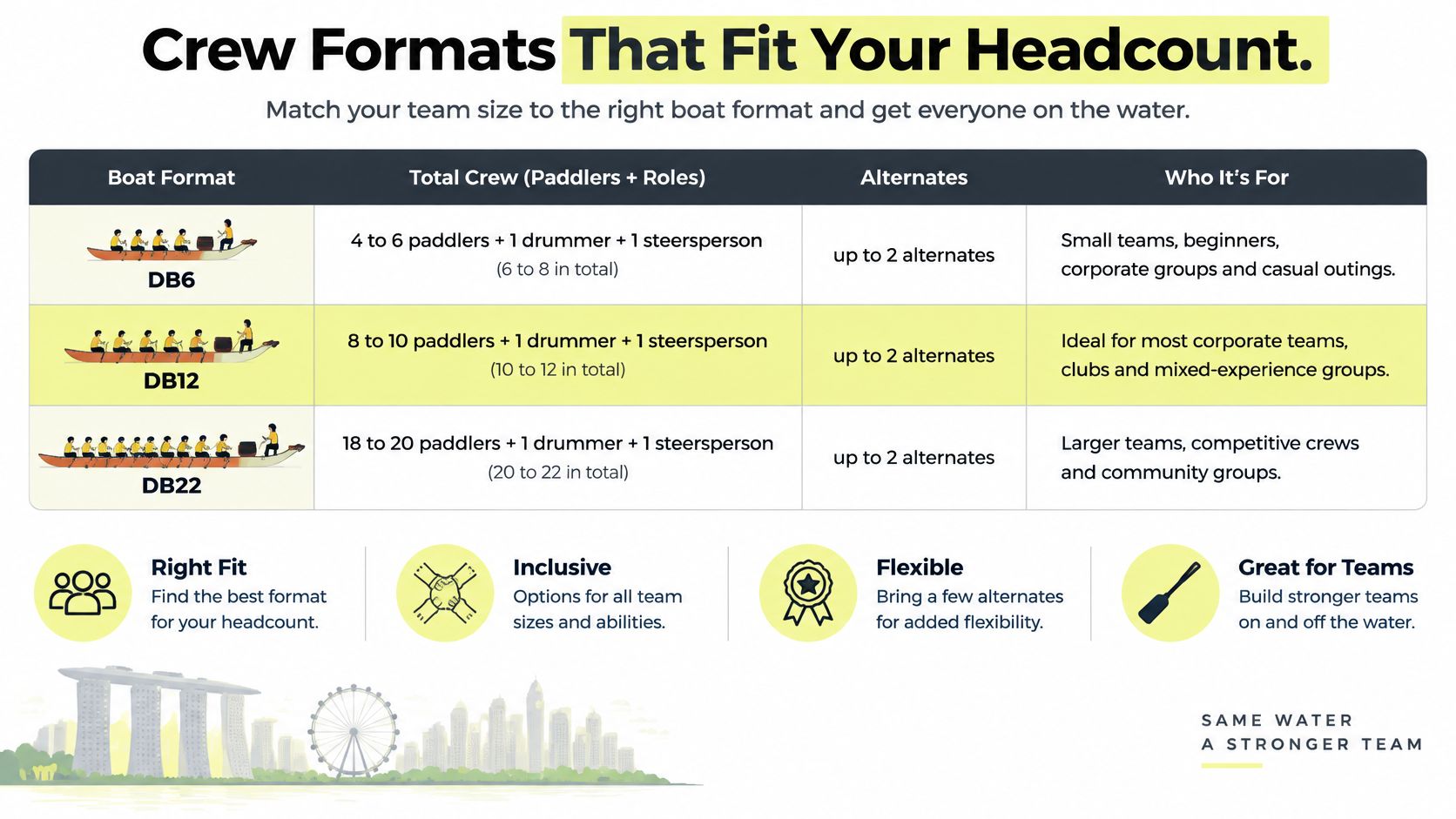
Start with the hull count, because it determines who paddles in each heat, how rotation works and how much trainer cover the session needs.
| Format | Crew composition | Reserves | Minimum operating crew | Best fit |
|---|---|---|---|---|
| DB12 | 8-10 paddlers + 1 drummer + 1 steersperson | Up to 2 | 10 | Mixed experience and first-timers |
| DB22 | 18-20 paddlers + 1 drummer + 1 steersperson | Up to 4 | 20 | Larger teams wanting a harder coordination test |
Those configurations come from Singapore's competition entry rules, which also require PFDs meeting ISO 12402-5 or an equivalent standard and recognise IDBF Type 202a paddles, as set out in the 2025 Pesta Sukan dragon boat entry rules. Worth asking about if a quote looks unusually cheap.
What changes between the two hulls
DB12 gives each person more paddle time per heat and forgives a wider range of fitness, which is why it suits mixed-experience groups and first-timers. DB22 puts more people into the same coordination problem. Stroke timing, balance and clean hand-offs become harder to sustain, so larger teams that want a genuine test should take the bigger hull.
Reserves are a participation tool, not a spectator bench. Rotate them between timed heats so everyone gets water time and nobody spends the morning holding a bag.
A 25-person team needs more than one DB12 rotation. A full DB12 carries 12 people on the water, with up to two reserves ready to swap in, so the other 11 employees must enter later heats or the group books a second boat.
A 40-person group has a real trade-off. Two DB12s put 24 people on the water at once and create direct racing, but the remaining employees still need planned rotation. One DB22 carries 22 people per heat with up to four reserves, leaving fewer people waiting but no head-to-head race unless a second hull is available. Extra hulls also increase the trainer and steering cover required, so compare formats on staffing cost rather than boat hire alone.
Score each crew on start discipline, sustained synchronisation and what they say in a two-minute post-race reflection. Finishing position is the least interesting number on the sheet, and the only one most groups record.
Confirm the format with the operator before you fix the headcount. Write the hull count, reserve rotation, staffing cover and shortened-session plan into the quote. If weather cuts water time, a group with clear heat priorities keeps its inclusion plan intact.
Trainer Ratios and Safety Staffing for Corporate Groups
The number that shapes every corporate booking is the trainer-to-participant ratio. The Singapore Dragon Boat Association specifies no more than one trainer for every 10 participants, under its safety measures for dragon boat orientation programmes.
| Group size | Minimum trainers at 1:10 | Steering cover to confirm |
|---|---|---|
| 10 participants | 1 | Trainer may steer a 12-crew boat |
| 20 participants | 2 | Bow trainer plus separate steersperson on a 22-crew boat |
| 40 participants | 4 | Four trainer-equivalents; add steering per boat |
| 100 participants | 10 | Split across several boats; confirm boat count with the operator |
Why the ratio changes the programme, not just the price
Boat size decides how the cover is arranged. On a 12-crew boat the trainer can double as steersperson. On a 22-crew boat you need a trainer at the bow and a separate steersperson at the stern to hold the ratio, which is a staffing difference the quote should show.
Work the arithmetic on a 40-person group and you get at least four trainer-equivalents, plus steering cover set by how many hulls are on the water. That's the floor, not the target.
The ratio earns its keep beyond compliance. Trainers handle boarding, paddling instruction, collision avoidance and emergency response, which is exactly the workload that stops a facilitator from watching how a crew talks to each other. Understaff a session and the coaching becomes queue management.
Every participant also needs a correctly sized personal flotation device, and trainers and the steersperson must monitor conditions and keep the group inside the agreed water boundary.
The budget question to settle early: if trainer cover isn't itemised, you're comparing a supervised session against an unsupervised one and calling it a price difference.
If cover isn't in the quote, ask what it costs to add before you compare providers on anything else. Carry that answer into the pre-booking checklist at the end of this guide.
Checking Whether Every Employee Can Take Part
Most booking conversations never reach the question that decides whether the programme is fair: can every employee take part safely?
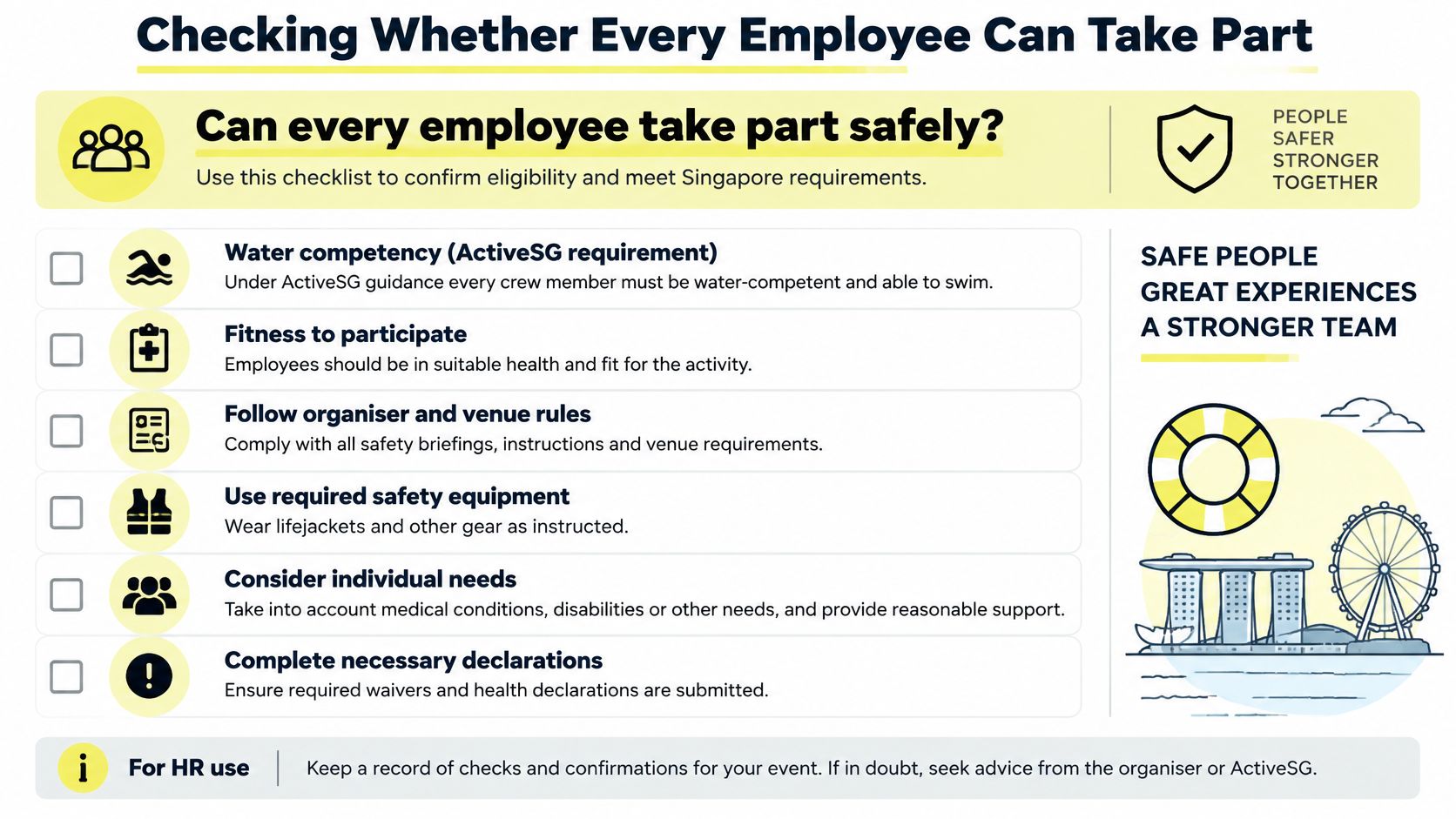
Singapore's rules are specific here. ActiveSG's safety regulations for traditional boat racing state that every crew member must be water-competent and able to swim at least 50 metres in wet clothes. The SDBA's 2025 orientation guidance goes further, requiring non-swimmers and weak swimmers to be identified and visibly marked.
That leaves an operational question nobody advertises an answer to. Is swimming ability mandatory for a non-racing team-building session? Whatever the answer is, it needs to be documented and sent to you in writing before a sign-up form goes out, not implied on a landing page.
Roles that keep everyone in the session
Plan for the people who won't paddle: pregnant employees, anyone with a recent injury, colleagues with mobility limitations, people anxious about open water, and staff who struggle in heat. A boat still needs a drummer, a steersperson working alongside a trainer, a timekeeper, a reflection facilitator and a scoring crew. Those roles are real work, not consolation prizes, and rotating them means nobody sits on the pontoon for two hours.
Handle the disclosure privately. A confidential pre-event declaration collects what the operator needs without asking anyone to explain a medical condition to their manager in a group chat.
For a group where paddling isn't realistic for a meaningful share of staff, run a facilitated indoor challenge alongside the boat sessions. Plan it with the same care as the main activity, since a parallel programme assembled on the morning is obvious to everyone in it. The principles behind inclusive team building that ensures 100% participation regardless of ability apply directly to a boat booking.
The inclusion standard to hold the operator to: nobody is excluded, and nobody is asked to explain why they aren't paddling.
How to Plan a Dragon Boat Session Step by Step
Eight steps, in order. Each one has a reason and a common slip that costs a morning.
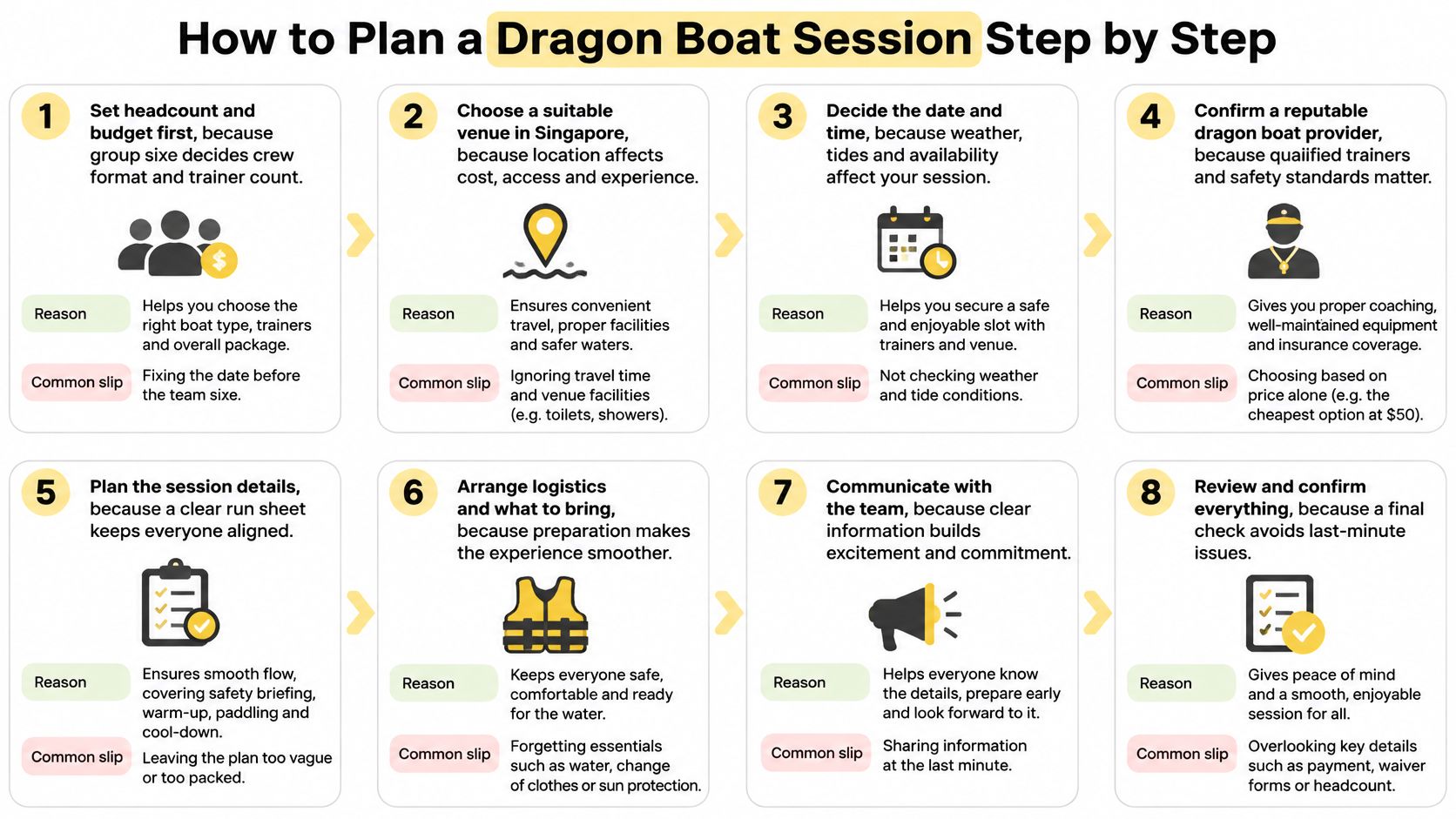
Set headcount and budget first. Group size decides crew format, trainer count and how many heats you run. The slip is fixing a date before the headcount is final, then discovering you've booked one hull for 26 people.
Choose DB12 or DB22 from the crew table. The format sets how many people paddle and how many trainers you need. The slip is assuming you can decide this later, when boat availability usually decides it for you.
Get trainer ratio, steering cover and PFD sizing confirmed in writing. These are the three items that separate a coached session from a supervised queue. The slip is assuming trainers are included because the word "coach" appeared on the page.
Run the confidential swim and health declaration, then assign non-paddling roles. This is how the session stays fair without anyone disclosing anything publicly. The slip is collecting medical details in a group chat where everyone can read them.
Agree the weather decision timeline, who has authority to stop, and a backup venue. A stop decision made at 7am is a plan. One made on the pontoon once the group is already changed is a scramble. The slip is leaving it to the morning.
Arrange transport, meals and any hotel block around the session slot. Boats run in fixed blocks, and a session that clashes with lunch means everyone eats cold. The slip is booking the activity before the coach times.
Brief all staff in advance, including that postponement is a safety decision. People accept a cancellation they expected. The slip is a briefing that covers only footwear and paddling.
Debrief after the race with three questions. Where did the call break down, who led the rhythm, and what would we change next time. The slip is skipping it and letting the morning become an anecdote instead of a lesson.
A session that lands leaves each crew with a short written debrief and a list of two or three coordination behaviours to try in the office the following week.
Weather Risk and Backup Plans for Outdoor Sessions
A rained-out morning costs far more than the activity fee. Add venue deposits, coach hire, catering, payroll time for 40 people and the airfare of anyone who flew in for the meeting, and the exposure becomes visible.
Most Singapore sessions run out of an open basin like this one, with no shade on the water and the weather fully in charge of the schedule.
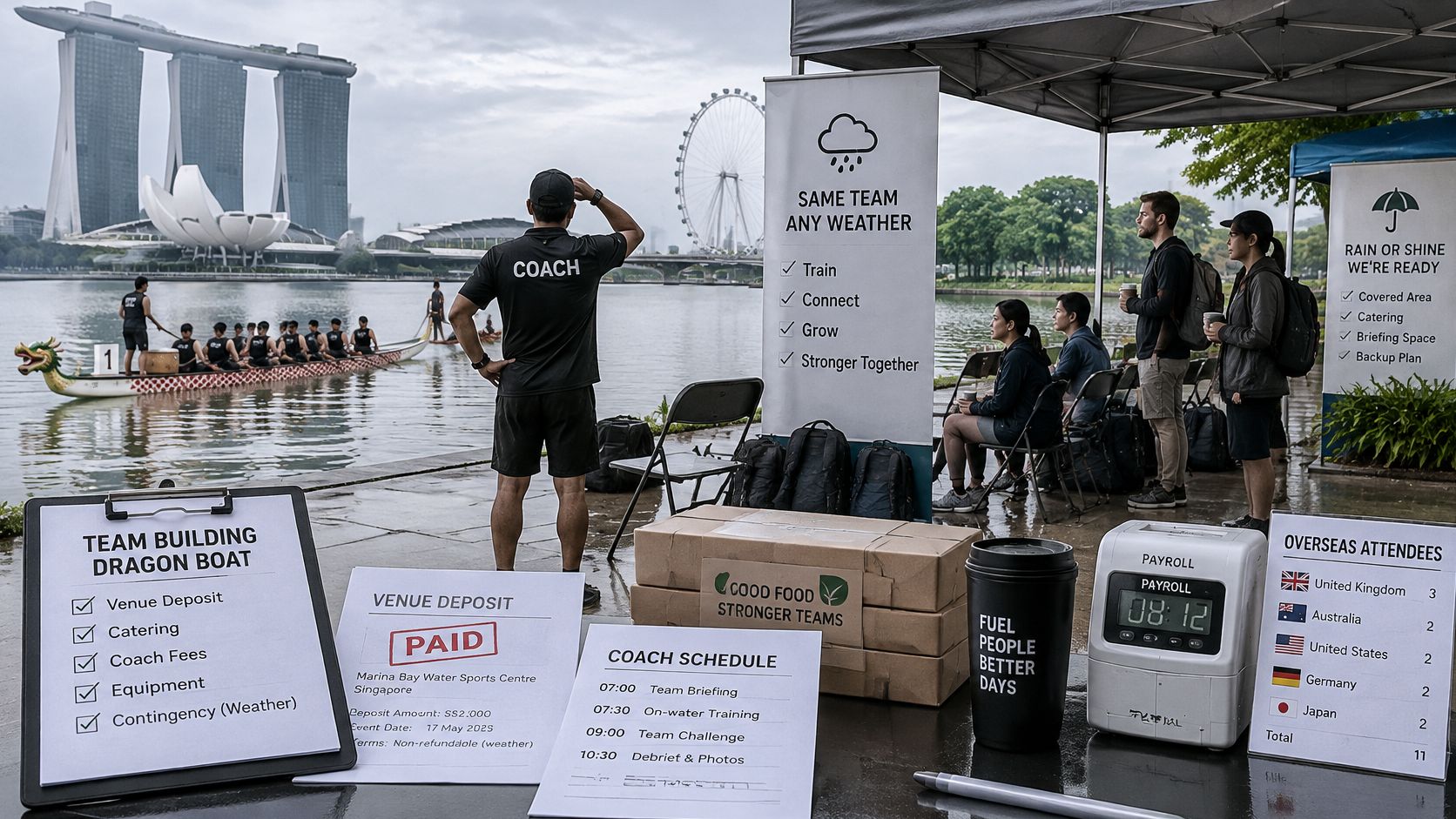
The rules reflect that. The Singapore Sports Council safe dragon boat guide requires organisers to monitor weather and water conditions and be prepared to postpone during extreme weather or rough water, and activities must stop when the inclement-weather siren is activated.
The four triggers that stop a session
Ordinary rain is not one of them. Lightning and heavy thundery showers are, and organisers can track both through NEA's myENV alerts and build programme buffers before issuing an all-clear. Unsafe water conditions are the third. Heat stress is the fourth, and the one most often ignored on a clear, still morning.
Name who holds final authority to suspend, and set a decision timeline, such as a stop call a fixed number of hours before the slot. Then tell participants what happens: waiting onsite, a rescheduled date, a transfer to an indoor module, or a partial refund.
| Plan | Weather exposure | Cost exposure if stopped | What it protects |
|---|---|---|---|
| Outdoor only | Full: stops under the siren | Transport, catering and staff time lost | The full dragon boat experience |
| Hybrid with indoor module | Low: indoor block runs if stopped | Modest extra planning and a second facilitator | Teamwork goal and attendance |
| Indoor-first with optional boat session | Minimal | Lowest, since the core programme is indoors | Safety and inclusion, with less physical reach |
The contrarian point: the best team-building plan often isn't a dragon boat-only itinerary. A weather-proof design with an indoor facilitation module protects attendance and the teamwork objective at the same time. That's why we run a 100% Weather Assurance guarantee on outdoor team building activities in Singapore, with alternative indoor venues or rescheduling built in rather than negotiated after the fact.
Ask any operator for its weather terms, notice periods and contingency venue in writing before signing. Then brief staff so a postponement reads as a safety decision, not as poor planning.
Full Packages for Regional Meetings and Retreats
A regional meeting gives you a narrow window to build connection around the business agenda. The bonding session has to fit the arrival time, meeting energy and dinner schedule. Treat it as a logistics brief first, then choose the activity.
Singapore hosted 156 international association meetings in 2025, an 8% increase on 2024, according to the Singapore Tourism Board. That demand puts pressure on coaches, venues and workable time slots, so build the programme around what can be delivered at your headcount.
The package components are familiar: a hotel room block, coach transfers between hotel and venue, a facilitated challenge, a group meal and a debrief room. The design work sits in the sequence. A short bonding session after a leadership meeting needs a different pace from a half-day challenge before dinner or a multi-day incentive. Put the facilitation, transfer and meal timings into one schedule before asking for quotes.
Accommodation needs to be locked early. Hotel rooms and group dining tend to book up around business-event peaks, and late room blocks can force a change of venue or transfer plan. For incentive travel, corporate business events account for roughly a quarter of Singapore's MICE sector, and incentive trips make up about half of that corporate segment, as The Straits Times reports on why global firms choose Singapore for incentive trips. That demand explains why hotels hold group space back for this kind of booking.
If you're building the retreat from scratch, this walkthrough of corporate retreat planning steps for 2026 gives a sensible order of work before approaching any venue.
For groups that want to leave Singapore, Bintan is the shortest step: a ferry, a resort and a programme that runs on site. The planning logic stays much the same. One Dynamics Team Building manages ferry scheduling, group check-in and transfer coordination at both ends of the Singapore to Bintan trip, and its programs include dragonboating, sailing, city-based races and thematic challenges. Groups comparing options further afield can look at overseas team building packages from Singapore built the same way.
A copyable three-part structure works for most regional meetings: arrival and hotel check-in on day one, an afternoon dragon boat session with a structured debrief, then a group dinner that evening. Confirm the crew format before the hotel block is signed, because boat capacity and trainer cover shape the timetable.
Confirm Your Crew Format Before You Book
The cheapest quote is rarely the cheapest session. A quote that omits steering cover or weather terms can cost more on the day than one priced higher with both written in, so compare line by line rather than on the headline figure. Take one checklist into every quote conversation:
- Headcount and crew format: DB12 or DB22, decided from the crew table rather than from availability.
- Pricing basis: per participant or per boat, since a half-filled hull is paid for twice.
- Trainer and steering cover: how many trainers, who steers each boat, and whether PFD sizing is included.
- Weather terms: the stop authority, the notice period and the contingency venue.
- Itinerary inclusions: transport and meals around the session, if the group is travelling.
On price, advertised starting rates are $45 per participant for indoor programmes and $35 per participant for outdoor programmes. Dragon boating is quoted within a custom arrangement that reflects group size, venue and requirements, so ask for a written figure at your real headcount rather than working from a website band. The same goes for trainer ratios: get the number of trainers and the steering arrangement stated in writing, because these two lines decide both the safety cover and the quality of the debrief.
Dragon boating also sits alongside formats that absorb a mixed group more easily, including laser clay shooting, sailing, city-based races and thematic challenges. Sentosa programmes can be scaled from groups of 20 to over 1,000 participants, so a headcount that strains one dragon boat format often fits comfortably in a land-based alternative on the same budget conversation. Weather cover matters here too: outdoor sessions carry alternative indoor venues or rescheduling options, and I would treat the exact wording of that fallback as a booking decision, not a footnote.
A dragon boat session gives a team something a workshop can't: a result everyone can feel within a stroke. One Dynamics runs dragon boat team building in Singapore alongside indoor, outdoor and Sentosa programmes, and can coordinate transport and F&B around the session. For groups that would rather travel, overseas programmes design Bintan and Asia retreats with logistics, venue coordination and programme delivery under one plan. Send your headcount, two or three preferred dates and the crew format you're considering through One Dynamics, and ask for a written quote that itemises trainer cover and weather terms so you can compare it line by line.