8 Fun Indoor Team Building Activities for Singapore Teams
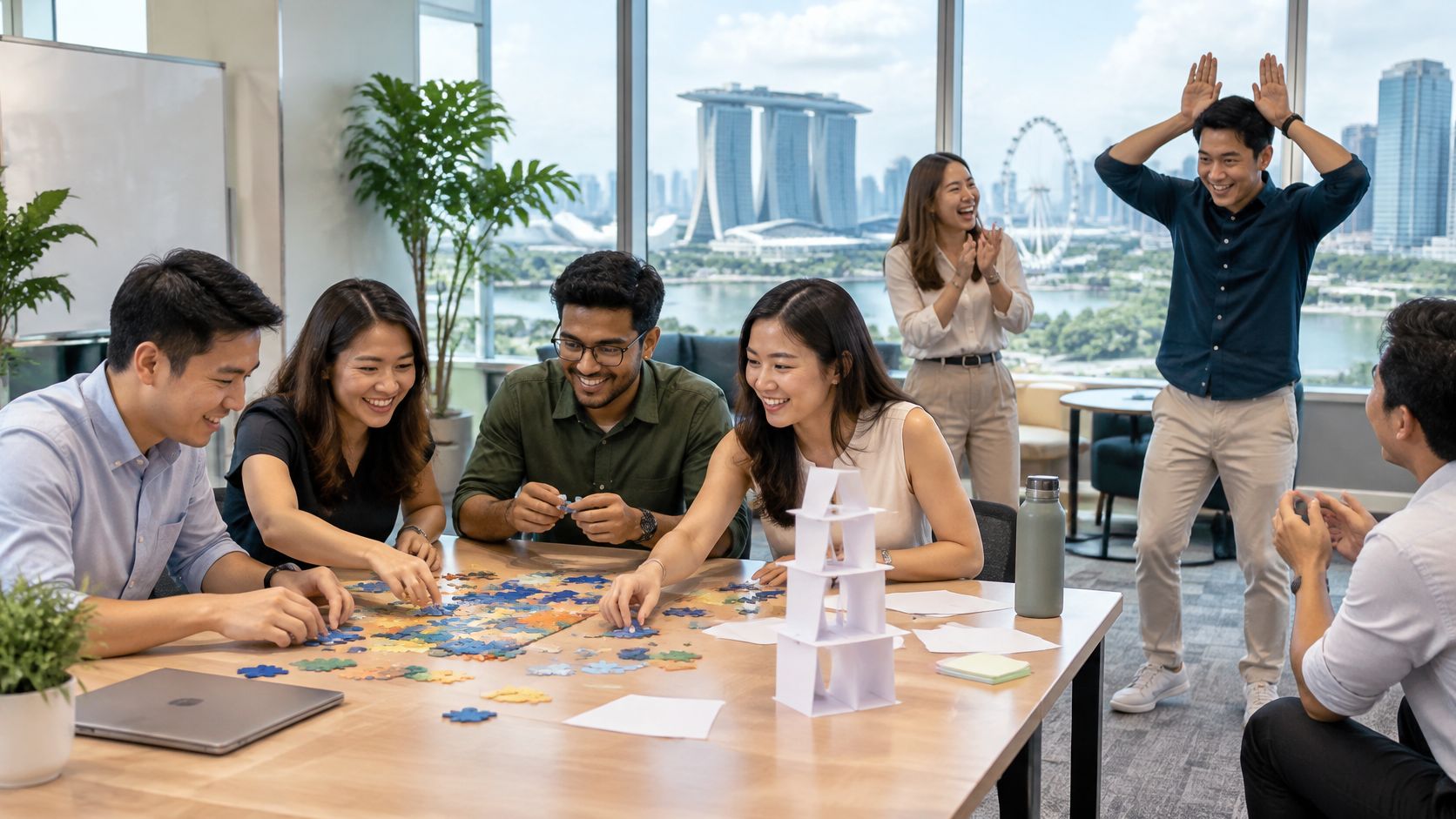
Two departments share a Singapore office floor for three years yet barely exchange a nod at the lift lobby. Tight project deadlines and unpredictable tropical downpours make an outdoor excursion feel risky, so HR books a hotel function room or large conference space for an afternoon of games. Without a clear diagnosis of what's broken, though, even the liveliest session ends with polite applause and the exact same office silos on Tuesday morning.
Low engagement isn't a rare edge case here. According to Gallup's Singapore Workplace Report 2026, only 14% of Singapore's workforce was engaged at work in 2025, trailing the 20% global average and the 25% Southeast Asian figure. That number has barely budged since 2019, holding at 13% through 2023 before ticking up to 14% in 2024 and 2025. Treating staff bonding as pure entertainment rarely shifts a pattern that stubborn.
The fun indoor team building activities below are judged by the exact workplace problem each one solves, whether that's silent departments, low morale, or messy cross-team coordination, alongside their honest trade-offs. If you're comparing broader office and social formats before locking in a corporate brief, the MyKaraoke Video guide to team activities offers additional context on how group formats differ. Matching the activity to your team's real bottleneck beats picking the flashiest game on a brochure every time.
Table of Contents
- 1. The Tycoon Challenge Business Simulation Trading Game
- 2. Running Man-Style Game Show Challenges
- 3. Laser Clay Shooting Team Competition
- 4. Kin Ball Team Sport
- 5. DISC Personality Profiling Workshop
- 6. Indoor Escape Room Team Challenge
- 7. Indoor Team Culinary Challenge
- 8. Indoor CSR Planning Workshop for Community Impact
- How the eight indoor team building activities compare at a glance
- Choosing the Right Indoor Activity and Booking It With Confidence
1. The Tycoon Challenge Business Simulation Trading Game
Silent friction between departments rarely shows up during polite town halls, yet it stalls projects every week. The Tycoon Challenge solves unclear coordination and short-sighted decision-making by placing colleagues inside a facilitated trading and business simulation. Teams run virtual enterprises, making buying, selling, pricing, and resource calls under strict time pressure while deciding when to compete and when to cooperate.
To see how game mechanics translate into everyday commercial skills, review the comparison below before mapping out your session goals.
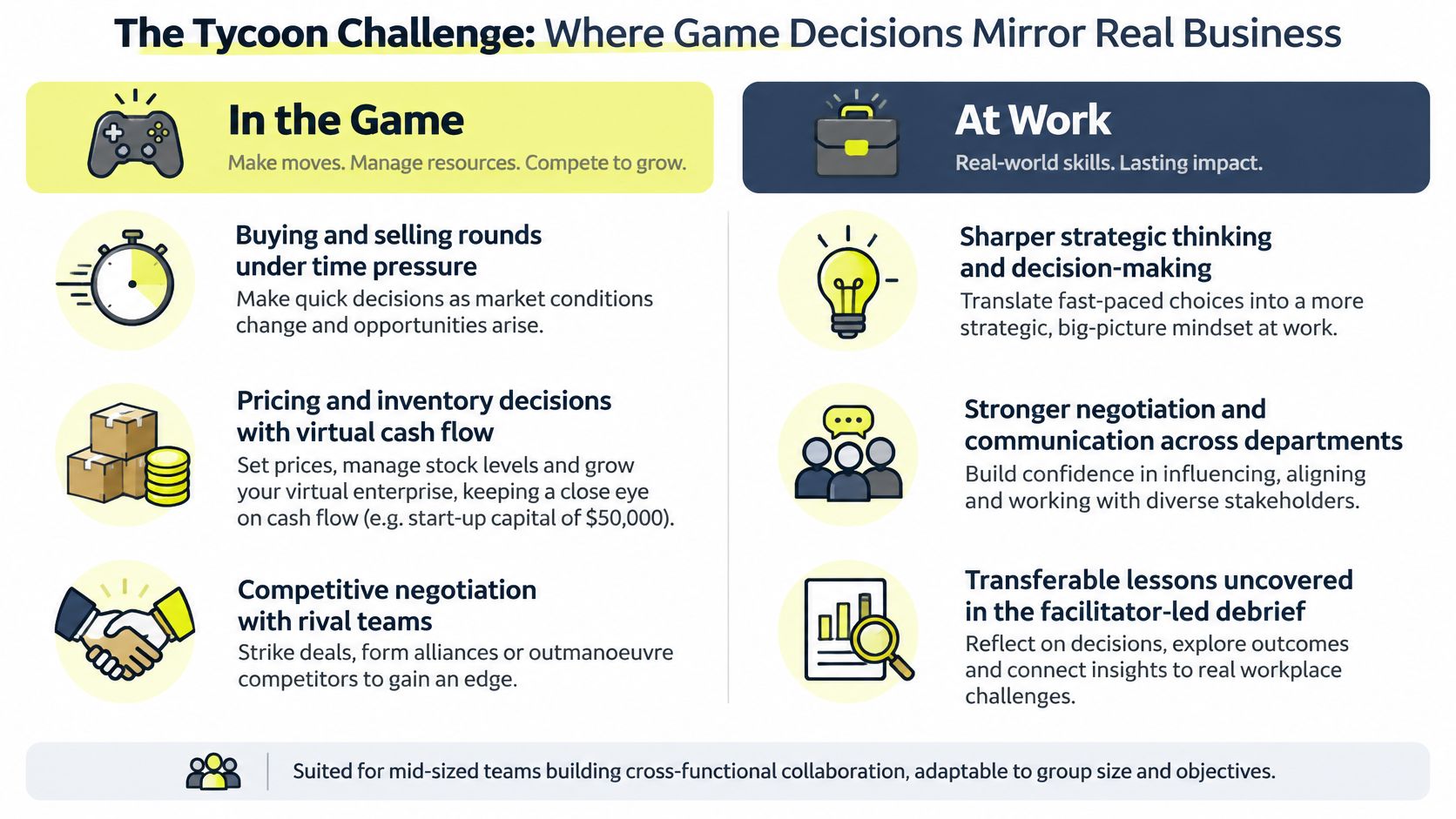
A typical scenario puts sales and operations staff into mixed teams across multiple trading rounds. Sales pushes for aggressive pricing while operations protects supply margins, exposing how one group's shortcut creates a bottleneck for another. Because the stakes are simulated, people discuss those trade-offs openly rather than getting defensive.
Manager involvement makes or breaks this format. Data from Gallup's State of the Global Workplace Singapore breakdown shows that 71% of employees were not engaged and 15% were actively disengaged in 2025, while managers account for roughly 70% of the variance in team engagement. Putting managers inside the trading floor lets facilitators observe how leaders share information, handle disagreement, and delegate under pressure.
How to Structure the Simulation and Debrief
The biggest downside of a business simulation is cognitive fatigue. If your team just survived a brutal audit or product launch, a heavy numbers-and-strategy game can feel like unpaid overtime. Keep energy constructive with a tight operational brief:
- Mix departments intentionally: Pair finance, sales, and operations staff on the same table so participants experience another function's pressures first-hand.
- Assign explicit roles early: Appoint a CEO, finance lead, and sales lead per group so quieter staff have a defined mandate instead of watching louder voices dominate.
- Protect the debrief window: Reserve 30 to 45 minutes after the final round to link pricing and negotiation failures back to real workplace workflows.
- Lock in a 30-day manager action: Ask each team lead to commit to one concrete habit, such as repeating a structured information-sharing protocol in weekly meetings.
We customise the complexity of The Tycoon Challenge to suit group sizes ranging from 5 to 50 participants in corporate offices or larger hotel ballrooms, adjusting trading rules to mirror your actual commercial environment.
2. Running Man-Style Game Show Challenges
Say two business units merge after a restructuring, and half the office still eats lunch only with their old colleagues. Formal workshops feel stiff in that situation, so Running Man-style game show challenges tackle low morale and awkward inter-departmental ice. Adapted in-house from popular game-show formats, the session works best when the games create repeated contact across old boundaries: short missions, quick decisions, and a shared target that gives people a reason to speak beyond their usual circle.
Hybrid schedules make this kind of deliberate social reset harder to plan. According to The Business Times coverage of workplace flexibility in Singapore, 89% of surveyed employees preferred hybrid or remote work, while Cisco's 2025 hybrid-work research cited in the same report found 92% of workers still view collaboration and community as vital to office culture. That makes shared office time more valuable, but it also means the format must earn attention. A game-show challenge gives people a concrete reason to meet in person, then gives the room something neutral to solve together.
High-energy games lift the mood fast, yet volume alone never builds trust. When extroverts grab every microphone and sprint to every station, quieter analysts walk away more detached than when they arrived.
The practical fix is to judge the format by the workplace problem it solves. For silent departments, use tasks that require information from another team before progress is possible. For low morale, choose rounds that create visible wins and public encouragement. For unclear coordination, make teams assign roles before each mission and review where handovers broke down.
One Dynamics adapts popular game-show formats in-house for team building, including the Running Man corporate game show experience in Singapore. Keep the design focused on participation, not spectacle.
Where Game Show Formats Break Down
The main trade-off here is surface-level bonding. Teams laugh hard for three hours, pose for photos, and then slip back into old habits because nobody connected the fun back to daily work. Competitive formats can also embarrass staff with mobility limits if physical tasks aren't optional. Loud formats reward speed and confidence, which can leave careful contributors sidelined.
Fix these issues before the countdown starts. Brief teams on the collaboration goal rather than only the trophy. Publish clear safety rules with opt-in intensity levels for active stations. Tailor trivia or mission references to your company's internal milestones so the content feels relevant. Close with a short reflection on which teamwork habits won the tougher rounds. That step turns an entertaining afternoon into useful workplace muscle memory.
3. Laser Clay Shooting Team Competition
Not every corporate crowd wants role-playing, whiteboards, or deep behavioural coaching. Sometimes a sales division has just closed a punishing quarter and needs a structured way to decompress together. Laser clay shooting addresses post-crunch burnout and flat morale by giving colleagues a low-impact, indoor competitive tournament using laser-equipped shotguns aimed at screen targets, with individual and group scores tracked in real time.
Matching intensity to stress levels matters enormously in Singapore offices. The 2026 Singapore Workplace Report recorded 43% of Singapore employees experiencing daily stress in 2025, jumping to 52% among actively disengaged staff compared with 26% among engaged employees, while only 40% were classified as thriving (slightly above Southeast Asia's 36% average). For a tired workforce, an accessible indoor format that depends on calm focus and steady turn-taking beats an exhausting obstacle course.
Picture a year-end town hall where department heads and junior executives pair up for a relay tournament before dinner. Nobody breaks a sweat, dress codes stay comfortable, and friendly banter flows easily between rounds while teammates cheer from the sidelines.
Turning Individual Aim Into Group Bonding
Laser clay shooting has one obvious limitation: shooting is an individual action. Left poorly structured, participants wait in line checking Slack on their phones while one person takes a turn. You avoid that trap through deliberate event design:
- Score by team totals and relays: Structure heats around combined group averages or timed relay handoffs so stronger shooters coach beginners instead of chasing solo glory.
- Give clear briefings and opt-out roles: Run a crisp safety walkthrough and offer scorekeeping or coaching roles for anyone uncomfortable holding simulated equipment.
- Pair shooting with a shared meal: Follow the tournament with a seated lunch or casual debrief so colleagues swap stories while the competition is still fresh.
- Run a quick five-point pulse check: Measure enjoyment, inclusion, confidence speaking up, usefulness, and physical comfort immediately afterward, aiming for at least 80% favourable scores on inclusion and psychological safety.
Because venue layout and headcount determine the number of lanes and screens needed, we build custom quotations around your function room dimensions and schedule.
4. Kin Ball Team Sport
Coordination failures happen when colleagues assume someone else is watching the ball. Kin Ball solves that blind spot physically using a giant, colourful ball roughly two metres in diameter. Teams must keep the ball off the floor while shifting positions around an object so large it partially blocks their line of sight, forcing non-stop verbal call-outs, spatial awareness, and mutual trust.
A newly formed project squad gets tremendous value from running Kin Ball early in its lifecycle. Say a cross-functional transformation team meets for a corporate sports day before kicking off a six-month rollout. Within ten minutes of play, everyone sees how fast silence causes a drop and how clearly designated verbal cues steady the whole group.
Because the ball is oversized and lightweight, raw athletic skill matters far less than synchronised timing. A senior director and a fresh graduate have to move as one unit under the canvas to control the bounce.
Space Constraints and Pacing Trade-Offs
Kin Ball's biggest realistic downside is its venue footprint. You can't run it in a standard boardroom with low ceilings, glass partitions, and overhead projectors. You need a high-ceilinged indoor sports hall, multipurpose gymnasium, or cleared hotel ballroom with zero breakable fixtures nearby.
Start every session with a proper warm-up and an unscored practice round so participants get used to the ball's weight and movement. Designate clear calling roles to reinforce verbal communication, and rotate positions frequently so nobody stays stuck at the back edge of the court.
If your group loves light physical movement but your office venue can't fit a two-metre ball, we also run Indoor Wacky Olympics with adaptable heats such as mini-golf putt, a 100-metre team caterpillar race, parachute volleyball, and human foosball. Teams that want fresh air can even combine a half-day outdoor session with an indoor programme for a full-day schedule, backed by our 100% Weather Assurance guarantee so sudden Singapore rain never derails the itinerary.
5. DISC Personality Profiling Workshop
Games expose friction, yet they rarely give teams a shared vocabulary to fix it permanently. A DISC personality profiling workshop solves chronic communication clashes, misunderstood feedback, and mismatched project roles by mapping behavioural styles across four dimensions: Dominance, Influence, Steadiness, and Conscientiousness. Instead of labelling a blunt teammate as rude or a cautious colleague as slow, the group learns how each style processes risk, urgency, and detail.
Understanding each other's working preferences directly supports everyday retention. As highlighted in Great Place To Work Singapore's analysis of local employee engagement, strong relationships with supervisors and colleagues are central to building belonging, ownership, and purpose at work. A management team preparing for annual performance reviews can use DISC profiles to tailor how they deliver tough feedback to an analytical Conscientiousness profile versus a big-picture Dominance profile.
Facilitator rule: Never run DISC as a hiring screen or performance appraisal. The moment staff suspect their profile will be used to judge promotions, honest self-assessment disappears and the workshop turns defensive.
Because meaningful behavioural patterns only emerge with enough variety in the room, our facilitated DISC offering works best for groups of at least ten participants.
Pairing DISC Insights With Action
The classic downside of personality workshops is binder syndrome: everyone nods enthusiastically during the morning seminar, files their colour-coded report in a drawer, and forgets it by Friday. High-energy teams can also find three hours of pure classroom discussion dry.
Keep the framework sticky by putting it under pressure right away:
- Clarify the developmental purpose upfront: State plainly before profiles are completed that no style is "better" and every dimension carries both strengths and blind spots.
- Follow theory with a live challenge: Pair a morning DISC briefing with an afternoon trading simulation or puzzle challenge so teams test their communication adjustments immediately.
- Assign roles against profiles: During planning retreats, let project leads map upcoming deliverables to natural strengths while intentionally pairing complementary styles.
- Schedule a four-to-six-week review: Block 30 minutes a month later to check which communication agreements held up during real deadline crunches.
6. Indoor Escape Room Team Challenge
When deadlines tighten, many teams default to two bad habits: everyone crowds around the loudest problem, or people hoard small details because they're unsure who needs them. An indoor escape room team challenge solves information hoarding and chaotic delegation by locking small groups into a themed scenario where they must uncover clues, connect patterns, and solve sequences before the clock runs out.
Teams quickly discover that no single person can spot every clue and decode every lock alone, as shown in the collaborative setup below.
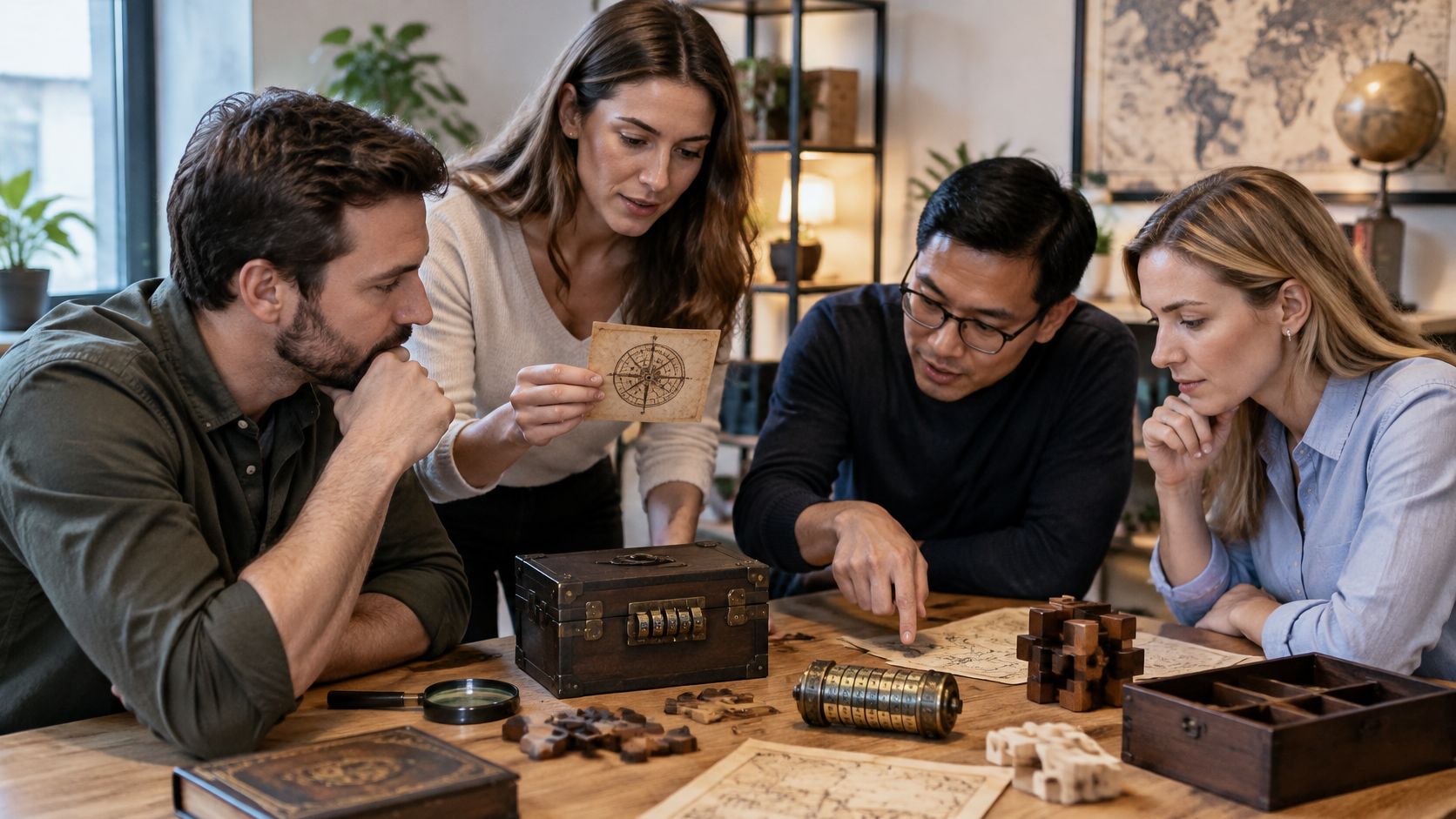
A product team can run a custom-designed puzzle built around its own upcoming launch timeline, while an HR team might stage themed rooms for a staff appreciation day. Because our game designers develop bespoke narratives in-house, clues can mirror your actual product milestones, compliance steps, or company values rather than generic pirate treasure hunts. You can read our detailed breakdown on how to host a team-building escape challenge at your Singapore office if you want to convert meeting rooms into playable spaces without hauling staff across town.
Preventing Bottlenecks Inside the Room
Escape rooms carry two real risks. First, group size bottlenecks: cram more than six or eight people into one small puzzle set and half the team ends up standing around watching two puzzle fanatics solve everything. Second, stalled momentum: if a team hits an obscure riddle and spins its wheels for fifteen minutes, frustration replaces fun fast.
Counter both flaws with clean facilitation design:
- Split large headcounts into parallel heats: Run identical rooms or tabletop kits simultaneously so teams of five to six compete on the same clock without overcrowding.
- Assign operational roles at minute zero: Name a clue tracker, a timekeeper, and a puzzle lead so quieter observers own critical handoffs.
- Build progressive hint triggers: Have facilitators nudge stalled groups with structured clues before morale drops, keeping tension productive rather than demoralising.
- Debrief communication under pressure: Ask teams after the timer stops where information got trapped and how they'd split tasks differently on a real client escalation.
7. Indoor Team Culinary Challenge
Companies flying regional directors into Singapore face a logistical headache: fitting strategy meetings, networking meals, and team bonding into a tight two- or three-day agenda without exhausting everyone on bus transfers. Regional meeting demand keeps climbing, and HR teams are under pressure to make every hour of a flying visit count. An indoor team culinary challenge solves both scheduling bloat and poor cross-regional coordination by turning meal preparation into a timed, budget-capped team project.
Working side by side at prep stations breaks down hierarchy far more naturally than a formal banquet, as seen in this collaborative kitchen session.

A typical format puts regional sales leads in teams with a fixed ingredient budget and 90 minutes to plan, cook, plate, and pitch a themed lunch. Teams divide procurement, prep, cooking, and presentation, then explain their trade-offs before sitting down to eat together. The pitch matters as much as the food. Defending a budget overrun in front of colleagues rehearses the same negotiation muscles used in cross-border project planning. If your committee wants inspiration for crowd-friendly dishes that scale smoothly without kitchen bottlenecks, you can browse party appetizers made ahead when scoping menu ideas with your culinary facilitator.
The format suits teams that rarely cooperate outside email. Colleagues who have never met in person share a cutting board within minutes, which is hard to replicate over a conference table.
Managing Dietary Needs and Kitchen Chaos
Food-based bonding carries very real operational downsides in Singapore's multicultural workplaces. Dietary restrictions, allergies, and halal certification are central planning inputs; getting them wrong excludes colleagues instantly and damages trust. Kitchen challenges also require sharp safety oversight around knives, heat, and allergens, and they cost more per head than tabletop games once studio rental and quality ingredients are factored in. I recommend this format only when the budget allows proper facilities, because a cramped improvised kitchen turns a bonding exercise into a queuing exercise.
Collect every participant's halal, vegetarian, vegan, and allergy requirements at least two weeks in advance so menus and prep stations are planned cleanly from the start. Set a strict ingredient budget and clear plating deadline so planning decisions carry real weight. Bundle the culinary session directly into your wider regional meeting package alongside hotel stays, airport transfers, and conference venues so your HR team deals with one coordinator instead of five.
8. Indoor CSR Planning Workshop for Community Impact
Many Singapore HR and CSR leads hit the same wall: they want staff bonding that means something, yet one-off charity afternoons often feel disconnected from everyday company culture. An indoor CSR planning workshop solves low sense of purpose and poor cross-team ownership by gathering employees indoors to design a real community or conservation project they'll execute together next.
Local corporate data highlights a sharp gap between company action and employee appetite. A 2025 Singapore Business Federation and KPMG study covering more than 430 companies (with SMEs making up 87% of respondents) found only 40% of businesses engaged in corporate volunteering, averaging about 40 volunteer hours a year while some large organisations topped 1,000 hours. Yet among participating employers, the National Volunteer and Philanthropy Centre figures cited in the same release show median employee participation climbed from 50% in 2021 to 70% in 2025. Once leadership builds a structured programme, staff show up.
Mapping logistics, beneficiaries, and measurable outcomes around a table turns vague goodwill into an actionable team plan, as illustrated below.

Sustainability expectations are sharpening too. The Singapore Tourism Board's sustainable MICE release reported average MICE venue-related emissions of 14.13 kilograms of carbon dioxide equivalent per attendee, with energy driving 94% of those emissions. Bringing teams indoors to plan conservation clean-ups, energy-conscious event logistics, or senior engagement visits in partnership with a local community centre connects employee morale directly to quantifiable ESG reporting.
Moving From Whiteboard Plans to Real Community Impact
The obvious pitfall of a planning workshop is all talk, no follow-through. If teams spend an afternoon brainstorming a brilliant community initiative and management never funds or schedules the execution day, staff cynicism worsens. Protect credibility with four ground rules:
- Define measurable impact targets upfront: Agree on concrete metrics such as beneficiary hours, conservation area cleared, or cross-department participation rates before brainstorming starts.
- Let employees vote on the cause: Ownership rises sharply when staff choose between senior engagement, community interaction, area improvement, or environmental conservation rather than receiving a top-down mandate.
- Book the execution and review dates immediately: Put both the live volunteering day and a follow-up celebration on the company calendar before anyone leaves the room.
- Consider overseas CSR retreats for regional offsites: We run structured CSR programmes across Singapore as well as Bali, Bintan, Batam, and the Philippines, pairing indoor planning and strategy workshops with hands-on local conservation or community projects.
How the eight indoor team building activities compare at a glance
Scan the table by problem, not by excitement level. The right column to read first is "Best For", because a format that thrills one team can actively hurt another. High-energy competition builds morale in a confident team but exposes fault lines in one already struggling with conflict. Quiet strategy formats sharpen coordination but can feel flat to a group that came wanting a celebration.
| Activity | Best For | Typical Group Size | Core Skill Built |
|---|---|---|---|
| The Tycoon Challenge: Business Simulation Trading Game | Mid-sized teams building strategic thinking and cross-functional collaboration | 5 to 50 participants | Strategic decision-making and negotiation |
| Running Man-Style Game Show Challenges | Companies seeking high-energy icebreakers and morale-building | 5 to 50 participants | Spontaneous teamwork |
| Laser Clay Shooting Team Competition | Competitive teams seeking a fun reward or celebration | 5 to 50 participants | Focus and turn-taking |
| Kin Ball Team Sport | Teams building communication and trust through physical activity | 5 to 50 participants | Communication and coordination |
| DISC Personality Profiling Workshop | HR teams and managers focused on long-term development and communication | At least 10 participants | Understanding behavioural styles |
| Indoor Escape Room Team Challenge | Teams sharpening problem-solving and collaborative decision-making | 5 to 50 participants, split across rooms | Collaborative problem-solving |
| Indoor Team Culinary Challenge | Full-day events or regional meetings combining activities and meals | 5 to 50 participants, subject to kitchen capacity | Planning and coordination |
| Indoor CSR Planning Workshop for Community Impact | CSR and HR teams combining employee engagement with community contribution | 5 to 50 participants | Project planning and shared responsibility |
Most indoor formats scale across the standard 5 to 50 participant range in conference rooms or corporate offices, running anywhere from half a day to a full day. The two exceptions worth checking early are DISC, which needs at least ten participants for the group dynamics to mean anything, and the culinary challenge, where kitchen capacity rather than headcount sets the ceiling.
Weight the realistic downsides before you commit. Kin Ball and the Running Man format demand physical mobility, so mixed-ability teams need modified roles or some staff will sit out mentally even when they join in physically. Escape rooms split larger groups into separate rooms, which weakens the shared experience if whole-team bonding is the point. Laser clay shooting rewards individual focus more than collaboration, so it works as a celebration rather than a fix for broken coordination. The culinary challenge consumes the most time per activity because it doubles as a meal, which is either efficient or wasteful depending on your schedule.
Format choice matters less than honest diagnosis. A well-matched activity run with a clear brief beats an exciting one aimed at the wrong problem every time.
Choosing the Right Indoor Activity and Booking It With Confidence
Start your selection by naming the one workplace problem costing your team the most time right now. Silent departments and newly merged offices need informal icebreakers like Running Man-style game shows or a culinary challenge. Unclear coordination and siloed handoffs call for The Tycoon Challenge or an indoor escape room backed by a structured debrief, while chronic communication friction needs a DISC profiling workshop (minimum ten participants) paired with a live exercise.
Budgeting accurately means looking beyond the activity fee alone, especially if you're hosting regional delegates in Singapore. Figures from the Singapore Tourism Board's 2024 tourism receipts report put Singapore's average hotel room rate at S$276 in 2024 (up 1.4% year on year), with revenue per available room at S$226 (up 3.0% from 2023). Factoring room blocks, conference facilities, meals, and airport transfers early keeps your finance team happy when adding facilitated programmes.
For local corporate sessions, our indoor team-building programmes start from $45 per pax (and outdoor programmes from $35 per pax), scaling cleanly for 5 to 50 participants in offices and hotel conference rooms or larger ballrooms across half-day and full-day schedules. Every partner venue we work with is assessed for indoor breakout capacity alongside outdoor options, giving you weather contingencies.
"Treat your activity brief like a project charter: state the behavioural shift you want to see thirty days later, then pick the format that forces teams to practise it."
If your organisation is comparing a local hotel conference against an overseas corporate retreat, look at total stress and logistics per head. Our overseas retreat planning arm coordinates all-in offsite packages to destinations like Batam, Bintan, Bali, and the Philippines, covering ferry or flight transfers, resort accommodation, meals, CSR projects, and weatherproof indoor function-room games such as strategy simulations or workshops alongside outdoor options like the Bintan Water Sports Park Challenge.
Established in 2010 with more than 1,500 corporate events and over 50,000 participants delivered across Singapore and the region, One Dynamics handles both custom activity facilitation and full end-to-end event logistics under one roof. Share your headcount, venue preferences, dietary needs, and core team challenge early so your HR team coordinates one accountable partner instead of juggling separate vendors.
Whether you're planning a half-day indoor simulation in a Singapore hotel ballroom, a full end-to-end regional meeting with accommodation and meals, or a stress-free overseas retreat in Batam, Bintan, Bali, or the Philippines, our team builds every programme around your exact headcount and workplace goals. Explore our custom indoor, outdoor, CSR, and overseas retreat packages and request a quotation directly through One Dynamics.