9 Staff Party Ideas for Singapore Teams in 2026
You've got a half-day budget, a department that rarely meets in person and a leadership team asking about a regional offsite. The HR decision is practical: group size, spend, venue and the behaviour you want to change. A competitive format suits colleagues who need a reason to talk; a facilitated session fits teams working on communication; an overseas programme pays off when the agenda leaves room for business discussion and informal time.
Match the format before the theme. Small teams can share one activity and a meal. Larger groups need rotations, clear timing and enough facilitators so nobody waits around. If the goal is trust or inclusion, build in roles for different abilities and communication styles rather than relying on physical confidence.
In Randstad's 2025 Singapore Workmonitor, 89% of respondents wanted their workplace to feel like a community. Treat that as a design brief with limits.
For planning basics, this guide to how to organize corporate gatherings is a starting point. Then choose the shortest option that delivers the goal: a Singapore afternoon, an indoor plus outdoor day, or a managed Bintan retreat with logistics, venue coordination and programme delivery handled end to end.
Table of Contents
- 1. Laser Clay Shooting Team Competition
- 2. The Tycoon Challenge
- 3. Kin Ball Team Sport Session
- 4. Running Man-Style Team Game Challenge
- 5. DISC Personality Profiling Workshop
- 6. Bintan Water Sports Park Challenge
- 7. CSR Community and Conservation Team Day
- 8. Singapore Amazing Race-Style City Challenge
- 9. All-Inclusive Overseas Corporate Retreat Package
- How the nine staff party ideas compare on price, setting and purpose
- Choosing the Right Staff Party Idea for Your Team
1. Laser Clay Shooting Team Competition
Best for a mixed department that wants outdoor competition without sustained running. Laser clay shooting uses infrared equipment to simulate shooting at launched targets. Participants compete in squads, with individual attempts contributing to a shared result.
For a Singapore department gathering, mix colleagues from different functions rather than letting existing friendship groups form every squad. Run rotating rounds, then finish with a group lunch where people can continue talking without a scoreboard.
The activity needs a suitable outdoor space, clear operating boundaries and an equipment briefing. Minimal running doesn't mean universal accessibility, so confirm how participants will handle the equipment and provide meaningful supporting roles.
Budget for the complete afternoon
Our outdoor team-building programmes start from $35 per participant, with quotations varying by programme, group size, duration and customisation. Treat that as a starting point, not a confirmed laser clay shooting price or an all-inclusive event rate.
Venue hire, meals, transport and sheltered alternatives need to be clear in the quotation. A cheaper activity fee can become less attractive if colleagues spend the afternoon waiting for equipment.
- Mix the squads: Give employees a reason to speak to colleagues outside their usual team.
- Broaden recognition: Recognise improvement, encouragement and thoughtful strategy alongside accuracy.
- Debrief the decisions: Ask how teammates shared advice and responded when someone struggled.
Practical rule: Keep the competition friendly enough that missing a target doesn't become the afternoon's lasting memory.
This works particularly well when you want a defined activity followed by relaxed hospitality, rather than an entire day of physical challenges.
2. The Tycoon Challenge
Put a finance manager, an operations colleague and a sales executive around the same trading table. Give them limited resources and competing priorities. The interesting part is not only who makes the most money, but how they reach decisions.
The Tycoon Challenge turns that situation into a business simulation. Teams buy, sell and manage resources while responding to changing conditions. It suits an indoor staff event where commercial thinking, negotiation and cross-functional planning matter more than physical energy.

A useful Singapore use case is a finance and operations gathering before a planning cycle. Customise the fictional market to resemble the company's sector, but keep the rules simple enough that specialist knowledge doesn't decide the winner.
Make the learning observable
In ADP's People at Work 2025 findings reported by Singapore Business Review, only 23% of Singapore workers felt they were part of the best team they'd ever worked with. A simulation provides something concrete to discuss: who shared information, who challenged assumptions and who controlled the budget.
Price this around facilitation, materials, customisation and room requirements. An existing office training room can avoid external venue costs, provided teams have enough space to negotiate without drowning each other out.
Don't let the strongest negotiator make every decision. Rotate responsibility for purchasing, analysis and presenting results. End by asking each team which behaviour they'd repeat at work and which they'd change.
3. Kin Ball Team Sport Session
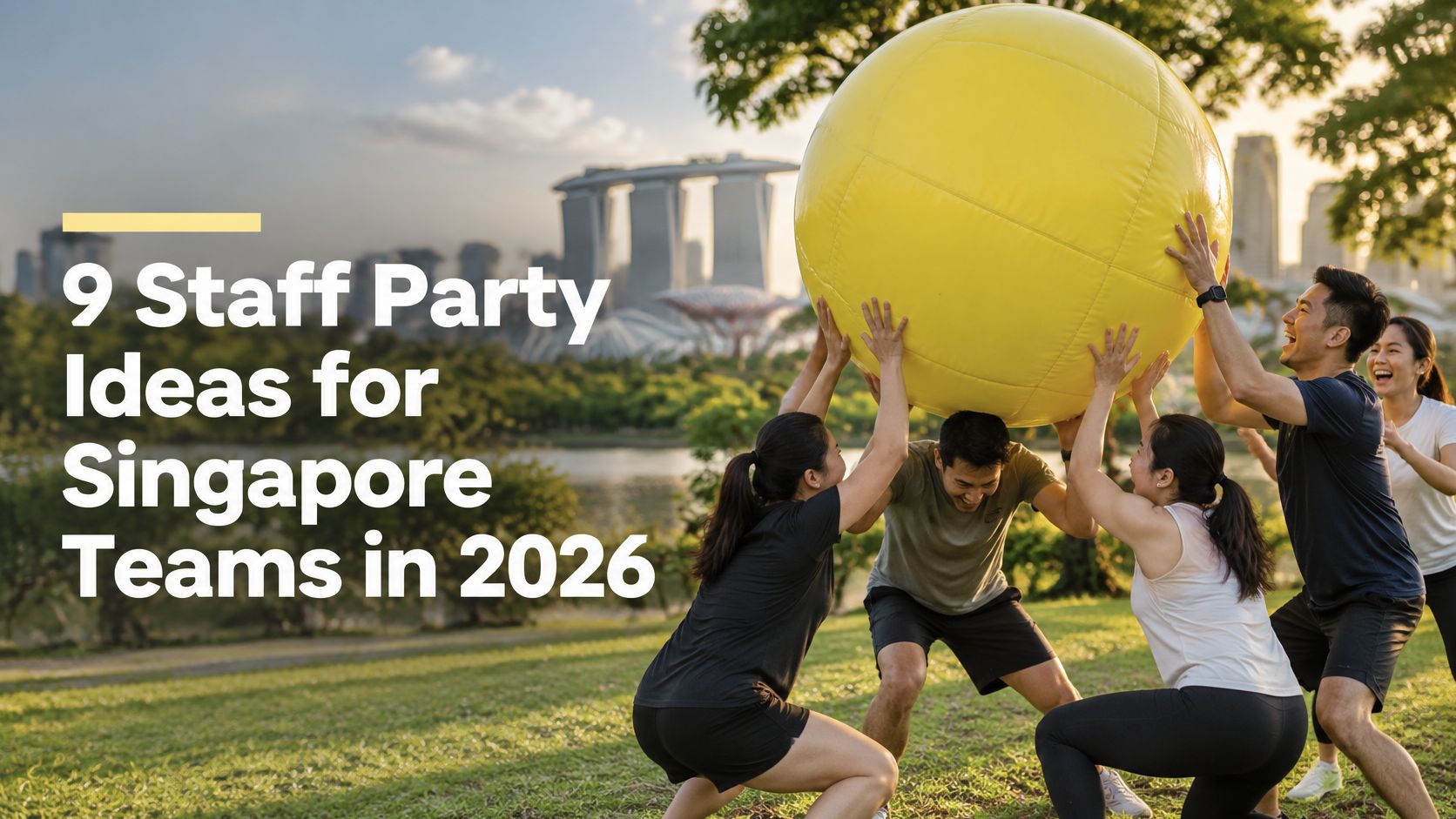
Kin Ball gives colleagues a shared coordination problem rather than a conventional football or basketball match. Participants support and move a large, brightly coloured ball while responding to calls and keeping it off the ground.
Choose it for an active company sports day where cooperation matters more than sporting experience. A department tournament can work well, but rotating mixed teams is better when the main objective is to break down hierarchy.

The shared task creates reasons to call clearly, adjust position and notice teammates. However, a cooperative sport is still physical. Employees with mobility limitations, injuries or concerns about close group movement need alternatives that aren't treated as second-class participation.
Choose the surface before the shirts
A level playing area, adequate clearance and a suitable wet-weather arrangement matter more than elaborate branding. For an outdoor session, provide drinking water, shaded rest areas and permission to pause without explanation.
- Rotate responsibilities: Let different colleagues practise calling, supporting and coordinating.
- Offer parallel roles: Include scoring, observation or team-planning responsibilities where appropriate.
- Keep clothing practical: Breathable team tops can help identify groups; the Simply Merchandise clothing range offers examples of branded clothing to consider.
Budget for equipment, facilitation, venue access and welfare arrangements. Team shirts are optional, not a substitute for good delivery.
Finish with a discussion about the calls that helped and the instructions people couldn't follow. That makes the activity useful beyond the sports-day photographs.
4. Running Man-Style Team Game Challenge
Running Man-style challenges suit a company anniversary or staff celebration that needs variety. Teams move through a sequence of puzzles, relays, quizzes and playful tasks, collecting points along the way.
The appeal is that colleagues can contribute differently. Someone who dislikes racing may solve a clue, remember a detail or organise the team's approach. The format stops working when every station rewards speed, shouting or willingness to look embarrassed.
For a Singapore anniversary event, use an activity block before an awards dinner. Keep the dinner venue close enough that the transition doesn't consume the afternoon.
Build variety into the stations
Use the Running Man game rules and challenge ideas to understand how missions and scoring can fit together. For a knowledge-based station, the Million Whys group trivia guide provides another planning reference.
Balance physical tasks with observation, reasoning and creative problem-solving. Avoid questions that depend heavily on a particular nationality, age group or company tenure unless that knowledge is deliberately shared.
Let teams laugh at the situation, not at a colleague who's been pressured into performing.
Costs depend on station equipment, facilitators, venue layout and the complexity of scoring. More elaborate props aren't automatically better; clear instructions and smooth transitions matter more.
For larger groups, stagger station starts and avoid a finale that leaves most employees watching. Make sure there's a genuine indoor alternative, not an instruction to continue outside in unsuitable weather.
5. DISC Personality Profiling Workshop
A quieter staff gathering can be more useful than another competition when colleagues keep misreading each other's intentions. DISC profiling provides a framework for discussing Dominance, Influence, Steadiness and Conscientiousness as behavioural preferences.
Participants complete an assessment, explore their profiles with a facilitator and discuss practical communication adjustments. It's a development conversation, not a diagnosis or a justification for labelling someone difficult.
A Singapore project department might use the session to examine how colleagues approach deadlines, detail and disagreement. Follow the discussion with a shared planning task so participants can test different ways of briefing one another.
Keep profiles out of performance judgements
The DISC profiling guide for corporate teams explains the workshop format and how to prepare. Position participation around self-understanding, and make expectations about sharing assessment results clear before the session.
- Use neutral language: Describe preferences rather than fixed strengths and weaknesses.
- Practise adjustments: Ask colleagues to rewrite a project brief for someone who wants more context or greater brevity.
- Review application: Return to the agreed communication changes after employees have had time to try them.
Budget for assessments, preparation, qualified facilitation and a room where people can hear one another. This is less dependent on elaborate staging than an entertainment-led party, but it deserves more preparation than a casual icebreaker.
It works best with lunch or a relaxed social element afterwards. Don't expect profiling alone to resolve workload problems, poor management or an unresolved workplace dispute.
6. Bintan Water Sports Park Challenge
A Bintan water sports park programme suits teams that want a clear break from the Singapore office. Colleagues tackle aquatic games and obstacle-style tasks that require coordination, encouragement and quick decisions.
Choose it for a willing, water-comfortable group, not just because the photographs look exciting. Swimming confidence, health considerations and comfort around water should influence the programme before bookings are committed.
For a corporate getaway, combine the challenge with a group meal and a facilitated reflection. A day trip keeps accommodation out of the budget, but an overnight stay gives the programme more breathing room.
Treat travel as part of the activity
Ferry schedules, terminal reporting, transfers and changing facilities all affect the usable activity time. Check current entry and visa requirements for each traveller's nationality, rather than assuming everyone has the same arrangements.
We manage overseas safety protocols and emergency contingencies as part of the planning process. That still requires accurate participant information and clear communication about activity suitability.
- Provide a dry alternative: Give non-participants an engaging programme rather than a seat beside the water.
- Protect the weather plan: Arrange an appropriate indoor substitute before departure.
- Allow recovery time: Leave room to shower, change and eat without rushing to the next transfer.
The budget needs separate visibility for travel, activities, meals, accommodation where relevant and insurance arrangements. Confirm what happens financially if travel or activities are disrupted.
A water-based challenge can create shared memories, but it's a poor choice when participation depends on employees hiding anxiety or exceeding their physical limits.
7. CSR Community and Conservation Team Day
Start with the community partner's needs, not the company's preferred photograph. A useful CSR day might involve senior engagement, neighbourhood improvement or conservation work, with employees completing tasks the partner has agreed are worthwhile.
For a Singapore company visiting Bintan, that could mean a beach clean-up followed by a locally coordinated community activity. Bali, Batam and the Philippines are other destinations to consider when the project and travel arrangements fit the company's goals.

The benefit is shared purpose, not a guaranteed morale boost. In the Ipsos Singapore workplace survey conducted in December 2023_2.pdf), only three in five respondents said they were proud to work for their employer or would recommend the organisation to others. A responsible community programme should support genuine organisational values rather than disguise everyday workplace problems.
Fund the work, not just the outing
Include partner coordination, tools, protective equipment, transport and appropriate waste handling in the budget. Unpaid staff participation doesn't make the programme free.
Let employees help select the cause, then agree on a meaningful output with the partner. For conservation work, that might involve completing an agreed area and ensuring collected material reaches the correct disposal stream.
Partner-first planning: Don't create extra work for a community organisation so employees can feel helpful.
Obtain consent before taking or sharing identifiable photographs. Report the completed work internally without exaggerating its impact, and consider whether the company can maintain support after the event.
8. Singapore Amazing Race-Style City Challenge
A city challenge works well when your venue is Singapore itself. Teams follow clues, move between checkpoints and complete collaborative tasks, finishing at a shared meal or reception.
For regional colleagues, it can combine introductions with a closer look at the host city. For local employees, unfamiliar clues and mixed-department teams keep the experience from becoming a routine walk between familiar landmarks.
A half-day route ending at a waterfront lunch venue is a practical format. Keep the route compact enough that employees spend time interacting rather than travelling.
Control distance, spending and accessibility
Give every team clear boundaries, a transport allowance and a reliable contact for assistance. Don't reward risky road crossings, frantic running or spending personal money to gain an advantage.
- Mix the clues: Combine observation, logic and local discovery rather than relying on fitness.
- Check every checkpoint: Confirm access, opening conditions and whether teams could obstruct other visitors.
- Plan equivalent routes: Employees with mobility needs should have a meaningful experience with comparable objectives.
The main cost drivers are route development, facilitation, transport and the finishing venue. Public spaces don't remove the need for planning or permission where applicable.
Hybrid teams need particular care. A 2025 workplace study reported by People Matters found that 68% of surveyed Singapore workers had access to hybrid work. Don't give remote colleagues a token video feed of everyone else's outing.
Use a parallel puzzle experience or an equivalent local gathering, with a shared closing conversation. Equivalent participation matters more than forcing identical activities.
9. All-Inclusive Overseas Corporate Retreat Package
Choose an all-inclusive retreat when the planning problem extends beyond an activity booking. Accommodation, transport, meals, meeting space and facilitation need to fit together, especially when colleagues arrive from different offices.
A Singapore leadership team might choose a Bintan stay combining strategy discussions, water activities and shared dinners. Another group may need an indoor programme at its chosen Asian destination, with more emphasis on planning than recreation.
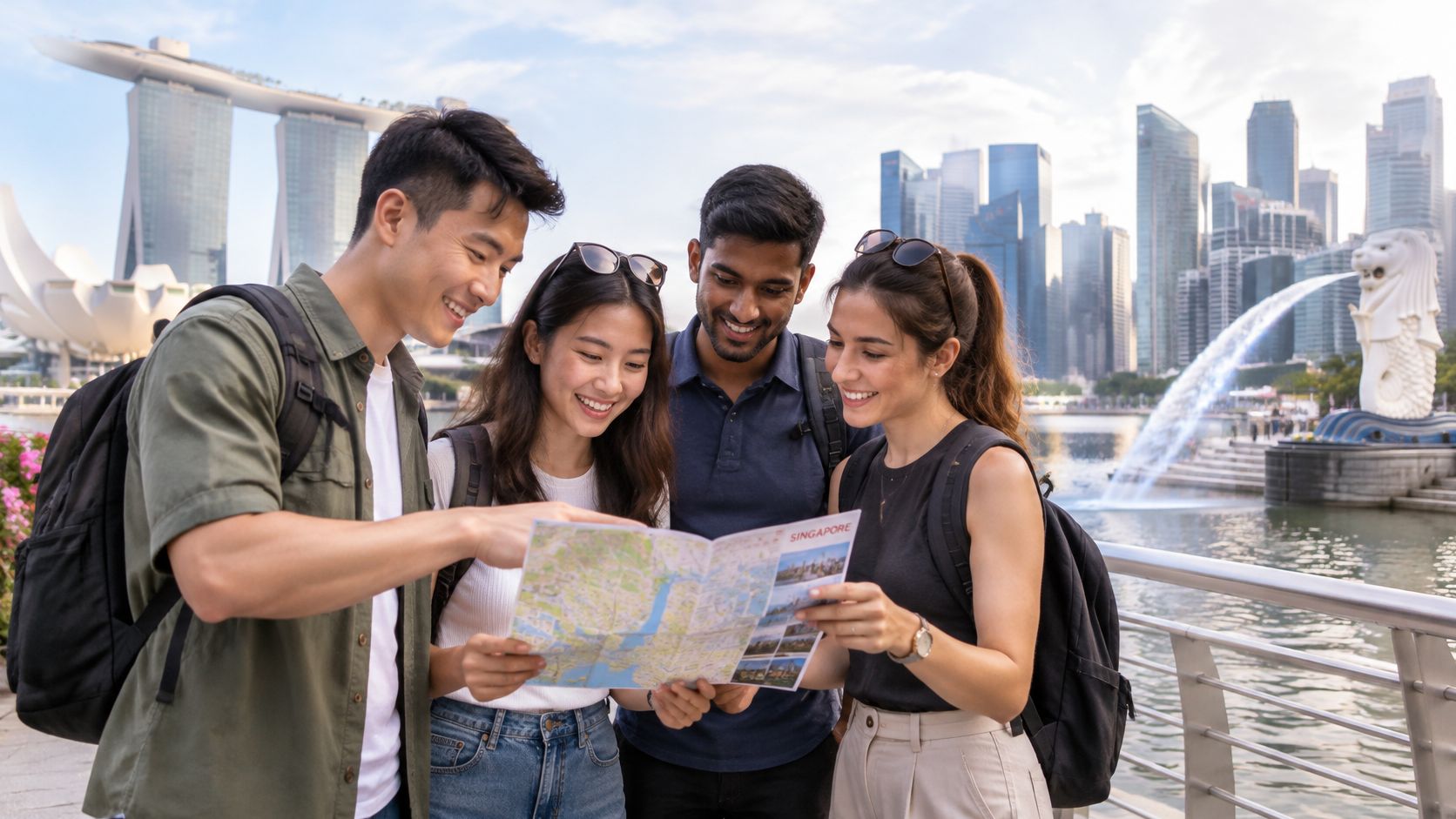
All-inclusive should describe the quotation clearly, not imply that every possible expense is covered. The guide to overseas team-building packages, destinations and budget considerations provides a starting point for scoping the trip.
Compare inclusions before comparing totals
Separate accommodation, room occupancy, meeting facilities, meals, transfers, activities and facilitation. Identify exclusions such as personal spending, optional activities and arrangements for employees travelling on different schedules.
We coordinate planning and programme delivery around the team's objectives, including logistics and contingency arrangements. HR still needs a clear internal decision-maker for attendance, travel approvals and business content.
Leave unstructured time in the itinerary. Employees shouldn't return from a retreat more exhausted because every meal and evening became another compulsory session.
For regional teams meeting in Singapore instead, the Singapore Tourism Board's SHINE programme describes participating-hotel benefits including negotiated room rates and delegate experiences. Check current eligibility and terms rather than assuming an ordinary staff party qualifies.
The strongest package is the one whose accommodation, travel and programme support the same purpose.
How the nine staff party ideas compare on price, setting and purpose
Starting prices below are typical references. Final figures depend on package type, group size, duration and the level of customisation.
| Item | Price Reference | Venue Setting | Best For |
|---|---|---|---|
| Laser Clay Shooting Team Competition | From $35 per participant | Outdoor venue | Energetic team competition and cross-department bonding |
| The Tycoon Challenge | From $45 per participant for indoor programmes | Indoor or venue-based | Business strategy, negotiation and commercial thinking |
| Kin Ball Team Sport Session | From $35 outdoors or $45 indoors per participant | Indoor or outdoor sports venue | Inclusive teamwork, communication and active bonding |
| Running Man-Style Team Game Challenge | From $45 indoors or $35 outdoors per participant | Indoor venue or outdoor space | High-energy, varied challenges and large-group fun |
| DISC Personality Profiling Workshop | From $45 per participant for indoor programmes | Facilitated workshop setting | Communication and work-style understanding for teams of 10 or more |
| Bintan Water Sports Park Challenge | Package quote covering programme delivery, venue coordination and travel logistics | Water sports park in Bintan, Indonesia | Short-haul overseas bonding and water-based challenges |
| CSR Community and Conservation Team Day | From $35 per participant for local outdoor projects; overseas formats quoted per itinerary | Community or conservation sites in Singapore or overseas | Purpose-led team bonding and social impact |
| Singapore Amazing Race-Style City Challenge | From $35 per participant for outdoor routes; final quote reflects group size and route design | Multiple locations across Singapore | City exploration, teamwork and problem-solving |
| All-Inclusive Overseas Corporate Retreat Package | Multi-day package priced per itinerary, covering accommodation, transfers, facilitation and programme delivery | Overseas destinations across Asia | End-to-end retreats combining team building, workshops and leisure |
Read the price column as a starting point, not a total. Outdoor formats sit at the lower end, facilitated indoor sessions cost more per head, and anything that crosses a border prices as a package because transport and logistics are part of the deliverable. Shortlist by headcount first, then match the setting to the goal.
Choosing the Right Staff Party Idea for Your Team
Start with the constraint that matters most: headcount, budget or the outcome you want. Shortlist a manageable selection of activities, check venue and weather arrangements, and compare quotations on the same basis. An activity-only price and a package including transport and lunch aren't comparable totals.
For a half-day event, a single substantial activity such as laser clay shooting or a city challenge is usually enough. Add a meal if the budget allows, but protect time for conversation. More stations don't necessarily create better connections.
For a multi-day offsite, put accommodation, transfers, meals and programme delivery into a coordinated plan. Decide which sessions need facilitation and which need space for colleagues to talk. A retreat shouldn't become an office timetable relocated to a resort.
Make participation comfortable, not compulsory theatre
In Gallup's Singapore Workplace Report 2026, 43% of Singapore employees reported experiencing daily stress in 2025. An event intended to support colleagues shouldn't add avoidable pressure.
Publish the schedule in advance. Explain physical requirements, provide accessible alternatives and make dietary arrangements clear. Offer non-alcoholic drinks, somewhere quiet to step away and a straightforward way to raise concerns privately.
Managers set the tone. They shouldn't tease employees who decline a performance, need a rest or choose a quieter role. Attendance tells you who arrived, not whether they felt included.
Measure what employees take back
After the event, ask whether colleagues feel more connected, more comfortable collaborating across departments and willing to join future activities. Invite specific comments about access, pacing and facilitation rather than relying only on an enjoyment score.
Then follow through at work. If teams identify unclear handovers during a game, improve the handover process. If newer employees make useful connections, give them opportunities to maintain those relationships.
When requesting a quotation, share the expected headcount, preferred dates, budget boundaries, participant needs and workplace objective. For regional meetings, include accommodation and arrival requirements; for overseas retreats, include destination preferences and travel constraints. Those details make it easier to compare suitable options without paying for complexity your team doesn't need.
One Dynamics offers indoor, outdoor and overseas team-building programmes, with event planning and coordinated arrangements for activities, meals, transport and accommodation where required. Visit One Dynamics to request a quotation matched to your group size, budget and goals, whether you're planning a Singapore afternoon or an overseas corporate retreat.