Communication Team Building Activities in Singapore
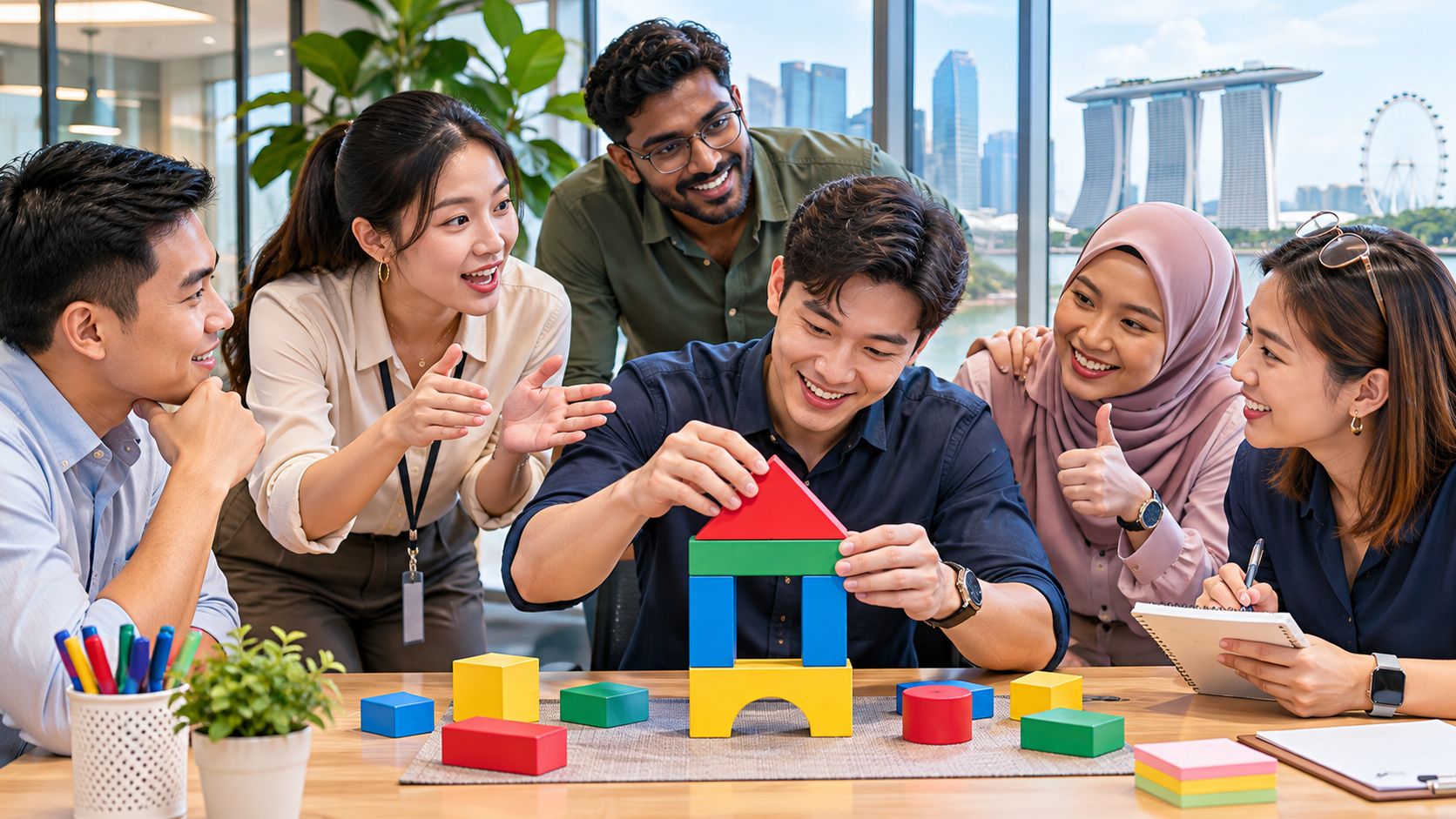
Your Singapore team returns from an offsite with cheerful photographs, a winning department and plenty to talk about over lunch. By the next project meeting, colleagues are interrupting one another, instructions are still vague and nobody knows who owns the handover. The day was entertaining. Employees did not practise communicating differently.
Communication team building activities need a specific behaviour to train. A sales team might need to brief clearly under time pressure. A project group might need to listen without interrupting, negotiate competing priorities or give feedback before a small mistake becomes expensive rework. Choose the behaviour first, then build the activity around it.
That choice carries real cost in Singapore workplaces. In a survey of Singapore knowledge workers conducted by Morning Consult for Zoom, 44% of Singapore team leaders spent at least an hour daily in meetings with no clear outcome or that failed to solve a problem, according to HRD Asia's coverage.
A successful activity gives colleagues a communication habit they can repeat at work, along with a result the team can celebrate.
The ten formats below suit different settings, from outdoor staff bonding in Singapore to regional meeting add-ons and overseas retreats. Each trains a distinct skill, whether briefing, calling, negotiating, listening or giving feedback, and each comes with delivery considerations and a debrief that connects play to work. For individual preparation between sessions, Translate AI's conversation skills guide gives participants a companion to facilitated group practice.
Table of Contents
- 1. Running Man-Style Communication Quest
- 2. The Tycoon Challenge Trading and Negotiation Game
- 3. Kin Ball Non-Verbal Coordination Game
- 4. Laser Clay Shooting Strategy Challenge
- 5. Bintan Water Sports Park Challenge Overseas Retreat Activity
- 6. DISC Personality Profiling Workshop
- 7. The Marshmallow Challenge
- 8. Blindfolded Minefield Navigation
- 9. LEGO Serious Play Workshop
- 10. CSR Community Conservation Project with Team Debrief
- Communication Focus and Practical Fit of Each Activity
- Choosing the Right Activity and Making It Happen
1. Running Man-Style Communication Quest
Skill trained: briefing and handovers under pressure.
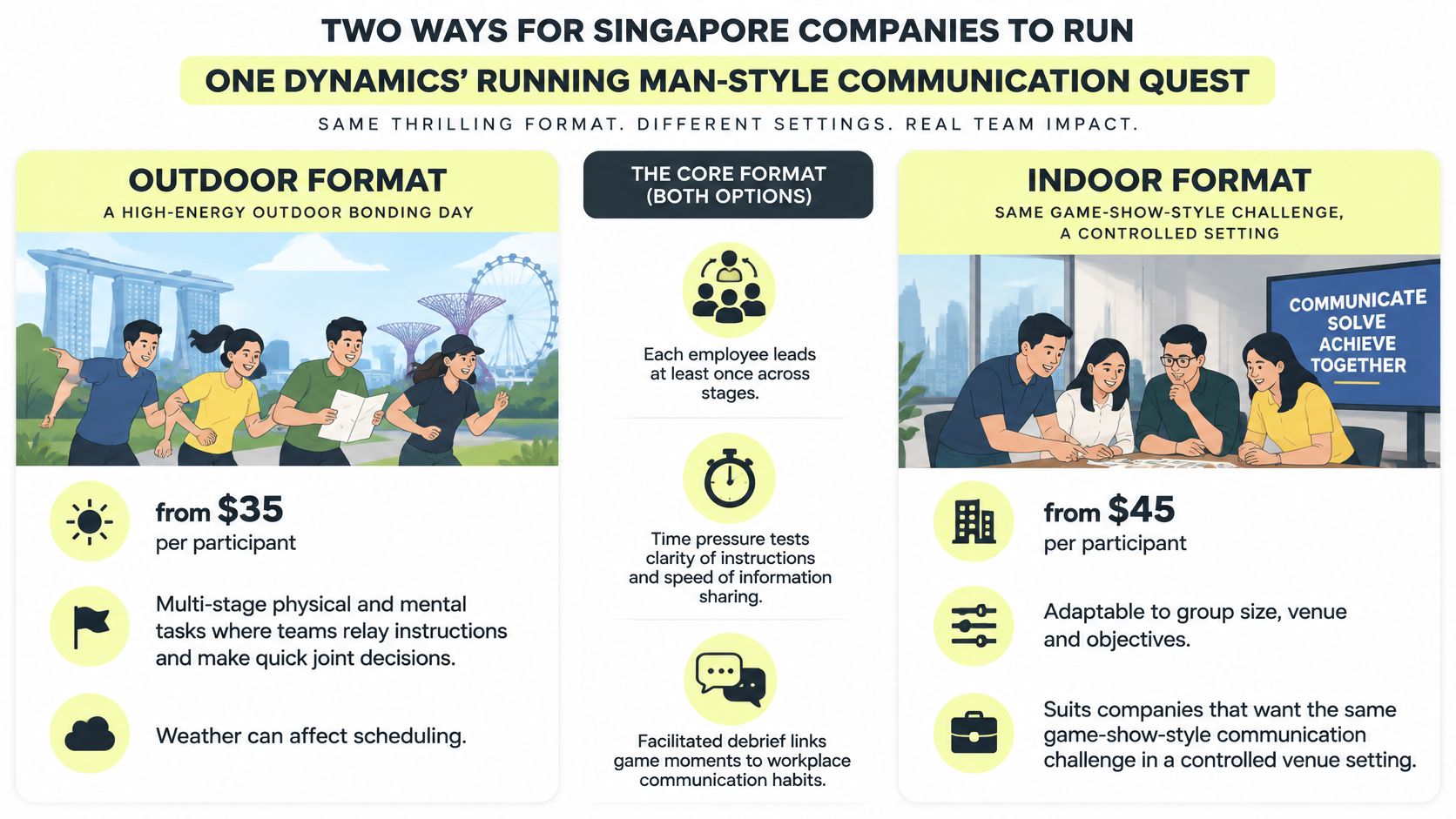
A Running Man-style quest sends teams through physical and mental challenges where colleagues must interpret instructions, share clues and agree on their next move. The useful pressure comes from incomplete information, not from asking everyone to run faster.
For a Singapore office-wide offsite, mix departments rather than letting existing teams stay together. Give different participants responsibility for reading instructions, tracking progress and explaining decisions. Rotate the stage leader so a confident manager doesn't become the permanent spokesperson.
Make the handover part of the game
Require the incoming leader to summarise the objective before the team starts its next challenge. That makes misunderstandings visible while there's still time to correct them.
- Brief clearly: Separate the objective, constraints and responsibilities instead of delivering everything in a rushed speech.
- Plan for Singapore weather: Include drinking-water access, sheltered regrouping points and an indoor contingency.
- Protect reflection time: Debrief immediately after the final stage, before prize-giving and departure distract participants.
Our in-house programme development includes adaptations of familiar game-show formats. The Running Man game rules and challenge ideas illustrate how different tasks can support a coordinated quest.
Ask teams where instructions changed during a handover and whether anyone checked understanding. Don't reward speed alone if your workplace objective is accuracy.
2. The Tycoon Challenge Trading and Negotiation Game
A regional sales meeting in Singapore can involve plenty of presentations without giving colleagues much opportunity to negotiate with one another. The Tycoon Challenge changes that dynamic through resource trading, competing priorities and a shared commercial objective.
Skill trained: negotiation and internal alignment.
Teams buy, sell and exchange resources within the simulation. Before approaching another table, they must agree on what they need, what they can offer and which concessions they're authorised to make.
The strongest learning often happens inside the team. A persuasive negotiator can still undermine the group by promising resources that colleagues have already committed elsewhere.
Separate persuasion from agreement
Mix sales, finance, operations and support colleagues where possible. Give participants different information so they have a reason to consult one another rather than follow the most commercially confident person.
- Nominate a summariser: Have someone explain the team's strategy and the assumptions behind it.
- Record commitments: Use a visible trading sheet so verbal agreements don't disappear between conversations.
- Review difficult exchanges: Discuss when a team clarified the other party's needs and when it merely pushed harder.
This format works well in a hotel function room between regional meeting sessions. Keep tables far enough apart for negotiations without overwhelming the room with competing conversations.
Finish by asking which workplace agreements need clearer ownership, written confirmation or an escalation route. Winning the simulation shouldn't excuse poor listening or misleading communication.
3. Kin Ball Non-Verbal Coordination Game
The ball is approaching, several colleagues move towards it and nobody clearly takes responsibility. That moment makes Kin Ball useful for teams whose workplace handovers rely on assumptions.
Skill trained: clear calling, turn-taking and reading movement.
Participants coordinate around a large, brightly coloured ball, keeping it off the ground through shared positioning and timely calls. Use an adapted communication-focused format rather than expecting inexperienced colleagues to master tournament play.
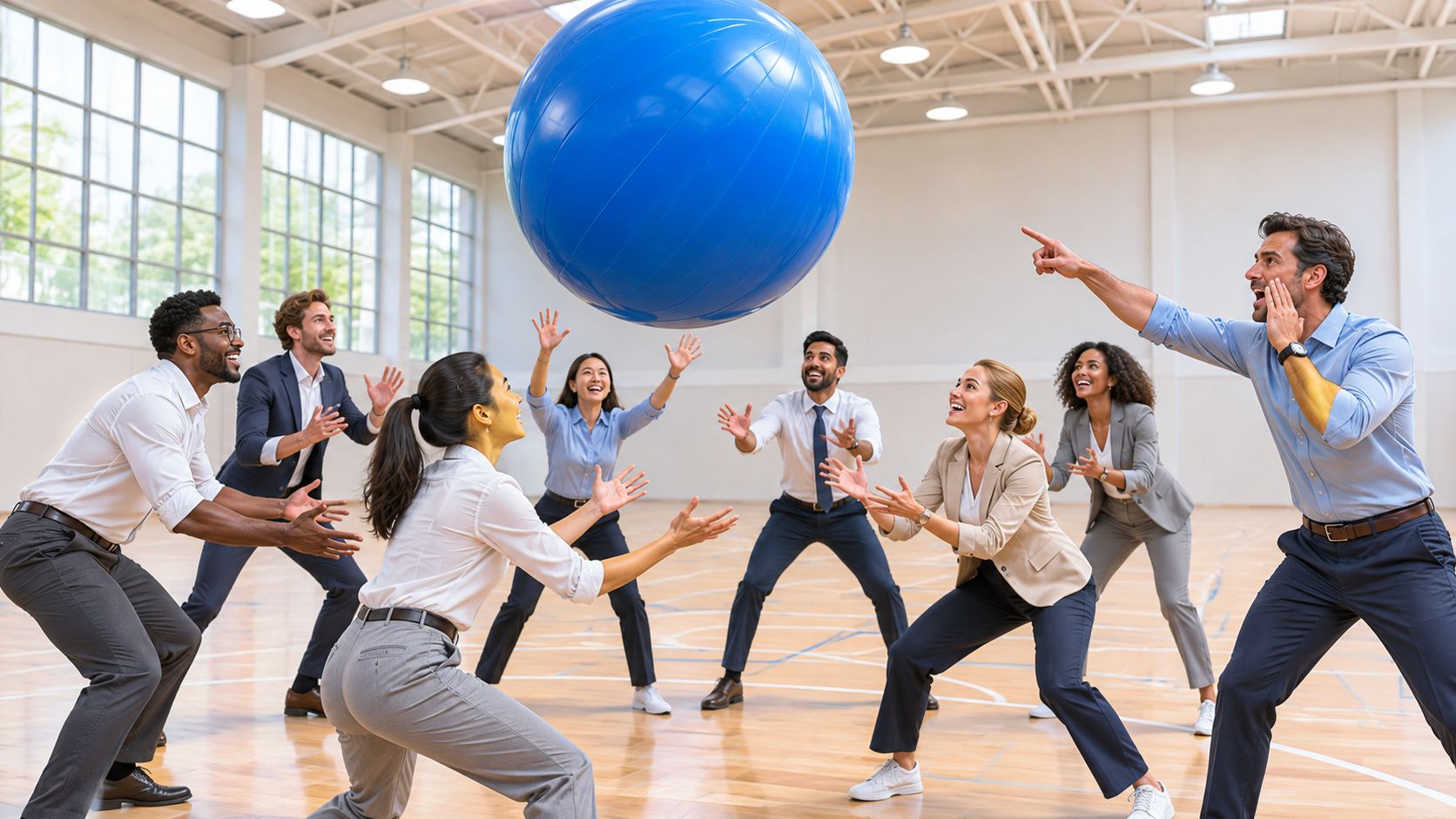
For a Singapore staff sports day, brief participants to call before making contact and acknowledge a teammate's call. Rotate captains and include meaningful coordination roles for colleagues who don't want sustained physical participation.
Practical rule: A louder call isn't automatically a clearer call. Agree on names, direction words and acknowledgement signals before play begins.
Use a suitable sports space with adequate clearance, a stable surface and boundaries away from spectators. A cramped meeting room isn't an acceptable substitute.
During the debrief, ask which gestures helped and which colleagues couldn't see them. Connect that discussion to warehouse coordination, event operations or busy service environments where people can't rely on uninterrupted conversation.
The interview with speaking coach Simone Rechel offers a related discussion of body language, including virtual communication. In the activity itself, focus on signals colleagues can recognise and confirm, not subjective judgements about confidence.
4. Laser Clay Shooting Strategy Challenge
Laser Clay Shooting becomes a communication exercise when teams plan and review together. Without that structure, it's primarily an individual aiming activity with a team score.
Skill trained: role clarity and concise feedback.
For a corporate retreat group in Singapore, organise a planning huddle before each round. Participants agree on responsibilities, how they'll share observations and when they'll adjust their approach.
Keep technical and safety instructions with the activity facilitator. Team members shouldn't improvise equipment rules or distract participants during an active shooting sequence.
Give feedback between rounds
The most useful comments describe something observable. A colleague can explain that the team changed its plan without informing everyone, rather than accusing others of being uncooperative.
Use these debrief prompts:
- Agreement: What did the team decide before starting?
- Breakdown: Where did actions or instructions differ from that agreement?
- Adjustment: What will everyone do differently in the next round?
Rotate planning and reporting responsibilities so the strongest shooter doesn't automatically become the leader. A participant who finds aiming difficult can still contribute through careful observation and a clear summary.
This format suits groups seeking a distinctive activity alongside a retreat or meeting itinerary. Its trade-off is that communication practice needs deliberate facilitation. If the schedule only allows participants to arrive, shoot and leave, don't present it as a substantial communication workshop.
5. Bintan Water Sports Park Challenge Overseas Retreat Activity
Moving a team overseas doesn't remove its communication problems. It adds travel coordination, unfamiliar surroundings and different comfort levels around physical activities.
Skill trained: safety communication and mutual support.
A Bintan Water Sports Park Challenge can combine water-based tasks with group problem-solving during a retreat from Singapore. Use activities that require participants to confirm readiness, explain the next step and respond when someone needs help.
For a mixed-department retreat, assign coordination responsibilities across functions rather than recreating the office hierarchy. Participation should reflect swimming confidence, mobility and personal comfort, with meaningful alternatives arranged alongside water activities.
Build the itinerary around readiness
- Travel preparation: Confirm ferry arrangements, passenger details and travel-document requirements before committing the activity schedule.
- Safety delivery: Include operator-led briefings, appropriate equipment and clear stop signals.
- Recovery and reflection: Reserve a shaded area or indoor room for changing, hydration and the debrief.
Don't squeeze the challenge between a delayed arrival and a fixed departure. Participants who are watching the clock won't give the safety briefing or reflection their full attention.
Our overseas planning work focuses on corporate retreats across Asia originating from Singapore. Coordination should connect accommodation, transfers, meals and activities rather than leave employees to manage gaps themselves.
Close by asking how colleagues signalled uncertainty. The useful workplace lesson is whether people felt able to stop, clarify and request support without being treated as an inconvenience.
6. DISC Personality Profiling Workshop
A manager wants the headline immediately. A colleague wants the background before committing. Neither preference automatically makes someone a poor communicator.
Skill trained: listening and adapting a message to its recipient.
DISC uses the dimensions Dominance, Influence, Steadiness and Conscientiousness to structure discussion about behavioural preferences. In a team workshop, the value lies in testing alternative ways to explain a decision, delegate work or raise a concern.
For Singapore department managers, use a familiar scenario: a deadline changes, and the team needs to redistribute work. Ask participants to practise a concise outcome-first briefing, then a version that provides more context and reassurance.
Treat a profile as a conversation starter, not a verdict about someone's abilities, suitability or future performance.
The DISC profiling guide for corporate teams in Singapore provides context for applying the framework to communication and leadership.
Keep the application specific
Our featured DISC offering recommends groups of at least ten participants. Pair discussion with an experiential challenge so colleagues can practise adapting their communication rather than only describing their preferences.
Avoid public labelling, compulsory disclosure of personal concerns or explanations that blame every disagreement on personality. A work dispute may concern unclear priorities or unequal workloads, not communication style.
End with an agreed behaviour, such as including the decision required in meeting invitations. Set a follow-up date to check whether managers and employees have used it.
7. The Marshmallow Challenge
A tower can look convincing until the marshmallow goes on top. That makes this simple construction exercise useful for discussing assumptions and delayed feedback.
Skill trained: feedback, testing and iteration.
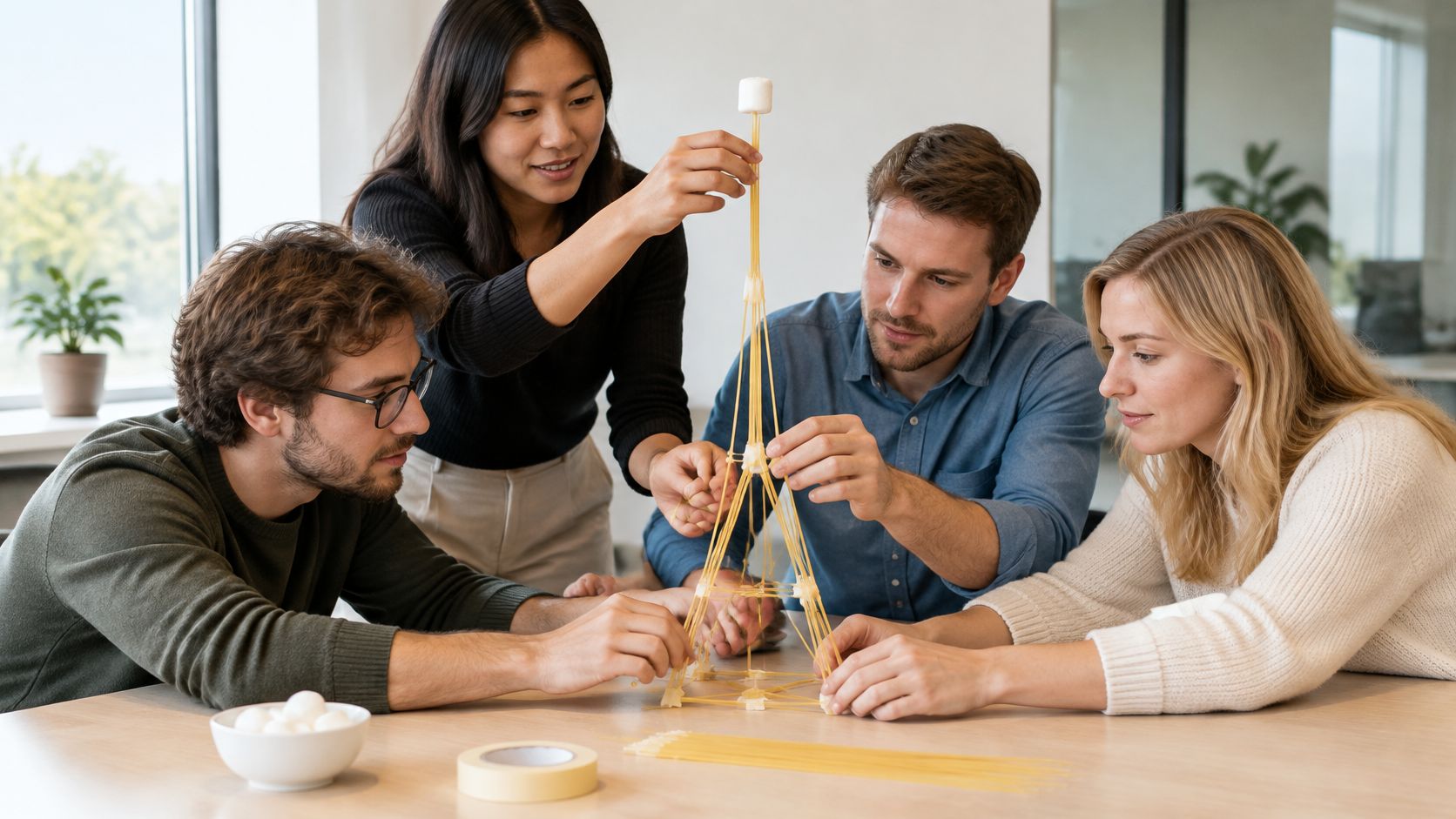
Teams build a free-standing structure with spaghetti, tape and string, placing a marshmallow on top. Use it as an opening exercise for a corporate workshop or a warm-up before a longer facilitated programme.
For a Singapore project team, connect the task to a familiar problem: colleagues spend the planning period agreeing with an attractive proposal, then discover a basic constraint near delivery.
Observe the conversation, not just the tower
Ask an observer to track when participants planned, tested, requested input and changed direction. Recording those moments is more useful than trying to count every word spoken.
- Test early: Encourage teams to check whether the structure supports the marshmallow before adding height.
- Make feedback actionable: Replace general criticism with a specific observation and proposed adjustment.
- Repeat after reflection: Let teams rebuild using an agreed communication change.
Provide stable tables, protect surfaces from tape and keep materials consistent across teams. Avoid introducing surprise advantages that turn the debrief into an argument about fairness.
The activity is inexpensive to equip, but it isn't automatically meaningful. A facilitator must distinguish between a structural failure and a communication failure. A collapsed tower may follow sensible experimentation; a standing tower may conceal a team where only a dominant participant contributed.
8. Blindfolded Minefield Navigation
A guide says “left” and the blindfolded partner steps toward a cone, not around it. The gap between intent and interpretation becomes visible in seconds.
Skill trained: precise instructions, active listening and checking understanding.
One participant crosses a marked course while a partner gives verbal directions from the edge. Keep the surface level and the obstacles soft, flat and clearly separated. Avoid steps, hard projections, running and any setup where a missed instruction could cause injury.
Trust requires a genuine choice
Offer an eyes-open alternative or an observer role without asking anyone to justify refusing a blindfold. The facilitator keeps stop authority, stays close enough to intervene and calls a reset when directions become rushed or confusing.
That caution matches local workplace conditions. A 2025 Calm Collective Asia–Milieu Insight survey found that 45% of Singapore workers reported little or no psychological safety, according to The Economic Times' coverage.
For a staff engagement day or a regional meeting breakout, require guides to state the marker's visible position before giving a movement instruction. The moving partner repeats what they heard, then asks for clarification when the instruction is ambiguous. Run it in a function room, open lawn or cleared event space; skip tight ballrooms with cables, stages and furniture edges.
In the debrief, avoid treating silence or hesitation as a trust verdict. Ask which instructions were usable, whether the guide adjusted after feedback and how comfortable the partner felt saying stop. Pair the exercise with a seated task afterward so teams can compare how their briefing changes under pressure.
9. LEGO Serious Play Workshop
A leadership team may agree that ownership is unclear while holding very different ideas about what ownership should mean. Building a model gives each participant something concrete to explain, and disagreements surface faster than they would in a round-robin discussion.
Skill trained: expressing ideas and listening without interruption.
In a facilitated LEGO Serious Play workshop, participants build models representing a challenge, relationship or desired way of working. Each builder explains the meaning of their own model; colleagues should not interpret it for them.
A useful prompt for regional leadership groups is to represent an effective handover between the Singapore office and an overseas team. Participants then identify missing information, approval points and conflicting expectations, which gives the debrief a concrete map to work from.
Give every builder equal space
- Prepare a focused question: Ask about a specific coordination problem rather than an abstract ideal team.
- Protect explanation time: Let each participant finish before inviting clarification.
- Agree on an action: Convert shared themes into a practical change with a named owner.
A general brick-building competition is a different product from the facilitated method. If the objective is strategic discussion, weight the agenda toward explanation and synthesis rather than judging the most attractive model.
Hybrid participation also needs deliberate design. Singapore leads other APAC markets on workplace flexibility, according to People Matters' report on the regional study, so expect a meaningful share of corporate groups to join partly remote.
For distributed teams, provide equivalent materials at each location, individual speaking turns and a shared digital decision log. Remote colleagues need to build and contribute, not watch an in-room conversation through a distant camera.
10. CSR Community Conservation Project with Team Debrief
Shared purpose doesn't remove the need for clear coordination. A community project can become confusing if employees arrive enthusiastic but don't understand their responsibilities or the host organisation's priorities.
Skill trained: respectful briefing, coordination and reflection.
Options include beach clean-ups, senior engagement, community interaction and area improvement. In Singapore, a corporate group might divide a conservation task into clearly assigned work areas, with designated responsibility for materials, collection and reporting.
Put the community's needs first
Agree on suitable work with the host before planning games or competitive elements. For senior engagement, prioritise consent, respectful conversation and the host's guidance over employee entertainment.
- Clarify roles: Explain the task, boundaries, reporting route and handling procedures before work starts.
- Notice communication moments: Ask participants to remember an effective exchange and an exchange that caused confusion.
- Report responsibly: Share the completed work afterwards without publishing unsupported impact claims or identifiable images without permission.
Our coordination work covers Singapore and overseas destinations including Bali, Bintan, Batam and the Philippines. The corporate volunteering guide for Singapore offers context for planning a suitable company activity.
Debrief away from beneficiaries so employees can discuss internal difficulties without making community members uncomfortable. Ask whether instructions were respectful, whether volunteers sought clarification and who noticed overlooked work.

Communication Focus and Practical Fit of Each Activity
| Activity | Primary Communication Skill | Format | Best For |
|---|---|---|---|
| Running Man-Style Communication Quest | Clear instruction and rapid information sharing | High-energy, multi-stage team challenge | Large groups seeking an active bonding session |
| The Tycoon Challenge: Trading and Negotiation Game | Negotiation and cross-team dialogue | Indoor trading simulation | Sales, operations, and management teams |
| Kin Ball: Non-Verbal Coordination Game | Verbal and non-verbal coordination | Inclusive team sport with a large ball | Mixed-fitness teams practising shared responsibility |
| Laser Clay Shooting Strategy Challenge | Role clarity and tactical communication | Team-based laser shooting challenge | Groups seeking a competitive, high-engagement activity |
| Bintan Water Sports Park Challenge (Overseas Retreat Activity) | Coordinated communication and mutual support | Overseas water-based team challenge | Singapore companies planning a retreat in Bintan |
| DISC Personality Profiling Workshop | Adapting communication to different styles | Facilitated behavioural assessment and discussion | HR teams and managers improving cross-team communication |
| The Marshmallow Challenge | Planning, feedback, and iteration | Short, low-cost team building exercise | Meeting or onboarding groups needing a quick activity |
| Blindfolded Minefield Navigation | Precise verbal instruction and active listening | Paired obstacle-course exercise | Teams building trust and clarity |
| LEGO Serious Play Workshop | Sharing ideas and listening to every voice | Facilitated model-building and reflection | Leadership teams working on strategy and alignment |
| CSR Community Conservation Project with Team Debrief | Coordination and reflective communication | Community or conservation project with a debrief | Teams combining employee bonding with social or environmental impact |
Choosing the Right Activity and Making It Happen
Start with the communication behaviour your team finds hardest. If handovers fail, choose a quest with distributed instructions. If departments protect their own priorities, use negotiation; if colleagues hesitate to clarify, choose a carefully facilitated listening exercise.
Match the format to the participants, not just the event theme. Consider mobility, language confidence, seniority, sensory needs and willingness to participate in physical tasks. A high-energy outdoor programme can suit a staff celebration, while a leadership meeting may need quieter discussion and more time to resolve competing interpretations.
Turn the objective into a delivery plan
- Set the working group size: Use smaller teams where everyone needs a speaking role, then scale through parallel groups and suitable facilitation.
- Choose the right setting: Check usable space, acoustics, shelter, accessibility and travel time, not merely venue capacity.
- Protect the debrief: Keep reflection inside the programme, before transfers, dinner or departures create pressure to finish.
- Define workplace follow-through: Agree on an observable habit, assign an owner and revisit it after colleagues return to work.
For larger Singapore events, our Sentosa arrangements can accommodate 20 participants to over 1,000, with objectives, facilitation and logistics coordinated from arrival to debrief. Scale still requires careful group allocation; a large audience watching a small number of volunteers isn't the same as broad participation.
Don't evaluate communication team building activities through enjoyment alone. A Singapore workplace well-being study drawing on Great Place to Work data found a 76.3% correlation between teamwork and the overall climate of employee well-being, as reported in the Johns Hopkins Carey Business School study. That's a relationship, not proof that an event causes improvement, so assess practical behaviours such as clearer handovers, willingness to seek clarification and more balanced meeting participation.
Companies also don't need to coordinate separate suppliers for every event component. One Dynamics, established in 2010, has more than 15 years of experience, over 1,500 corporate events and over 50,000 participants. Our one-stop corporate packages start from $35 per pax for outdoor programmes and $45 per pax for indoor programmes, with customised indoor, outdoor, virtual and CSR formats.
Regional meetings can combine hotel stays, transport, meals and facilitated activities, while our overseas retreat planning supports corporate offsites across Asia. Final pricing depends on group size, duration, venue and customisation, so request a quotation that separates programme requirements from travel and accommodation needs.
One Dynamics offers communication-focused team building in Singapore and coordinated overseas retreats, with facilitation and event arrangements aligned to your team's objectives. Visit One Dynamics to request a custom quotation, sharing your group size, preferred dates, communication challenges and budget, plus any hotel, transport and meal requirements.