Laser Tag Singapore Indoor for Company Teams
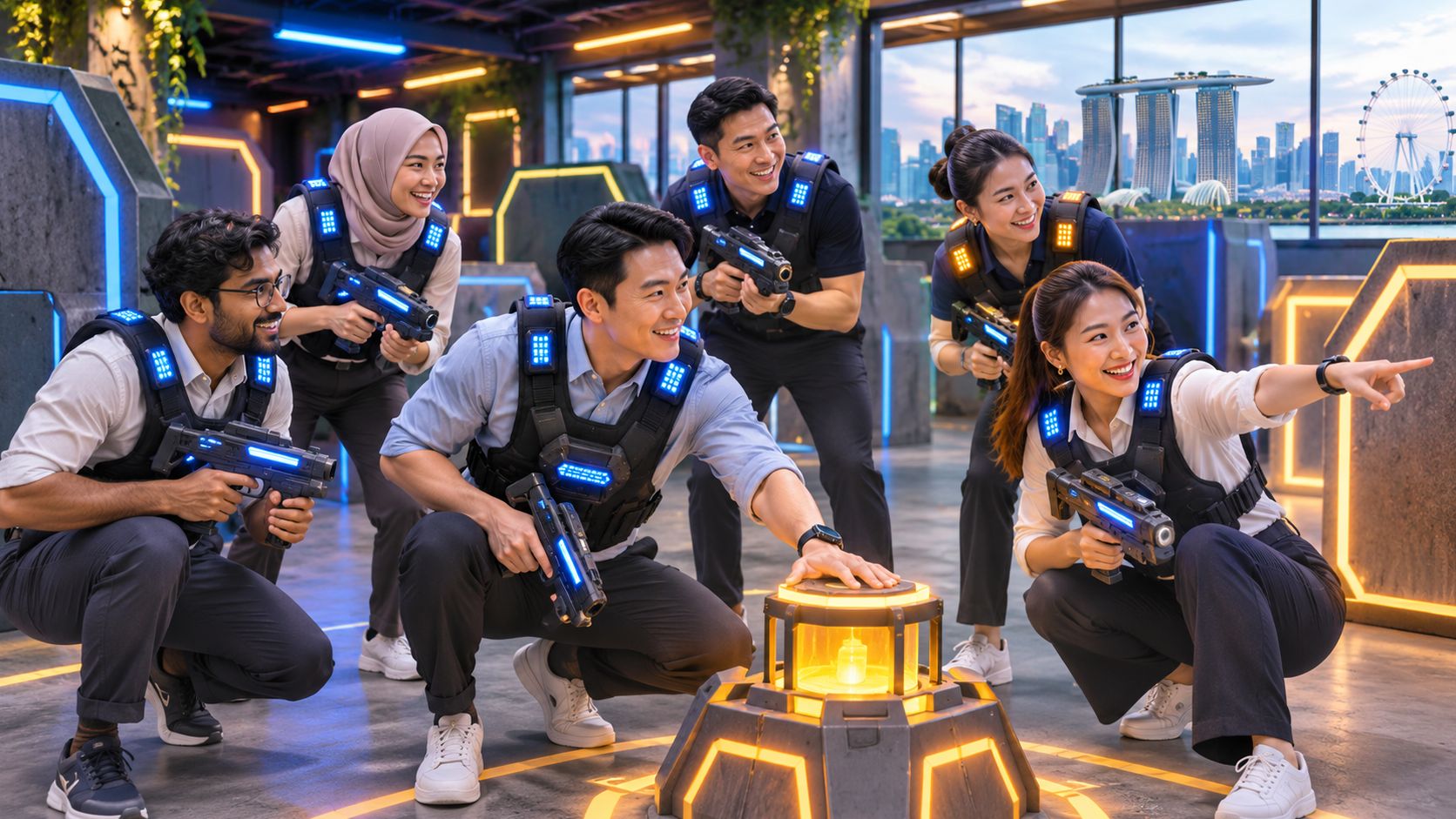
The last plenary of a regional meeting ends at 3.40pm on a Thursday. Dinner is booked for seven in the hotel's own restaurant, the breakout rooms are being reset for tomorrow, and the twenty-eight people drifting towards the coffee station include colleagues who flew in from Jakarta, Manila and Kuala Lumpur for two days of workshops. The agenda has a three-hour hole in it, and the rain outside has already cancelled the waterfront walk someone pencilled in for the group.
That hole is where indoor laser tag earns its place. It's a timed combat-simulation game played in a darkened arena, where each player wears a sensor vest and carries a low-power tagger. Nothing gets stained, nobody gets sunburnt, and the whole session runs to a schedule you control.
This guide is for the person who has to fill that hole: an HR manager or executive assistant with a real activities budget, either bonding a local department or hosting colleagues who flew in for a regional meeting and expect the hotel, the transport, the activity and the meals handled as one arrangement. By the end you'll be able to judge a private booking on more than a glossy photograph, understand how teams score points, run a safety and access check before you invite anyone, place one session inside a meeting day without wrecking the agenda, and decide whether the game needs a facilitated debrief or just a good dinner after it.
The booking snapshot comes first, because it's the part most venue roundups skip. Whether a later overseas retreat makes sense is a separate decision, and this afternoon doesn't have to solve it.
Table of Contents
- Why Indoor Laser Tag Fits a Singapore Workday
- What to Book Before You Reserve an Arena
- How Teams Play and What the Score Really Tests
- Safety Rules and Who Can Join Comfortably
- Fitting a Session into a Regional Meeting Day
- What a Game Can and Cannot Fix at Work
- Book a Facilitated Indoor Session in Singapore
Why Indoor Laser Tag Fits a Singapore Workday
An indoor arena removes the two variables that wreck a corporate afternoon: weather and drift. The game runs in an air-conditioned space with walls, lanes and cover, so an afternoon downpour changes nothing, and the briefing area, holding space and exit all stay within sight between rounds.
That containment is the product: a start time and an end time the rest of the day can be built around.
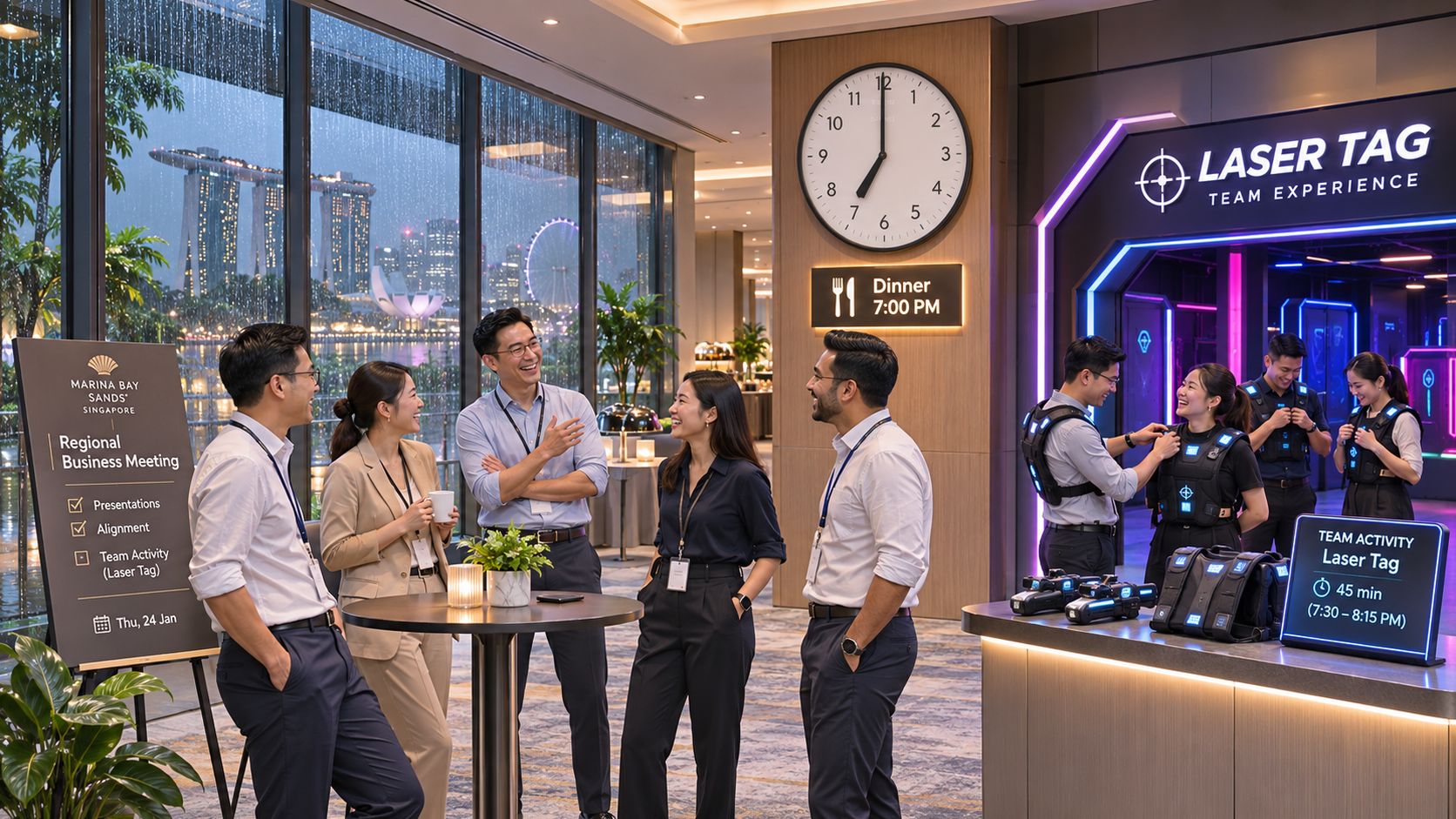
The public version of this activity is a children's birthday: one shared hour, lanes mixed with strangers, cake afterwards. The corporate version is a different purchase. You need the arena to yourselves, a host who briefs the rules properly, a scoreboard that means something to the people in the room, and a timetable built around your meeting rather than the venue's walk-in traffic. A department of forty will probably play in waves; a regional group arriving by coach may need dinner within walking distance of the venue.
Where the budget actually goes: privacy, facilitation and the logistics wrapped around the hour. The taggers are the cheapest part.
A fair question is whether one afternoon changes anything measurable once everyone is back at their desks. If tracking that sits inside your role, the tools collected under piattaforme di performance management alternative record goals and check-ins across months, a longer clock than any single game runs on.
Five decisions sit between a glossy venue photo and a session that fits the day: what you are booking, how the game is played and scored, who can take part comfortably, where the session lands inside the meeting schedule, and what happens once the last round ends. The checks that matter, tagger output, step-free access, whether a debrief is included, are the ones venue roundups tend to skip.
What to Book Before You Reserve an Arena
A listed Singapore private package starts from S$25 per player in 2026 with a minimum group of 8 participants, according to LaserTag.SG. Treat that as a public floor rate rather than a corporate quotation. The moment you ask for a private arena, a host briefing, scorekeeping and several waves, you're buying something different from a walk-up game, and the invoice will say so.
| Planning item | Known Singapore benchmark | What HR should confirm |
|---|---|---|
| Private package price | From S$25 per player in 2026 (LaserTag.SG) | Whether a private arena, briefing and facilitation are charged separately |
| Minimum group | 8 participants for a listed private package | Arena capacity, and whether a larger department must play in waves |
| Laser output | Not above 1.5 mW under the Singapore Police Force's amusement-centre conditions | A written note of approval from the Centre for Radiation Protection |
| Play zones | Players kept out of the line between taggers and targets | A briefing covering beam direction, the emergency stop and no-touch handling |
| Access and effects | Stairs, strobe lighting and fog differ between venues | A step-free route, the option to limit effects, and non-running roles |
Read the table as five questions
Price. The S$25 figure buys a slot at a stated minimum. A company booking usually adds privacy, a referee, a readable result and often multiple waves. Ask for the quote broken down: arena hire, per-player fee, facilitator, food, transport and any weekend surcharge. The number that matters isn't the headline rate, it's the total divided by the people who turn up.
Minimum group. Eight is the venue's floor, not your headcount. If 34 colleagues are coming, ask how many can be on the floor at once and how long one wave takes, because three waves of twelve change your schedule before you've left the office.
Equipment and approval. Ask the venue to confirm in writing that its equipment and operating model meet the amusement-centre conditions, and to state the output limit and approval it operates under.
Play zones. Confirm the format keeps players out of the firing line between taggers and targets, rather than relying on participants to remember it in the dark.
Access and effects. A step-free route, the option to reduce strobe and fog, and a role for anyone who can't sprint. Ask before invitations go out, not after someone replies to the calendar invite with a question.
Documents worth requesting before a deposit:
- Equipment confirmation: a written statement of output and the regulatory approval the venue operates under
- Briefing outline: what the host covers, including the emergency stop and prohibited zones
- Floor description: entry route, stairs, exits and where bags and bottles are stored
- Contingency terms: what happens if the group arrives late, or if fewer people attend than booked
Ask in writing: a venue that can't answer the equipment, zone and access questions before you pay a deposit is an incomplete supplier, not a cheaper one.
Get those answers and the rest of the planning gets easier, because you'll know the floor, the capacity and the constraints before a single invitation goes out.
How Teams Play and What the Score Really Tests
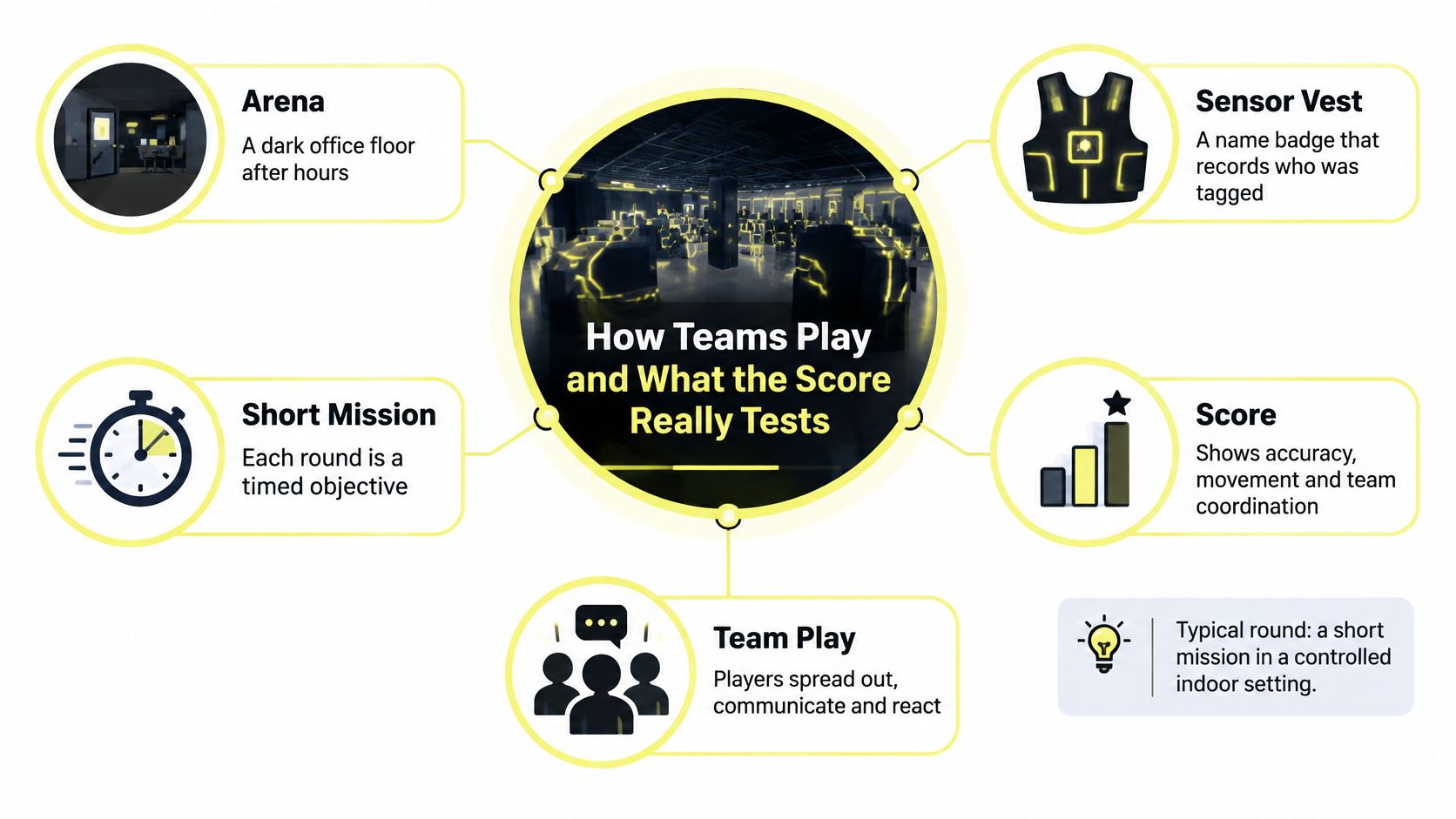
Picture the arena as your office floor after everyone has gone home. The lights are low, the layout is unfamiliar, and the only way to know what's happening two lanes over is for someone to tell you. Each sensor vest is a name badge that records who was tagged and by whom, so the scoreboard becomes a record of decisions rather than a record of athleticism.
The shape of a round
Most sessions are built from short missions, often a few minutes each, reset several times so nobody sits out the whole hour after an early tag. Formats differ between operators, but three objectives turn up again and again. Team elimination rewards accuracy and patience. Capture or hold a base rewards coordination, because holding ground needs someone watching a lane while someone else moves. Escort or defend a nominated player rewards planning, since the protected person has to be told where to go.
Four roles to assign before the lights drop
A facilitator who names roles before play gets a far more useful session than one who lets the group self-organise.
- Scout: moves first, reports back, and is the person who finds out where the opposition is.
- Defender: holds a lane and resists the urge to chase, which is harder than it sounds when the score is close.
- Commander: calls reloads and rotations, decides when to fall back, and is the voice the squad listens to.
- Support: watches the scoreboard, tracks time, and tells the team when to stop attacking and protect a lead.
The score then tells you something more interesting than who won. Did information reach the people who needed it? Did one loud colleague monopolise the tagger while three quieter ones stood still? Did the analyst who never speaks in meetings say something decisive once handed the commander vest? Those observations are worth more to you than the final tally, and they're what a debrief later draws on. Read more on structuring that kind of communication team building activity so the lesson survives the drive back to the office.
Two edge cases are worth planning for. Large groups should rotate in waves so the debrief compares squads rather than crowning one athlete. And brand-new hires shouldn't spend their first outing as the only visible target, because being eliminated repeatedly in front of a new team is a memorable experience for the wrong reason.
Safety Rules and Who Can Join Comfortably
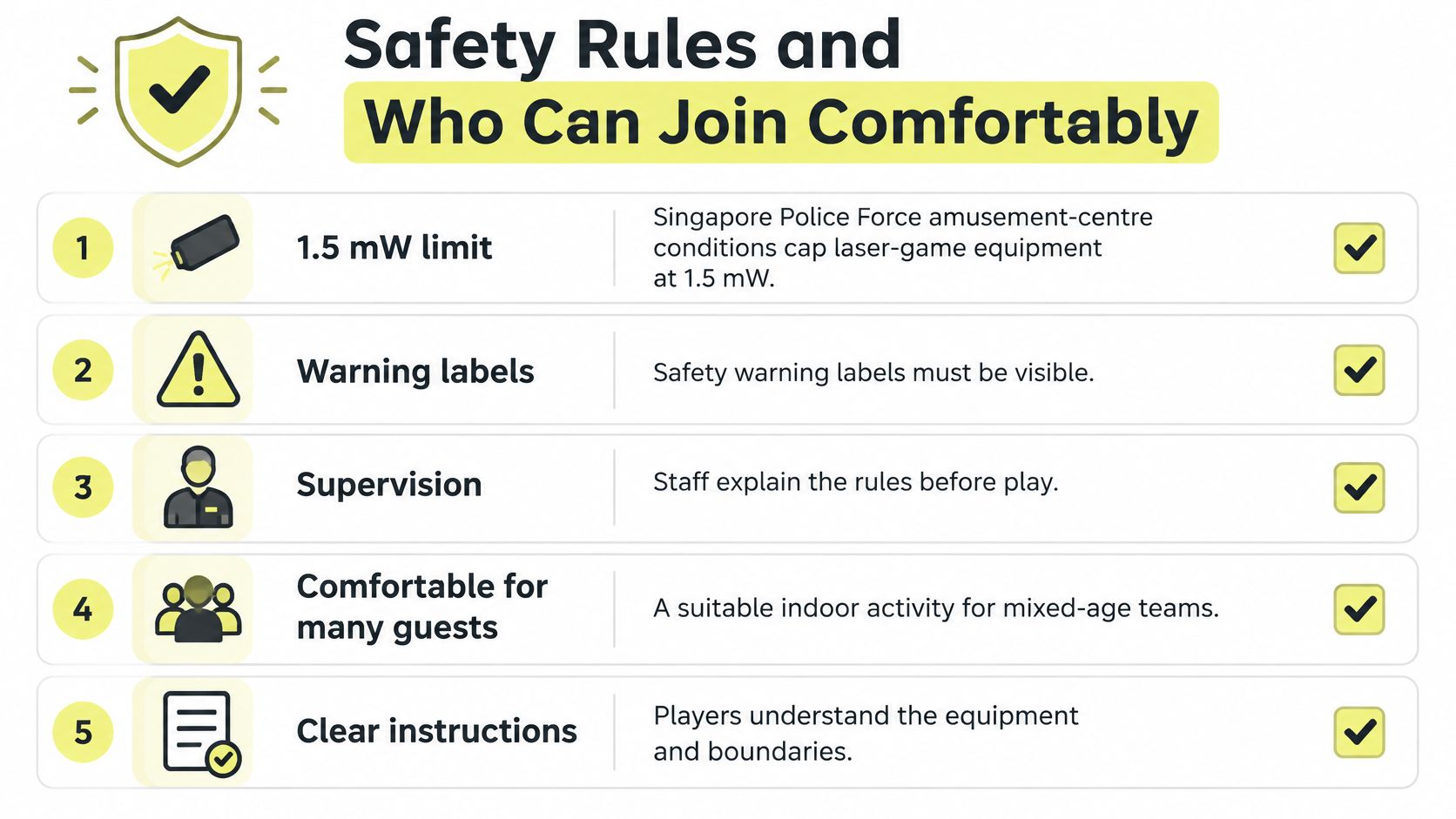
Start with the equipment, not the décor. The Singapore Police Force's amusement-centre conditions specify that laser-game equipment must not exceed 1.5 mW output, must carry safety warning labels, must prevent players from entering the line between laser guns and targets, and requires prior approval from the Centre for Radiation Protection, Health Sciences Authority before operation, as set out in the SPF amusement-centre licence conditions. Hazard depends on wavelength, exposure duration, power output and accessible emission level, which is why the word "laser" alone tells you nothing about a particular venue. A compliant arena can disclose its output limit and keeps firing zones controlled.
So the pre-event control is administrative, not athletic. Request written confirmation that the venue's equipment and operating model satisfy those conditions, then check that its briefing covers beam direction, prohibited play zones, emergency stopping and equipment handling.
Low impact is not the same as inclusive
An activity can be gentle on the joints and still exclude people through a staircase, a strobe light or a rule against mobility aids. Singapore venue information flags stairs, strobe lighting and fog as conditions to verify before booking, as Battlebox's laser tag venue notes set out, along with safety briefings that cover emergency stops and no-running rules. That's the gap to close: not whether laser tag is generally safe, but whether a specific arena is usable for every person on your list.
| Employee situation | Barrier to verify | Way to take part |
|---|---|---|
| Uses a wheelchair or cannot climb | Stairs and narrow lanes | Fixed post or strategist if there is no step-free route |
| Sensitive to light, fog or noise | Strobe, haze and loud music | Effects reduced, or the briefing held outside the arena |
| Cannot or should not run | Chase rules and tight corners | Scorekeeper, commander or station-based player |
| Hearing difficulty | Spoken briefing only | Written mission card and a named buddy |
| New hire or senior leader | Public elimination and banter | Mixed squads and a debrief that credits calls, not only tags |
If the venue can't describe its stairs, its lighting and a role that keeps a non-runner in the game, don't tell the company that everyone can play. Our guide to accommodating diverse team member needs during activities covers the questions that get a useful answer rather than a reassuring one.
Ask for a specific person, a specific role and a specific route. "Anyone can play" is a marketing line, not an answer.
Fitting a Session into a Regional Meeting Day
A booking in isolation is easy. A booking welded into a day with flights, a hotel, a conference block and a dinner reservation is the brief, and it falls apart when nobody owns the whole sequence. Write the day out before you approach a venue, because the arena has to slot into an existing gap.
One day, written out
Take a visiting regional team of about thirty. The morning is a conference block in the hotel's meeting room, finishing at noon. Lunch is a short walk away, booked for 12.30. A coach collects the group at 1.45 for an early-afternoon transfer to the arena, where 60 to 90 minutes of play covers briefing, several rounds and a short debrief. The coach returns by 4.15, giving people time to change before a 7pm group dinner in the same hotel.
The national picture supports the investment. Singapore's MICE tourism receipts reached S$2.3 billion in 2025, up 35% from S$1.7 billion in 2024, and the country held its position as Asia-Pacific's leading meeting city for the 23rd consecutive year with 156 ICCA-tracked meetings in 2025, according to the Singapore Tourism Board. Companies are making real budget decisions about bringing people here.
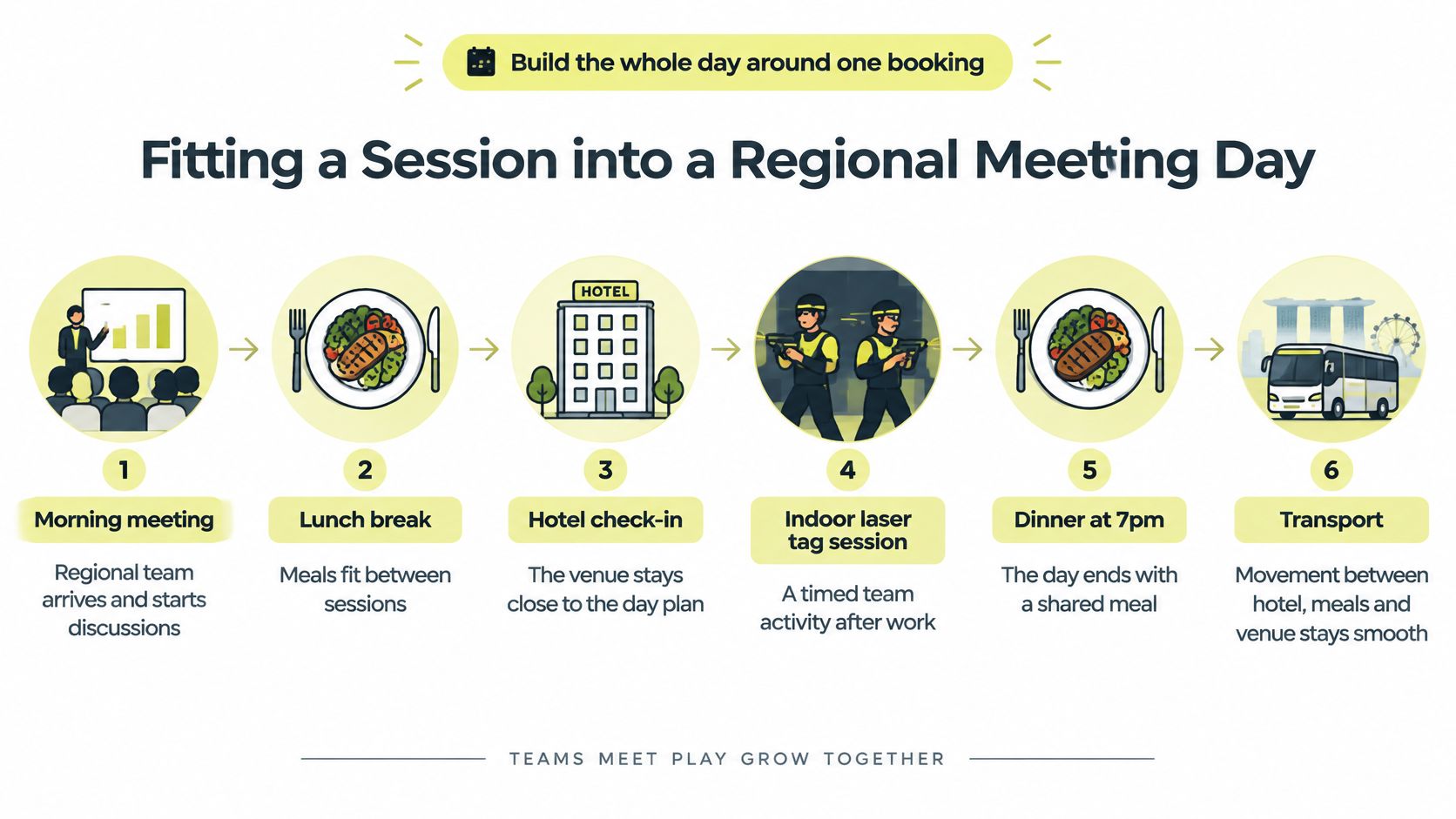
Name one coordinator who owns the hotel stay, the airport or inter-hotel transport, the activity window and the dietary requirements. When three people each own a piece, the coach leaves without the two colleagues who were still in a breakout session.
Build the whole day around one booking, not one booking around an already full day. If the only available gap is during a working session, the answer is a shorter session, not a cancelled meeting.
When the group is too large for one arena
For a larger incentive group, make laser tag a choice session running alongside a meeting stream or a longer lunch. Delegates who want to play get a time slot, delegates with a client call or a mobility need aren't pushed through a small arena, and nobody is herded through a queue for forty minutes. Waves also give you a comparison: the debrief can contrast how three squads approached the same objective.
When the real brief is an offsite
If the conversation has already moved from one afternoon to a two-day retreat, the same logic travels. An overseas programme packages accommodation, transfers, meals and activities into one itinerary, and indoor problem-solving sessions hold their slot even when weather or formal meetings eat the daylight.
What a Game Can and Cannot Fix at Work
Here's the uncomfortable part. A lively hour doesn't move an engagement score. Singapore-specific figures from Gallup's workplace data for Singapore put employee engagement at 14%, against 25% across Southeast Asia and 20% globally. Among employees under 35, engagement was reported at 10%, versus 16% among older employees. A squad capturing a base on a Thursday won't shift those numbers by itself.
So be honest about what you're buying. If the aim is a shared experience, a decent lunch and a reason for two departments to learn each other's names, laser tag does that well. If the aim is clearer handovers, faster escalation or a team that stops talking over each other, an hour of shooting is a starting point at most, and only if someone converts it into a lesson afterwards.
Entertainment is not development
The distinction shows up in preparation. Before the event, HR writes one observable aim, such as clearer handovers between shifts or wider participation in meetings, not a vague hope to lift morale. During play, a facilitator notes who gets interrupted, who shares the objective and who withdraws once the score goes public. After the final round, run four questions with the group:
- What information arrived too late, and who was waiting for it?
- Whose call changed the round, and did anyone thank them for it?
- Where did competition drown out a teammate, and what would you do differently?
- What one habit will you try on Monday, and who will notice if you don't?
That last question is the bridge back to the office, and it's where a lot of programmes stop short. If miscommunication is the underlying issue you're chasing, this breakdown of miscommunication in the workplace is worth reading before you write the debrief questions, because it separates unclear instructions from unchallenged assumptions.
What to measure afterwards
A week later, send a four-question pulse survey and agree one visible action, such as rotating who chairs the next stand-up. If you're building this into a wider programme, the design principles behind corporate training in Singapore apply to the debrief as much as to the classroom session.
And skip laser tag entirely when the actual issue is workload, pay or a live conflict between two people. A game that forces them onto the same squad makes the problem worse, and everyone in the arena will know it.
Book a Facilitated Indoor Session in Singapore
Three decisions settle the brief before you ask anyone for a quotation. First, headcount and waves: how many people, how many can be on the floor at once, and whether the group splits. Second, the one behaviour the debrief should name, because a session with no stated aim becomes a photo opportunity. Third, the shape of the booking: is this an afternoon insert in a Singapore meeting day, or the activity block inside a larger overseas offsite?
One Dynamics runs customised indoor, outdoor and CSR team-building programmes in Singapore, combining event planning and programme delivery in one provider, with F&B arrangements coordinated to complement the activity. Indoor team building starts from $45 per pax, and Combat Skirmish Laser Tag from $55 per person. That format uses infra-red rays for combat simulation games with changing objectives, so participants have to think both as individuals and as a squad, which is exactly what the debrief questions earlier are built to surface.
Send four things when you enquire: group size, preferred date, the hotel or office you're working around, and any access needs from the inclusion table. Ask for the written equipment confirmation before paying a deposit. If the brief turns out to be an overseas retreat rather than one afternoon, programmes in Bintan, Bali and Langkawi mean the offsite arrives as one package instead of five vendor threads.
One Dynamics has spent more than fifteen years building indoor and outdoor team-building programmes for Singapore companies, including Combat Skirmish Laser Tag sessions built around changing mission objectives that test individual decisions and team coordination. If you're holding a regional meeting in Singapore and need the activity and meals to run as one itinerary, or you're ready to move a whole offsite overseas, One Dynamics can quote the full programme around your headcount and dates. Visit One Dynamics to start the conversation, and bring your access needs with you so the arena is checked before anyone is invited.