8 Leadership Development Activities for Singapore Teams
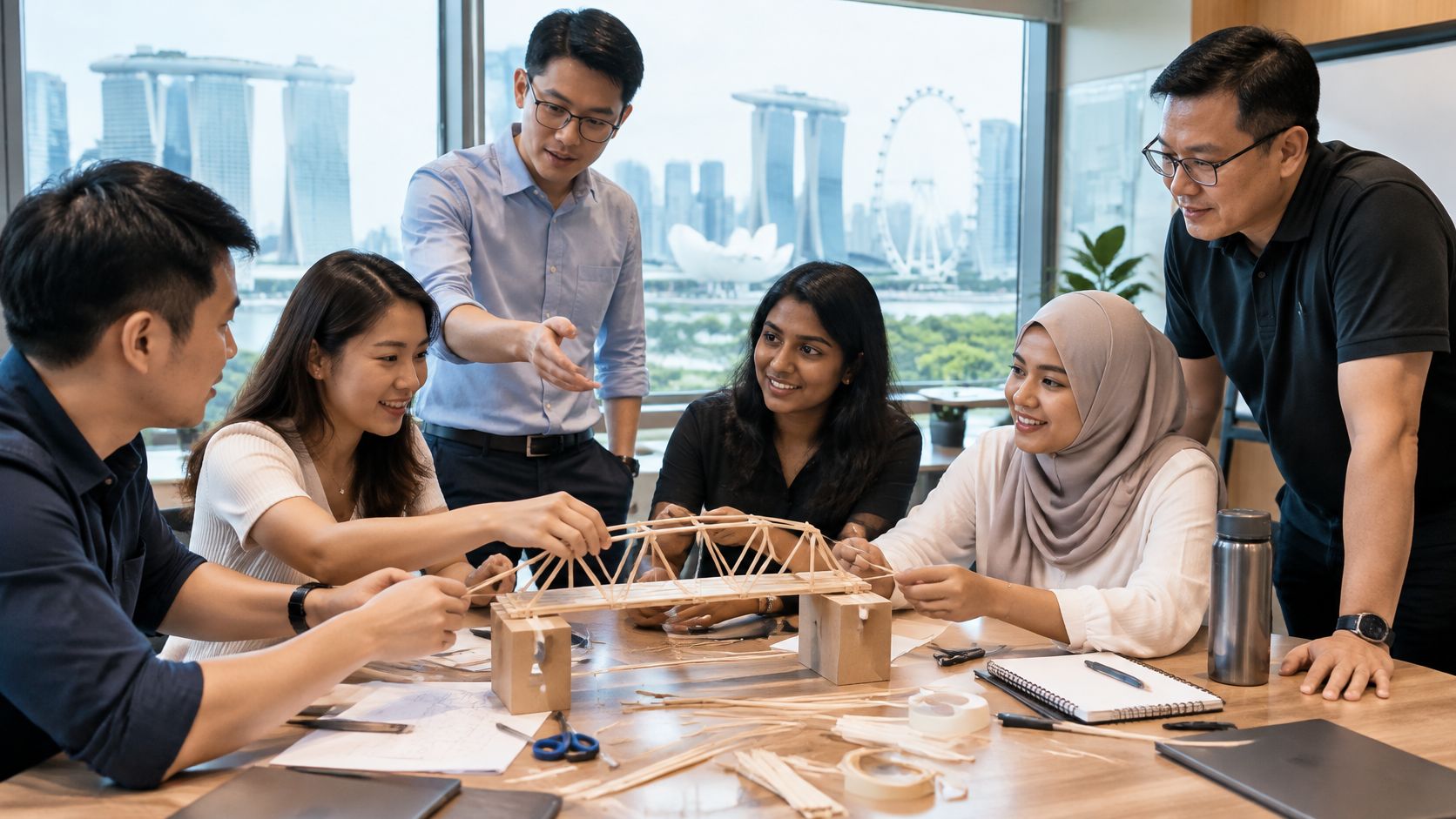
A senior manager who runs crisp Monday stand-ups steps into an offsite challenge with a 60-second timer. Two junior staff offer conflicting ideas, the clock drops below half, and she grabs the equipment to finish the task herself. Her team watches in silence.
That single moment reveals more about her delegation habits than an entire day of leadership slides. Real habits surface when people act under pressure, not when they nod along in a conference room. Yet many Singapore firms still underinvest in practical practice. In the 2025 NTUC LearningHub Leadership and Coaching Report, which surveyed 150 business leaders and 300 full-time working professionals in Singapore, 60% of business leaders acknowledged gaps in their leadership abilities, but only 44% had participated in leadership training during the preceding year. Encouragingly, 76% of business leaders believed the training they did receive developed their abilities.
What turns a lively corporate afternoon into genuine capability is the structured debrief that follows. At One Dynamics, our Lead Facilitator, Josh Tay, builds in-house programmes around continual observation and data-driven debriefs that link game behaviour back to daily office friction. That same principle applies whether you're planning full-department workshops or exploring team exercises for startup executive teams.
The eight leadership development activities below cover indoor venues, outdoor fields, community projects, and overseas retreats from Singapore. Each one isolates a single leadership behaviour, pairs it with a practical role rotation, and gives you a sharp debrief question so the lesson sticks.
Table of Contents
- 1. Laser Clay Shooting Team Challenge (Singapore)
- 2. The Tycoon Challenge
- 3. Kin Ball Team Sport
- 4. Running Man-Style Team Game Challenge
- 5. DISC Personality Profiling Workshop
- 6. Bintan Water Sports Park Challenge (Overseas Team Retreat)
- 7. Corporate Community and Conservation Offsite
- 8. End-to-End Corporate Offsite and Regional Meeting Package
- How the eight leadership development activities compare by setting, price and best use
- Turning One Afternoon Into Lasting Leadership Habits
1. Laser Clay Shooting Team Challenge (Singapore)
High-energy competitions often create an illusion of great teamwork. Everyone cheers, scores climb, and two confident voices dominate every decision while quieter colleagues fade into the background. Laser Clay Shooting exposes that exact dynamic because teams compete across timed rounds using laser-equipped shotguns aimed at clay targets on a screen or range setup.
The leadership behaviour this activity forces is calm delegation under visible time pressure. A squad leader can't fire every shot alone, so they must read each teammate's pacing, set a simple firing order, and stay composed when a round goes badly. Without deliberate guardrails, however, loud rivalry can shut down honest feedback. A 2025 Calm Collective Asia and Milieu Insight survey found that more than six in ten Singapore workers did not feel psychologically safe, while 45% said their workplace provided little or no psychological safety.
Facilitator rule: Never judge a competitive session by applause or noise levels. Watch who stays silent between rounds, because that's where your real leadership gap sits.
Running the Role Rotation and Debrief
Say a 24-person regional operations team splits into four squads for an afternoon offsite. Instead of letting the department head lead all afternoon, appoint a rotating squad captain before every round. Give each new captain two minutes to gather input from the quietest squad member first, agree on a target sequence, and call the round.
To get real behavioural transfer rather than just an energetic afternoon, tighten how you plan the session:
- Hold a focused post-round debrief: Spend 15 to 20 minutes asking the group which specific instruction helped under pressure and which one added noise.
- Match the venue to your objective: Laser Clay Shooting works indoors or outdoors, so confirm room acoustics, safety zones, and session length early.
- Flag participant sensitivities upfront: Ask HR to check for any discomfort around simulated shooting formats so facilitators can adapt roles or offer a parallel station.
- Connect competition to evening bonding: Many companies pair a competitive afternoon challenge with relaxed Singapore staff party ideas to keep momentum high without losing the afternoon's coaching insights.
End the session with one direct debrief question: when the score dropped mid-round, did the captain open space for quick advice, or did they take over and stop listening?
2. The Tycoon Challenge
Classroom workshops rarely test how managers handle competing departmental priorities when resources run dry. Here is what a focused strategy simulation looks like when cross-functional colleagues sit around one table.

Imagine a regional management group from finance, sales, and marketing gathering before quarterly planning. Each table operates as a rival business in The Tycoon Challenge, buying raw materials, negotiating trades, managing cash flow, and weighing risks across several timed rounds. Within 20 minutes, finance leaders start guarding reserves while sales leads push aggressive bids, recreating real office silos in miniature.
Singapore employers already invest heavily in formal courses. Ministry of Manpower data cited in the Singapore Business Federation's AfA-BLD Insights Report.pdf?sfvrsn=b01fc3e6_1/) shows that 65.4% of companies provided employee training in 2020, backed by more than 4,000 "Leadership and People Management" courses on MySkillsFuture and over 2,200 leadership courses on LinkedIn Learning. The gap isn't access to theory. It's giving managers a safe arena to practise commercial trade-offs and cross-functional negotiation before real revenue is on the line.
Assigning Cross-Functional Roles
The fastest way to waste a business simulation is letting people play their everyday job titles. Swap them instead. Put an operations lead in the CFO seat, assign a finance manager as sales negotiator, and rotate the CEO role halfway through the rounds so two people experience final sign-off pressure.
Our in-house facilitators adapt the trading variables to mirror your sector's real bottlenecks, whether that's tight inventory, margin compression, or regulatory constraints. Define one clear commercial objective before the first bell rings so participants know what they're testing.
Close with a debrief question tied straight to Monday's budget meeting: which concession felt risky during trading, and how did your team weigh short-term wins against next round's survival?
3. Kin Ball Team Sport
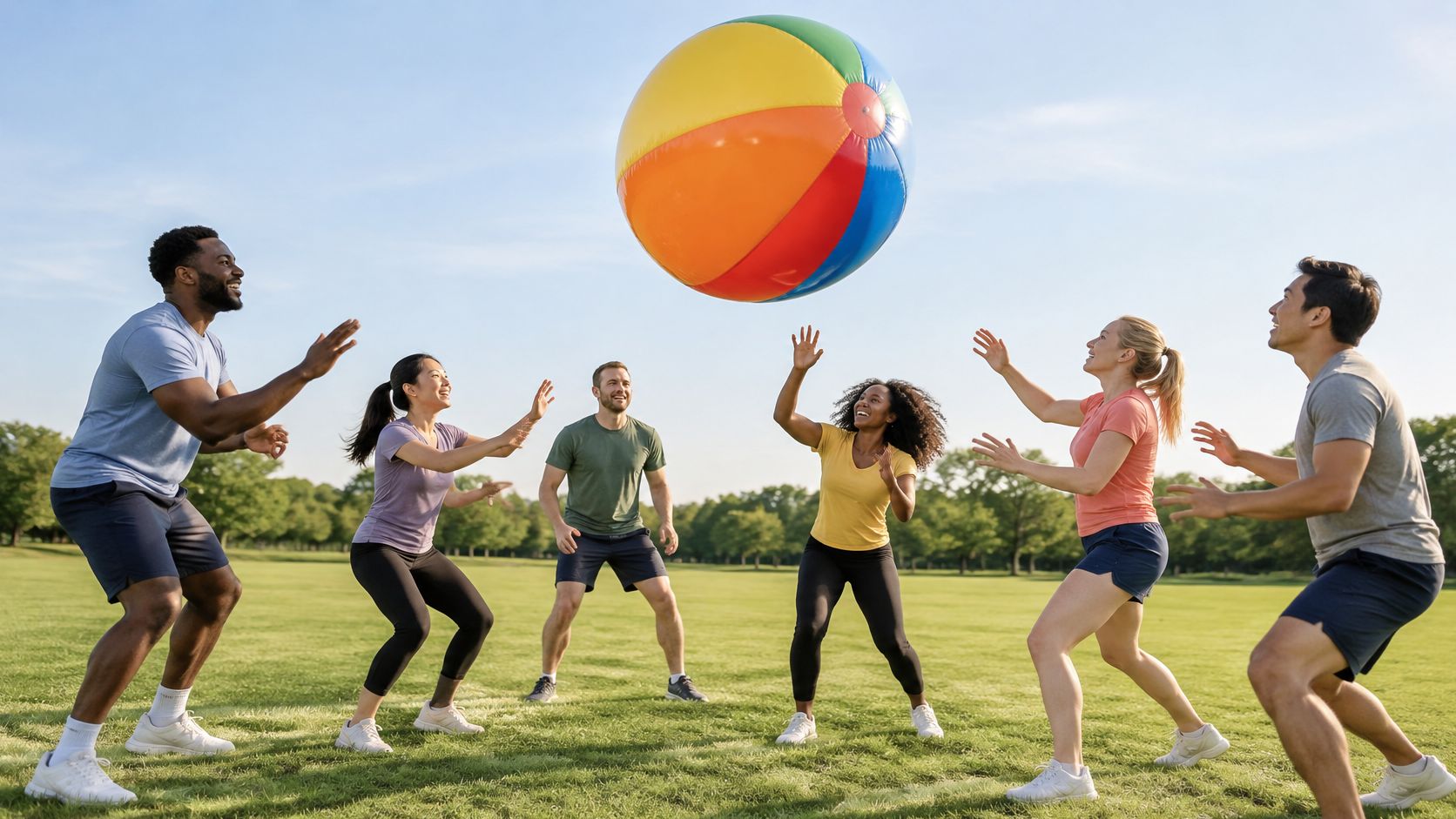
Most corporate managers are fluent in email threads and slide decks, yet struggle to give crisp, real-time support when conditions shift every three seconds. Kin Ball strips away slow office habits immediately. Played with an oversized inflatable ball roughly two metres across, the game pits teams against one another to keep the giant ball from touching the ground while opponents try to force a landing.
No single athlete can carry a Kin Ball squad. Because every serve and catch requires simultaneous movement from multiple players, the game forces real-time vocal support and collective accountability. That matters for Singapore's younger workforce. According to Deloitte's 2025 Gen Z and Millennial Survey, only 38% of Singapore Gen Z respondents and 34% of Singapore millennial respondents said their managers provided guidance and support to team members in 2025.
Because the format doesn't favour traditional sports stars, junior staff and senior directors start on equal footing. You can see the collective reach and energy required in an outdoor group setting below.
Keeping Play Inclusive and Structured
Suppose a sales department books Kin Ball ahead of a demanding quarter-end push. To stop familiar cliques from forming, remix team rosters after every round and nominate one designated caller per squad whose sole job is calling out player names and landing zones before the ball drops.
- Right-size your squads: Keep team numbers compact so nobody stands on the sidelines waiting for a turn.
- Book a wet-weather fallback: Singapore afternoon storms and midday heat derail outdoor fields quickly, so lock in a sheltered court or indoor hall early.
- Debrief the signal system: Spend ten minutes right after the final whistle dissecting which verbal calls prevented collisions and where hesitation cost points.
Ask one practical debrief question before everyone grabs water: when the ball dropped, did teammates assume someone else had it covered, and where does that exact assumption happen on live client projects?
4. Running Man-Style Team Game Challenge
Large company-wide bonding days often fail for a simple reason. Planners design one massive game, two outspoken extroverts seize control of every clue, and half the group spends two hours walking behind them checking their phones.
A Running Man-Style Team Game Challenge solves that when built with deliberate constraints. Adapted from the Korean variety format into corporate missions, teams race across a venue completing timed physical relays, mental puzzles, and trivia stations to earn points and strategic advantages. Because Singapore's workforce participates widely in structured upskilling, with a Ken Research Singapore corporate-education market analysis reporting that 54.8% of the resident labour force and 57.1% of employed residents participated in training in 2025, organisations get far better returns when leadership practice reaches mixed-level departments rather than only senior executives.
The behaviour this challenge forces is rapid role allocation across mixed abilities. Good leaders spot strengths fast, pair analytical thinkers with high-energy runners, and adjust tactics when a station throws a curveball.
Loud energy is not the same as shared ownership. If one person solves four stations in a row, your challenge entertained the room without developing a single new leader.
Designing Missions Where Everyone Leads
Say a regional company runs a themed challenge to integrate newly onboarded staff with colleagues from three ASEAN offices. Build at least two stations that strictly require every teammate's input before points count. To prevent senior managers from defaulting into the captain's seat at every stop, use a quick randomiser like the FlipSimu dice roller to assign a fresh station lead at each checkpoint.
Keep logistics tight so the pace stays sharp. Publish the exact scoring rules and cut-off clock before launch, and design every physical station with low-impact alternatives so colleagues of all mobility levels stay fully involved. With 42.8% of training delivery estimated to happen digitally in that same market analysis, pairing the physical race with a quick digital reflection form the next morning extends the learning well past the finish line.
Your debrief question here should target delegation habits: how quickly did each station lead identify a teammate's hidden strength, and how often do you pause to do that before assigning office tasks?
5. DISC Personality Profiling Workshop
Personality workshops earn a bad reputation when facilitators hand out colourful four-letter charts, laugh about office stereotypes, and pack up by 4pm. Nobody changes how they run a difficult one-on-one because they learned a colleague is high-D or high-S.
Done properly, a DISC Personality Profiling Workshop forces adaptive communication and empathetic coaching. By mapping working preferences across Dominance, Influence, Steadiness, and Conscientiousness, managers learn to spot why direct pushback energises one direct report while shutting down another. That skill is urgently needed in Singapore workplaces. June 2025 Singapore data from the TELUS Health Mental Health Index found that only about half of people leaders felt equipped to address employee mental-health issues, 39% were unsure what to do if an employee struggled, and 27% reported no training in effective coaching or management techniques.
Using structured behavioural language helps managers notice stress responses early, hold supportive conversations, and keep clear boundaries without pretending to be therapists. Teams looking for a deeper breakdown can explore our guide on using DISC profiling for leadership development, which walks through how profiling pairs with management coaching.
When a leadership team of twelve sits down to review their combined map, the workshop stops feeling theoretical and immediately reshapes real meetings.

Turning Profile Data Into Meeting Habits
DISC works best with groups of at least ten participants so every behavioural style is visible in the room. Pair the profiling readout with a live role-play where each manager practises delivering critical feedback or checking in on an overwhelmed colleague using an unfamiliar style.
- Frame profiles for growth, not appraisal: State upfront that DISC scores never factor into performance reviews, otherwise people answer defensively.
- Rotate meeting facilitation styles: Have a fast-paced D-style leader run a consensus-building discussion while a steady S-style manager drives a rapid decision sprint.
- Schedule a 30-day check-in: Revisit one concrete team habit four weeks later, such as shortening weekly updates for direct thinkers while sending pre-reads to analytical colleagues.
Ask the room this debrief question before closing: which workplace behaviour from another style frustrates you most, and what small adjustment will you test in your next one-on-one?
6. Bintan Water Sports Park Challenge (Overseas Team Retreat)
Keeping an offsite in Singapore saves travel time, yet staff often slip back into checking Slack between sessions or ducking out early for dinner errands. Crossing the straits for a Bintan Water Sports Park Challenge changes the psychological container in under an hour by ferry, without the jet lag or budget strain of a long-haul trip.
That short-hop model makes particular sense for companies flying in regional managers from across Asia. In a 2025 Tourism Industry Conference speech by Singapore Tourism Board Chief Executive Melissa Ow, Singapore is positioned as a major Asian air hub whose seat capacity to Mainland China, Malaysia and Australia had returned to pre-pandemic levels, while capacity to India and South Korea had exceeded 2019 figures. Regional heads can land at Changi, link up with Singapore teams, and head straight into a focused multi-day resort itinerary.
The leadership behaviour water challenges force is leading calmly through unfamiliar environments where office titles carry zero weight. On floating obstacle courses and relay rafts, a senior vice president falls in just as fast as a graduate analyst.
Structuring a Two-Day Bintan Itinerary
Imagine a regional sales organisation spending two days in Bintan. Day one opens with mixed-seniority squads tackling water relays where newly promoted managers serve as safety and pacing coordinators, balancing risk-taking with group stamina. After dinner, the same squads sit down for a facilitated strategy review while informal trust is still fresh.
Strip away office titles in the water, watch who naturally steps up to steady a nervous teammate, and bring that exact habit back to Monday's pipeline review.
Good overseas retreats live or die on friction-free logistics. Confirm passport validity and visa rules at least six weeks ahead, build generous buffers around ferry schedules and coastal squalls, and book an all-in package covering transfers, resort rooms, meals, and facilitated debriefs so HR isn't chasing five separate vendors across borders.
During the evening reflection, ask one pointed debrief question: who earned the group's trust fastest on the water today, and what specific actions made people willing to follow them?
7. Corporate Community and Conservation Offsite
Singapore professionals already put serious hours into formal upskilling. SkillsFuture Singapore's 2024 Year in Review notes that participation in SSG-supported training rose from approximately 520,000 learners in 2023 to 555,000 in 2024, an increase of roughly 6.7%. Technical skills keep climbing, yet classrooms rarely build servant leadership and stakeholder empathy.
A Corporate Community and Conservation Offsite fills that gap by pairing structured teamwork with real social impact. Depending on your goals and budget, teams can join senior engagement or neighbourhood improvement projects right here in Singapore, or travel to conservation sites in Bintan, Batam, Bali, or the Philippines. Companies planning local impact initiatives can review structured formats for corporate volunteering in Singapore to see how community projects integrate with facilitated team reflections.
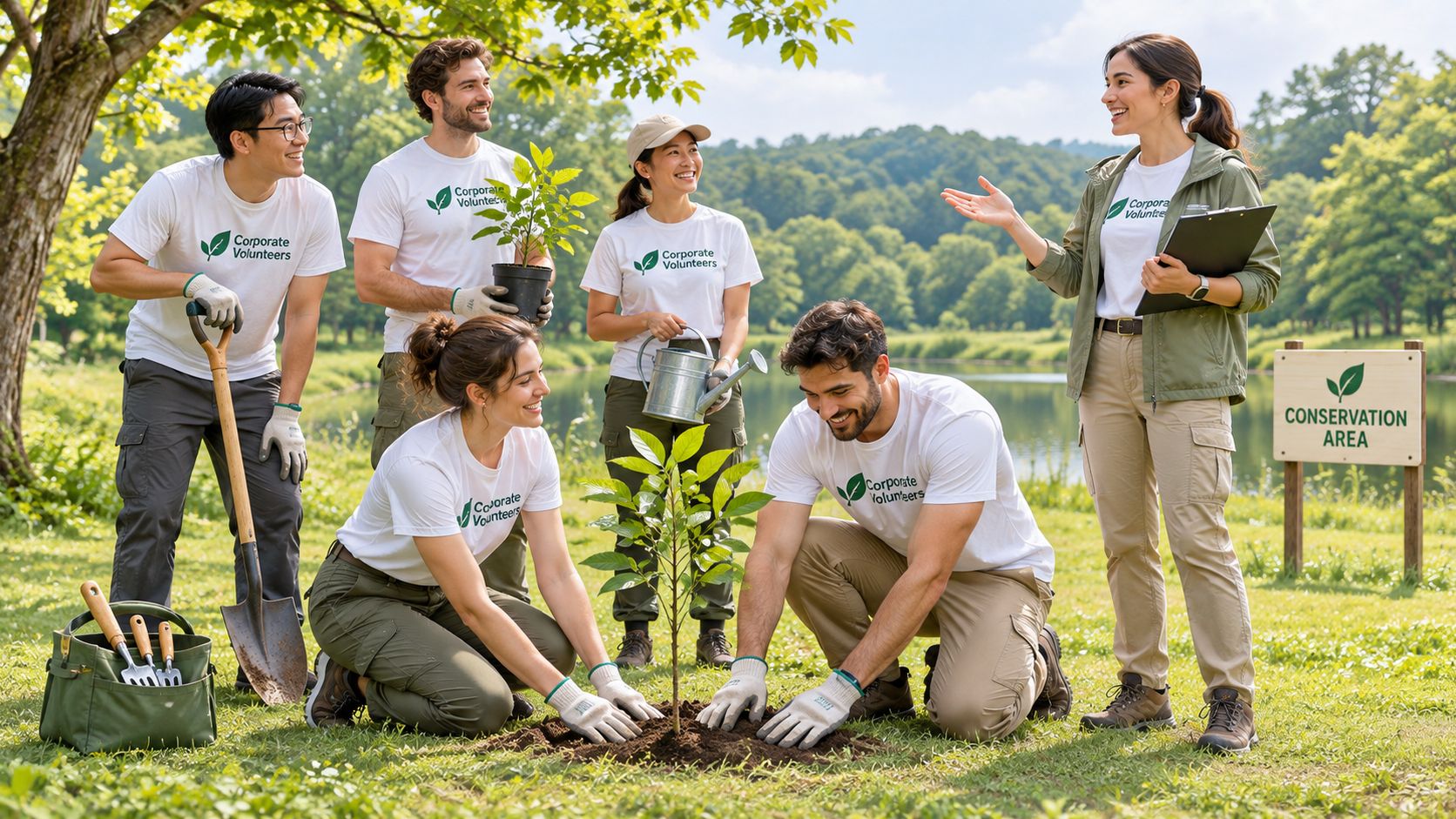
Picture a corporate group spending a morning planting native saplings and clearing coastal debris in Bintan, or pairing senior executives with elderly residents during a Singapore community activity. Because the beneficiaries' needs come first, leaders can't rely on corporate jargon or top-down authority. They have to listen, adapt to local coordinators, and solve practical bottlenecks with limited tools.
Moving Beyond Corporate Photo Opportunities
I always advise CSR and HR leads to avoid dropping volunteers into a site for two hours of photos and leaving. Treat the day as an active leadership lab:
- Appoint rotating community liaisons: Let mid-level managers coordinate logistics with local partners and brief their own teams on cultural etiquette and project goals.
- Align causes with employee input: Poll staff on environmental or eldercare priorities beforehand so ownership starts before boarding the bus.
- Capture measurable impact: Request a post-event outcome summary covering trees planted, area restored, or seniors engaged for internal ESG reporting.
- Run a grounded debrief: Connect the day's patience and active listening back to how leaders handle difficult clients and cross-cultural stakeholders.
Finish the afternoon with this debrief question: when our original plan didn't match what the community needed, how quickly did we stop talking and start listening?
8. End-to-End Corporate Offsite and Regional Meeting Package
When regional directors fly into Singapore for a quarterly summit, HR teams often end up juggling a hotel sales manager, a coach operator, two restaurants, an AV vendor, and a separate team-building facilitator. By day two, the schedule slips, energy dips after lunch, and the leadership workshop gets squeezed into a rushed 45-minute slot.
Demand for coordinated regional gatherings in Singapore continues to climb. The Singapore Tourism Board reported that MICE tourism receipts reached S$2.3 billion in 2025, a 35% jump from S$1.7 billion in 2024, alongside 156 ICCA-listed meetings that kept Singapore as Asia-Pacific's top meeting city for the 23rd consecutive year. At the same time, high demand tightens room availability and budgets. Figures from the Singapore Tourism Board's 2025 hotel performance update put Singapore's 2025 average hotel occupancy rate at 81.9% and the average room rate at S$273.56.
An End-to-End Corporate Offsite and Regional Meeting Package bundles hotel stays, airport and ground transfers, conference facilities, group dining, and facilitated leadership programmes under one operational workflow. As reported by The Straits Times citing Singapore Tourism Board data, corporate business events represent roughly one-quarter of Singapore's MICE sector, with incentive trips making up about half of that segment and 22 MICE-focused SHINE hotels covering approximately 25% of Singapore's room inventory.
Balancing Strategy Sessions With Facilitated Bonding
The leadership behaviour a well-paced regional offsite forces is executive alignment between business strategy and team cohesion. Say a 40-person APAC leadership team books a two-day Singapore summit or an all-in resort retreat in Batam. Instead of siloing business meetings on day one and fun games on day two, assign rotating session co-hosts from different country offices to bridge each morning's strategy keynote into an afternoon leadership simulation.
- Lock room blocks and transfers early: High hotel occupancy means securing accommodation and coach movements together prevents costly last-minute venue splits.
- Request an itemised scope: Ask for transparent line items covering accommodation, dining, transport, and facilitation so you can scale options to your budget.
- Protect recovery windows: Alternate heavy strategic reviews with active indoor or outdoor challenges so decision fatigue doesn't derail day two.
- Confirm overseas paperwork early: For outbound retreats across Asia, verify travel insurance, dietary requirements, and ferry or flight manifests weeks ahead.
Use the final plenary for one unifying debrief question: what single cross-border friction did we surface during the activities that we now commit to removing in next quarter's operating plan?
How the eight leadership development activities compare by setting, price and best use
| Item | Setting | Price Range | Best For |
|---|---|---|---|
| Laser Clay Shooting Team Challenge (Singapore) | Indoor or outdoor team competition | Indoor from $45/person; outdoor from $35/person; activity-specific quote required | High-energy teamwork and friendly competition |
| The Tycoon Challenge | Indoor business simulation | Indoor programmes from $45/person; custom quote applies | Practising negotiation and business decision-making |
| Kin Ball Team Sport | Usually outdoors in open space | Custom quote; depends on group size, venue and format | Inclusive, physical team communication |
| Running Man-Style Team Game Challenge | Indoor or outdoor mission-based game | From $45/person indoors or $35/person outdoors; varies by format and group size | Entertaining challenges with varied team tasks |
| DISC Personality Profiling Workshop | Facilitated workshop | Custom quote; depends on group size and facilitation | Leadership teams improving communication |
| Bintan Water Sports Park Challenge (Overseas Team Retreat) | Resort and water activities in Bintan, Indonesia | Custom quote; varies by duration, group size and inclusions | Multi-day overseas team retreats |
| Corporate Community and Conservation Offsite | Community or conservation project in Singapore or overseas | Custom quote; depends on project, location and group size | CSR-focused team engagement and social impact |
| End-to-End Corporate Offsite and Regional Meeting Package | Local or overseas meeting and retreat | Custom quote based on group size, venue, duration and inclusions | Companies seeking coordinated offsite planning |
Turning One Afternoon Into Lasting Leadership Habits
Every activity on this list can fail if it's treated as a one-off reward. Even the sharpest simulation fades by Wednesday morning when managers return to overflowing inboxes with zero follow-through. The activity itself only opens the door. What builds real leadership capability is choosing a format that matches one active team gap, rotating who holds authority during play, and holding a short follow-up huddle within seven days.
Keep your follow-up simple so busy managers use it. Pick one clear objective before the event, track two or three observable behaviours during play, and schedule a 30-day check-in where each leader reports one habit they changed at work. If your HR team needs a structured way to document those commitments after an offsite, Coachful's leadership development template gives managers a practical framework to map individual goals and review dates.
If you're weighing local versus regional formats, match the setting to the depth of reset your team needs:
- Half-day Singapore sessions: Use Laser Clay Shooting, The Tycoon Challenge, Kin Ball, or DISC profiling when you want sharp skill practice without pulling teams off client work for multiple days.
- Full-day Singapore summits and CSR days: Combine strategic reviews, community volunteering, and curated dining when cross-functional alignment or morale needs a stronger lift.
- Multi-day overseas retreats: Choose nearby hubs like Bintan, Batam, or Bali when regional teams need uninterrupted time away from daily noise to rebuild trust and align on annual strategy.
For Singapore companies that want programme design, facilitation, and logistics handled under one roof, One Dynamics delivers customised indoor, outdoor, and CSR team building in Singapore, alongside all-in overseas corporate retreat packages across Asia such as Batam and Bintan. Advertised starting prices begin at $45 per participant for indoor programmes and $35 per participant for outdoor programmes, with bespoke quotations based on headcount, venue, hotel stays, transport, and meeting requirements.
Share your team size, preferred dates, and the top two leadership habits you want to strengthen, and you can build a focused shortlist that fits both your objectives and your budget.
Ready to turn your next corporate offsite, regional meeting, or overseas retreat into measurable leadership growth? At One Dynamics, we combine in-house game design, Lead Facilitator debriefs, and full end-to-end event coordination across Singapore and Asia so your team can focus completely on the people in the room. Visit our website to share your group size and objectives for a custom programme shortlist and quotation.