10 Employee Engagement Strategies for Singapore in 2026

Your finance manager emails colleagues in another department every week but has never met them properly. When a project stalls, nobody knows who to call. Everyone shares a floor, yet they still work through inboxes rather than working relationships.
HR gets asked to organise a bonding day. The budget is available, but another dinner won't necessarily fix unclear handovers, strained communication or low morale after restructuring. You need an activity that addresses the actual problem, without creating more work for an already stretched team.
The starting point is sobering. Gallup's Singapore workplace figures put employee engagement at 14% in 2025, with 43% of employees experiencing substantial stress the previous day. Those findings call for more than occasional entertainment. Managers still need to address workload, development, feedback and role clarity.
Use the latest workplace engagement data as context, then listen to your own employees. A team that barely interacts needs a different intervention from a leadership group struggling to agree on priorities.
These employee engagement strategies connect workplace problems with practical Singapore formats, from indoor challenges and outdoor activities to CSR projects and overseas retreats. Budget considerations, group arrangements and planning trade-offs matter throughout. The right choice should leave colleagues with useful relationships and a concrete change to make at work, not just photographs from an enjoyable afternoon.
Table of Contents
- 1. Indoor Team-Building Programmes for Singapore Offices
- 2. Outdoor Team-Building Programmes in Singapore
- 3. Game-Show-Inspired Challenges Including Running Man, Tycoon Challenge, Kin Ball and Laser Clay Shooting
- 4. DISC Personality Profiling Workshops for Team Development
- 5. Turnkey Regional Meeting Packages in Singapore
- 6. Overseas Corporate Retreats and Outbound Team-Building in Asia
- 7. CSR-Linked Team Engagement in Bali, Bintan, Batam and the Philippines
- 8. Trusted Corporate Clients and Track Record as a Selection Factor
- 9. Single-Provider Event Planning for Stress-Free Corporate Engagement
- 10. Using Team-Building to Address Morale, Communication and Cross-Team Silos
- How the main employee engagement formats compare
- Choosing the Right Mix for Your Next Engagement Plan
1. Indoor Team-Building Programmes for Singapore Offices
Best for colleagues who exchange work but rarely interact. Indoor challenges give employees a shared task without the travel demands or weather exposure of an outdoor programme. Meeting rooms and hotel ballrooms can work, provided there's enough space for movement, equipment and discussion.
Our indoor programmes start at $45 per participant, while outdoor programmes start at $35. One Dynamics customises the final quotation around group size, venue and programme requirements, so treat advertised prices as starting points rather than complete event budgets.
For example, a finance department could use a facilitated problem-solving challenge before its quarterly planning cycle. Mix seniority levels and reporting lines so employees don't recreate their usual office groups.

Plan for learning, not just participation
- Define the problem. Choose clear objectives such as onboarding, cross-team communication or better handovers.
- Match the headcount. Confirm the activity's recommended minimum and how facilitators will divide the room.
- Protect the debrief. Leave time to discuss who shared information, who stayed quiet and what helped the team progress.
- Separate the costs. Compare facilitation, venue, refreshments and equipment within the written scope.
Indoor sessions are practical for time-poor Singapore teams. They won't resolve unclear responsibilities unless managers use the debrief to agree on better working arrangements.
2. Outdoor Team-Building Programmes in Singapore
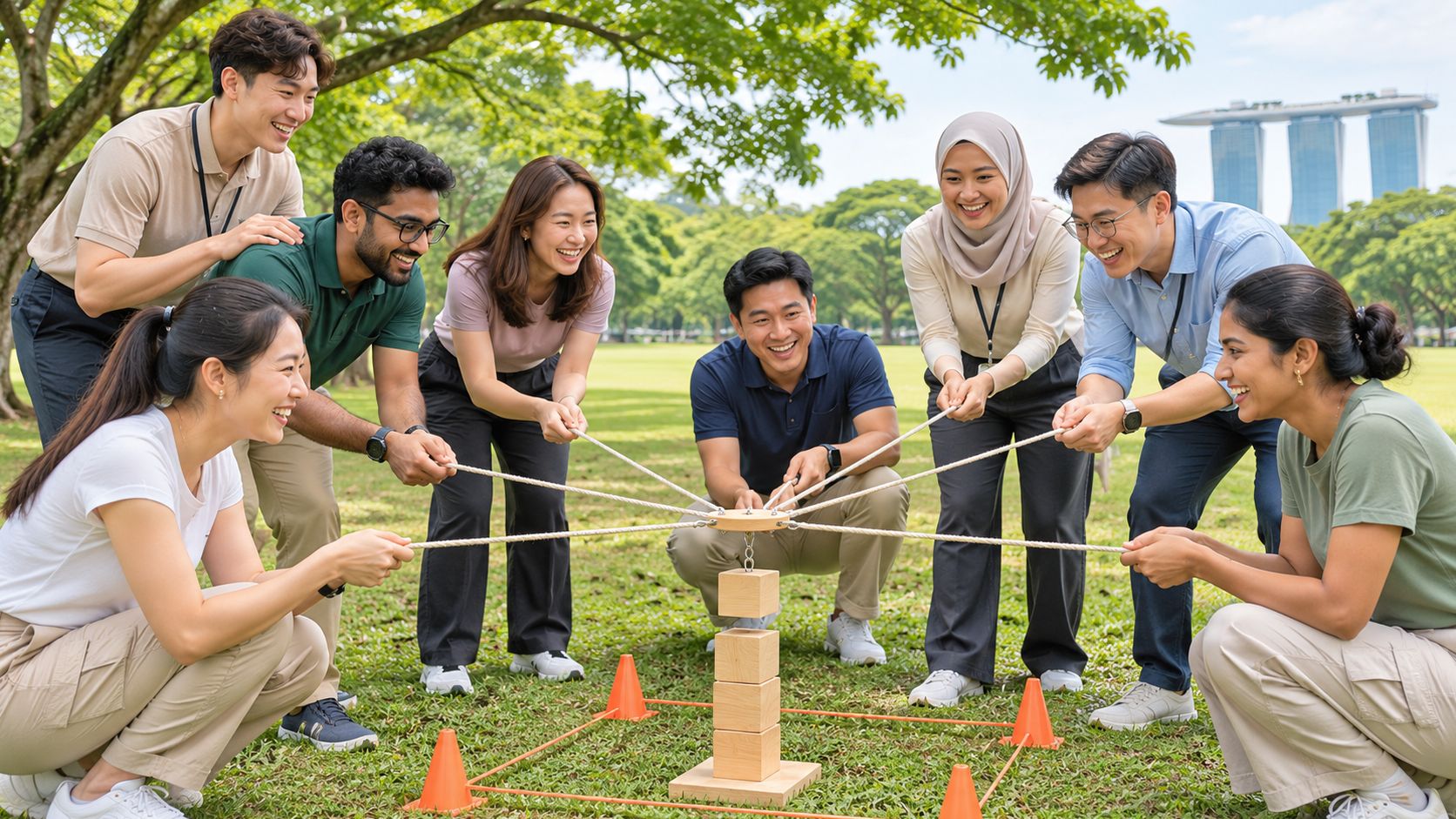
A manufacturing team may work in the same facility but remain divided by shifts. Outdoor relay challenges can bring those employees together through mixed teams, shared responsibilities and informal conversations away from production pressures.
Parks, sports grounds and purpose-built venues offer room for larger groups. For a manufacturing workforce of over 100 staff, split participants into manageable activity groups rather than making everyone wait for a single challenge.
The budget trade-off isn't just indoor versus outdoor. Transport, shelter, drinking water, venue arrangements and a workable rain alternative all affect the total spend.
Practical rule: Nobody should have to prove their commitment by pushing through an activity that isn't suitable for them.
Schedule around Singapore's heat, preferably in the early morning or late afternoon. Share the expected physical demands beforehand and collect mobility requirements privately, without asking employees to disclose medical details to colleagues.
Give non-running participants meaningful roles in planning, observation or coordination. Deliberately mix departments and shifts, and arrange staggered participation if operations must continue.
Outdoor programmes work well when employees need fresh interactions and shared achievement. They work poorly when speed and fitness become the only ways to contribute, or when the wet-weather alternative exists only as a vague promise.
3. Game-Show-Inspired Challenges Including Running Man, Tycoon Challenge, Kin Ball and Laser Clay Shooting
Competition can expose communication habits quickly. A team may discover that everyone negotiated enthusiastically but nobody checked the budget, or that the loudest participant made decisions without hearing useful information.
Running Man, The Tycoon Challenge, Kin Ball and Laser Clay Shooting offer different participation styles. Match the format to the behaviour you want employees to practise rather than choosing solely by entertainment value.
Say a marketing department needs to improve resource allocation. A trading challenge can create a useful scenario for discussing budgeting, negotiation and strategic priorities. A coordination-focused game suits colleagues who need to communicate quickly and share responsibility.
Keep competition useful
- Check group fit. Recommended minimum headcounts vary by activity. Smaller teams need enough participation without leaving employees waiting.
- Balance the roles. Include planning, negotiation and observation alongside physical participation.
- Control the tone. Avoid public penalties or elimination formats that leave less confident employees sidelined.
- Budget for adaptation. Bespoke rules, equipment and venue requirements should appear clearly in the quotation.
We develop activities in-house and adapt facilitation to client objectives. That matters when the desired lesson is more specific than getting everyone involved.
Finish with a workplace question: when did the team act without checking understanding? The useful outcome isn't identifying the best player. It's agreeing how colleagues will exchange information when real deadlines create similar pressure.
4. DISC Personality Profiling Workshops for Team Development
Repeated friction doesn't always mean colleagues dislike each other. A manager may want a quick recommendation while a colleague needs supporting detail before committing. Without discussing those preferences, both can mistake a working-style difference for poor attitude.
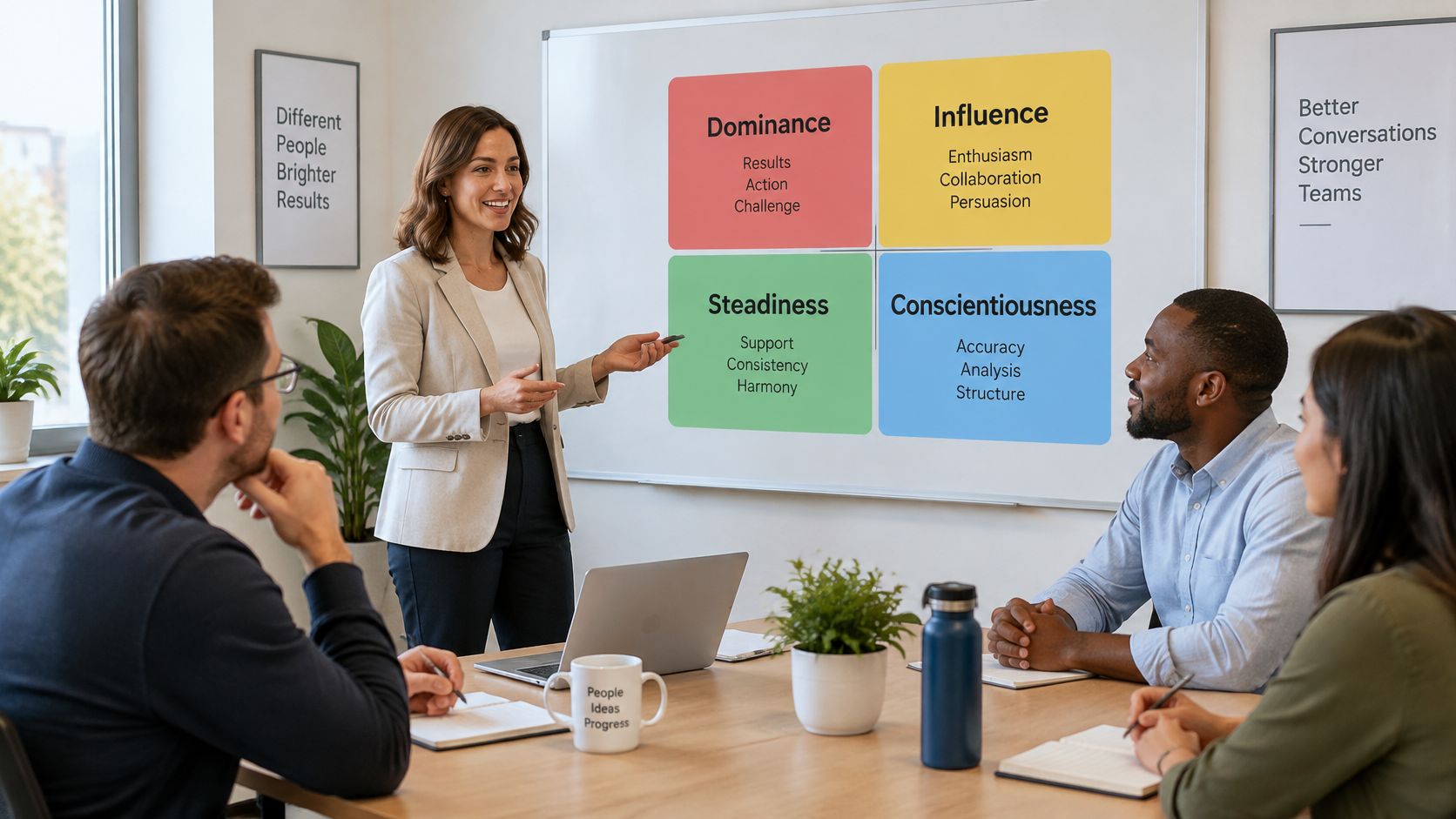
DISC covers Dominance, Influence, Steadiness and Conscientiousness. Use the guide to DISC personality assessment to understand the framework before deciding how it fits your development objectives.
For facilitated team comparisons, plan for at least ten participants. A project team could use the discussion to rebalance meeting roles so detail-focused employees and big-picture thinkers both contribute.
Turn preferences into working agreements
Budget for interpretation and facilitated discussion, not just assessment completion. Participants need time to discuss actual situations, such as how they prefer to receive feedback or what information they need before making decisions.
We use structured debriefs to connect activities with workplace goals. Pairing a behavioural discussion with a shared challenge gives colleagues something concrete to reflect on.
Don't use DISC as a fixed judgement of capability, a hiring shortcut or an excuse for unhelpful behaviour. Agree on practical changes, then schedule a review three to six months later to assess whether meeting habits and communication have improved.
5. Turnkey Regional Meeting Packages in Singapore
Regional meetings can fail socially even when the business agenda runs perfectly. Delegates arrive, sit with familiar colleagues, complete presentations and leave without building relationships across markets.
Singapore's role as a meeting destination supports a broad supplier ecosystem. The Singapore Tourism Board reported S$2.3 billion in MICE tourism receipts in 2025, reinforcing the importance of coordinating hospitality and programme delivery rather than treating them as separate purchases.
For a three-day regional leadership meeting, combine hotel accommodation, airport transfers, meeting arrangements, meals and a facilitated team challenge within a single itinerary. Place the relationship-building activity early enough that delegates can use those connections during business discussions.
- Arrival planning. Share flight details and allow for different arrival times.
- Group arrangements. Use full-group briefings alongside smaller cross-market discussions.
- Budget control. Separate accommodation, transport, meals, facilitation and optional excursions.
- Participant needs. Confirm dietary requirements and accessibility before committing to venues.
A single itinerary should tell every delegate where to be, how they'll get there and who to contact when plans change.
Our planning and delivery processes sit together, reducing the need for HR to coordinate disconnected activity suppliers. Still, retain internal ownership of the meeting's business purpose. A well-run package can remove logistical friction, but it can't compensate for an overloaded agenda.
6. Overseas Corporate Retreats and Outbound Team-Building in Asia
Choose an overseas retreat when distance from routine work serves a clear purpose. Leadership alignment, strategy development and a reset after sustained delivery pressure are stronger reasons than wanting a more impressive venue.
Bintan offers a format combining planning sessions with activities such as the Bintan Water Sports Park Challenge. Batam is another option for a structured offsite, while other Asian destinations can suit teams travelling from different regional offices.
Say a management group plans a two-day Bintan offsite. Put demanding strategy work before the recreational programme, and finish with named decisions, owners and follow-up actions.
Compare complete itineraries
An all-in quotation should distinguish transport, accommodation, meals, meeting facilities and activities. Confirm what happens if an employee can't join a water-based challenge, and whether alternative participation creates additional costs.
For a small leadership team, shared discussion time may matter more than an extensive activity schedule. Larger groups need clearer movement plans, rooming arrangements and activity rotations.
Check travel documentation requirements for every nationality represented. Don't assume employees based in Singapore have identical entry requirements, and give participants a private route to raise travel constraints.
We tailor overseas planning to each organisation's needs and coordinate logistics, venues and programme delivery. That can reduce HR's administrative burden, but an overseas retreat still requires internal decisions about attendance, work coverage and spending.
Leave genuine downtime. A retreat packed from breakfast to bedtime can feel like a longer working day in a different country.
7. CSR-Linked Team Engagement in Bali, Bintan, Batam and the Philippines
Some employees would rather contribute to a useful project than compete for points. CSR-linked engagement can connect colleagues through senior engagement, community interaction, area improvement or conservation work in Singapore, Bali, Bintan, Batam and the Philippines.
Sustainability belongs in the event brief, not just the closing presentation. A Ministry of Trade and Industry speech citing American Express Global Business Travel stated that 83% of meetings and events professionals said their organisations consider sustainability when planning meetings and events.
For example, a Bintan conservation clean-up could combine small-team responsibilities with a host-led explanation of the work. A Singapore senior-engagement visit could centre on conversation and shared activities rather than a performance staged for corporate photographs.

- Start with host needs. Confirm that the activity is useful and appropriate.
- Size the group responsibly. Split volunteers when the host can't accommodate everyone meaningfully.
- Fund the delivery. Include materials, transport, supervision and host coordination.
- Document carefully. Record completed work and obtain consent before sharing identifiable photographs.
We coordinate community-focused activities around client objectives, but participation shouldn't become a publicity exercise. Report tangible outputs without claiming long-term social impact that the host hasn't assessed.
8. Trusted Corporate Clients and Track Record as a Selection Factor
Provider selection is part of engagement planning because employees experience every operational failure directly. Poor instructions, long queues or unsuitable activities can undermine the message that the company values their time.
One Dynamics was established in 2010 and reports more than 15 years of experience, over 1,500 corporate events and more than 50,000 participants across Singapore and overseas. Published testimonials include representatives from OCBC Bank, Tetra Pak and Schneider Electric.
Those credentials support an initial shortlist. They don't replace checking whether a proposed programme suits your workforce.
Evaluate delivery, not just reputation
Use the decision-maker's guide to choosing a corporate team-building provider in Singapore to structure procurement discussions around programme fit and execution.
An HR director planning a multi-group event should compare sample schedules, activity transitions and contingency arrangements. Procurement should compare equivalent scopes, rather than treating a venue-inclusive proposal and an activity-only quotation as interchangeable.
- Relevant references. Seek feedback from organisations with comparable headcounts and requirements.
- Facilitation detail. Review how instructions, participation and debriefs will work.
- Operational readiness. Establish responsibility for weather changes, delays and accessibility.
- Reporting. Agree what feedback will be collected and how it will be presented.
A higher quotation may cover meaningful coordination or facilitation. It may also include extras your team doesn't need. Make the distinction before approval, not after the purchase order is issued.
9. Single-Provider Event Planning for Stress-Free Corporate Engagement
Your HR team shouldn't become the switchboard between a venue, transport company, caterer and activity operator. Single-provider planning gives the organiser a clearer route for resolving dependencies and communicating changes.
Consider an annual staff bonding day for a company without an internal events team. HR owns objectives and employee communication, while the organiser coordinates the venue, schedule, facilitators and agreed logistics.
We combine event planning with programme delivery and customise quotations around headcount, venue and programme requirements. That reduces separate coordination, but the written scope still matters.
Procurement safeguard: A single point of contact is useful only when responsibility for each deliverable is explicit.
Include the budget range, preferred dates, participant profile and decision-maker in the initial brief. Plan several weeks ahead for custom quotations and venue confirmation, with more flexibility where travel or extensive customisation is involved.
Hybrid participation needs particular attention. A Singapore workplace report published by the Singapore Institute of Directors noted that 48% of Singapore respondents felt judged for using flexible-work arrangements.
Don't turn a bonding event into a test of office visibility. For distributed groups, specify meaningful remote participation or an equivalent activity, including facilitation and technical support in the budget.
Keep an internal owner for approvals. Outsourcing coordination doesn't outsource decisions about employee needs or acceptable trade-offs.
10. Using Team-Building to Address Morale, Communication and Cross-Team Silos
Name the workplace problem before choosing the activity. Limited interaction calls for different facilitation from low morale after restructuring, where employees may first need honest answers about responsibilities and priorities.
In a representative study of Singapore employees, Ipsos found that 29% planned to leave their employer in less than two years_2.pdf). A pleasant event shouldn't be mistaken for evidence that employees now intend to stay.
For a department with communication breakdowns, use a facilitated challenge followed by a workshop on meeting norms and handovers. For a restructured team, start with smaller mixed-group discussions before asking employees to participate in energetic competition.
Build the follow-through into the budget
- Before the event. Identify the main problems through confidential feedback and manager conversations.
- During the debrief. Ask what participants will do differently in actual work.
- Afterwards. Assign owners to agreed changes and review progress within one to three months.
- When measuring. Track useful contacts, clarity of handovers and perceived inclusion, not just enjoyment.
Recognition can complement the programme. Consider gifts that improve employee retention as a prompt for thoughtful appreciation, not a substitute for fair treatment or development.
Our structured debriefs connect activities with workplace goals. Managers then need to reinforce those agreements through everyday decisions.
How the main employee engagement formats compare
| Item | Advertised Starting Price | Setting | Best For |
|---|---|---|---|
| Indoor Team-Building Programmes for Singapore Offices | $45 per participant | Indoor venues in Singapore | Weather-independent bonding and cross-team interaction |
| Outdoor Team-Building Programmes in Singapore | $35 per participant | Parks, sports grounds, and outdoor venues in Singapore | Energetic activities for large groups |
| Game-Show-Inspired Challenges: Running Man, Tycoon Challenge, Kin Ball and Laser Clay Shooting | No starting price stated | Facilitated group challenges | Teams seeking entertaining, competitive activities |
| DISC Personality Profiling Workshops for Team Development | No starting price stated | Facilitated workplace workshop | Teams developing communication and behavioural awareness |
| Turnkey Regional Meeting Packages in Singapore | Custom quotation; no starting price stated | Hotels, meeting venues, and activity sites in Singapore | Regional teams needing coordinated meeting logistics |
| Overseas Corporate Retreats and Outbound Team-Building in Asia | No starting price stated | Overseas destinations across Asia, including Bintan | Leadership offsites and teams seeking an immersive reset |
| CSR-Linked Team Engagement in Bali, Bintan, Batam and the Philippines | No starting price stated | Community and conservation projects in Singapore and overseas | Companies combining employee engagement with social impact |
| Trusted Corporate Clients and Track Record as a Selection Factor | Not applicable; no programme price stated | Provider evaluation and procurement | HR and procurement teams assessing vendor experience |
| Single-Provider Event Planning for Stress-Free Corporate Engagement | Custom quotation; no starting price stated | Local or overseas event venues | HR teams seeking one point of contact for event delivery |
| Using Team-Building to Address Morale, Communication and Cross-Team Silos | No starting price stated | Workplace activities with facilitated debriefs | Teams addressing morale, communication, or collaboration issues |
Choosing the Right Mix for Your Next Engagement Plan
Start with the workplace problem, not the activity. If colleagues rarely interact, a focused indoor or outdoor session with a proper debrief may be enough. If leaders need uninterrupted strategy time, an overseas retreat can provide a more suitable setting.
For regional meetings in Singapore, prioritise a coherent itinerary. Hotel stays, transfers, meals, business sessions and team activities should support one another rather than compete for time. A generous budget is most useful when it pays for thoughtful facilitation, appropriate venues and reliable coordination.
Don't spend around a problem that management needs to fix directly. In Randstad's Singapore Employer Brand Research, leading motivation factors included work-life balance at 40% and manageable workload at 36%. Adding a demanding bonding programme to an overloaded week can contradict the message HR wants to send.
Make the decision manageable
Shortlist two or three options against the same objectives. Compare total scope, group suitability, physical demands, travel requirements and the quality of the debrief. Request custom quotations with clear inclusions and exclusions, then book at least several weeks ahead.
Our one-stop planning approach brings programme design and delivery together, with arrangements adjusted to budget, group size and organisational needs. Keep ownership clear internally as well: HR coordinates the plan, managers reinforce the behaviours, and leaders address structural concerns that emerge.
Protect employee choice where activities involve physical exertion, overseas travel or personal reflection. Equivalent participation should feel legitimate, not like a lesser option for employees who can't take part in the main format.
Measure what should change
Ask whether employees now know someone they can contact across departments. Check whether teams have adopted clearer meeting norms or improved handovers. Review the findings alongside workload, manager support and development opportunities.
If manual follow-up becomes difficult, compare leading employee engagement software picks against your actual needs for confidential feedback, segmentation and action tracking. Technology should help managers act on feedback, not create another reporting exercise.
The strongest employee engagement strategies connect a well-chosen experience with a visible workplace change. Employees should leave knowing not only who won a challenge, but also who they can approach, what the team agreed and what management will do next.
One Dynamics offers indoor, outdoor, CSR and overseas team-building programmes, alongside end-to-end arrangements for regional meetings and corporate retreats. Visit One Dynamics with your workplace objectives, headcount, preferred dates and budget range to discuss a customised engagement plan covering activities and the logistics your team needs.